

On this page
When you look at a single, perfect ice cube, you can see right through it. Yet a fresh snowfall, which is made entirely of frozen water, looks like a solid white blanket. If snow is just frozen water, why doesn't it look like glass?
The answer lies in how light travels through different materials, a combination of reflection, refraction, and multiple scattering.
Why is ice clear but snow is white?
Solid ice is continuous. When sunlight strikes a clear ice cube, the light passes through it because there are very few internal boundaries to interrupt its path.
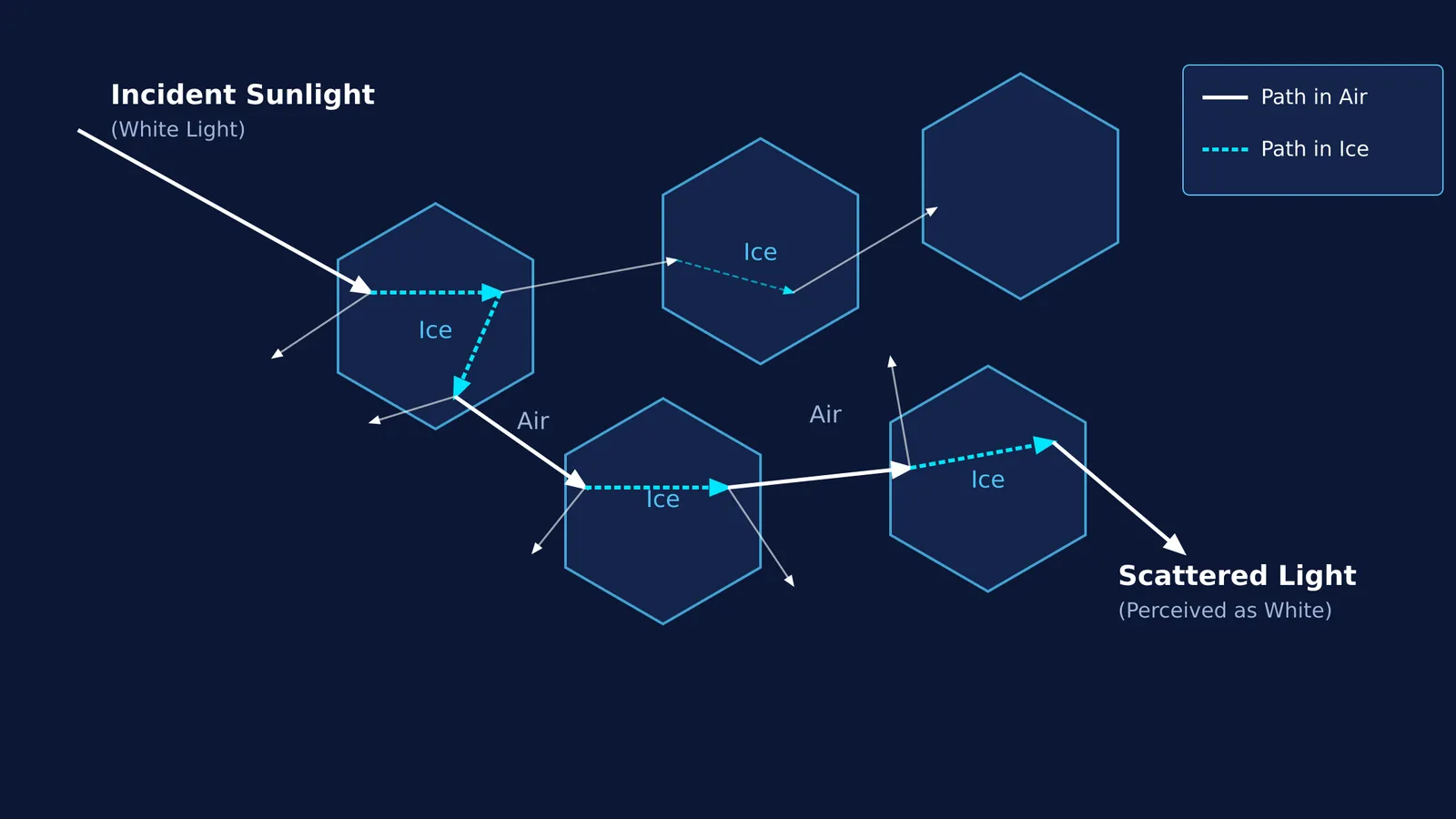
Snow, on the other hand, is a porous collection of millions of tiny, complex ice crystals separated by air gaps. It is not a solid block, but a chaotic pile of microscopic prisms and mirrors. The National Snow and Ice Data Center notes that clean snow reflects most of the sunlight that strikes it, and because visible light is white, the snow appears white (NSIDC). When light enters this pile of crystals, it doesn't pass straight through.
How does light interact with a snowflake?
The interaction depends on the speed of light in different materials. Light travels slightly slower in ice than it does in air. This difference is measured by a property called the refractive index. The refractive index of air is about 1.00, while the refractive index of ice is approximately 1.31 (Wikipedia).
Every time a ray of sunlight moves from the air into an ice crystal, or from an ice crystal back out into the air, it hits a boundary. At each boundary, some of the light is reflected, or bounced back. The rest of the light is refracted, bending as it enters the new material. The exact angle at which the light bends is governed by Snell's Law, which relates the angles of incidence and refraction to the refractive indices of the two media.
Because a snowbank contains thousands of these air-ice interfaces in every cubic centimetre, a single photon of light is bounced and bent repeatedly in random directions. The light might enter one facet of a hexagonal ice crystal, refract inside, reflect off the back wall, and refract again as it exits, only to immediately hit another crystal. This "pinball" effect is known as multiple scattering. It ensures that light entering the snowpack is sent back out in almost every possible direction.
What makes the scattered light white?
Sunlight contains all the colours of the visible spectrum: red, orange, yellow, green, blue, indigo, and violet. When combined, these wavelengths look white to the human eye.
Most objects get their colour by absorbing certain wavelengths and reflecting others. A red apple absorbs blue and green light, reflecting only red. However, ice crystals are much larger than the wavelengths of visible light, meaning they do not absorb specific colours strongly.
Instead, they scatter all colours of the visible spectrum roughly equally. While it is true that different colours of light bend by slightly different amounts when entering ice — a phenomenon known as dispersion — the sheer number of random scattering events inside the snowpack mixes all those separated colours right back together. When all these scattered colours reflect back to your eyes in equal measure, your brain perceives the combined mixture as white.
This high level of uniform scattering gives fresh snow a very high albedo, making it one of the most reflective natural surfaces on Earth.
Why does wet snow look darker?
When the temperature rises and snow begins to melt, the air gaps between the ice crystals fill with liquid water. Liquid water has a refractive index of about 1.33 (Wikipedia).
Because the refractive index of water (1.33) is much closer to that of ice (1.31) than air (1.00) is, the optical mismatch is greatly reduced. When light passes between the ice and the water, it does not bend or reflect nearly as much as it did at the ice-air boundaries.
With less scattering happening at these interfaces, the "pinball" effect is dampened. More light penetrates deeper into the snowpack or passes through entirely, rather than being scattered back to your eyes. This reduced reflection makes the wet snow look darker, more translucent, or even grey. If the snow melts completely, it becomes a puddle of water, which is mostly transparent.
How active modeling helps you understand light
Reading about reflection and refraction is one thing; predicting how light will behave when it hits a new medium requires practice. Drawing ray diagrams and calculating refractive indices are core skills for physics exams like the JEE or NEET.
If you find optics problems tricky to visualise, the Fermi Simulation Lab offers interactive simulations for the ideas that are easier to see than to read. Fermi's AI tutor teaches rather than answers. It works out what you know and builds a plan for the session — running the simulation and checking understanding as it goes, so you sit down to a clear next step.
For more practice with how light changes direction, you can explore Light in Class 10: reflection, refraction and the lens formula or try solving problems on Apparent depth and normal shift: refraction problems solved.


