

On this page
Switch off the lights and shine a torch through a glass of salt water, then through a glass of water with a few drops of milk in it. Look from the side. In one glass you see a bright rod of light; in the other, almost nothing. That single observation sorts most liquids you meet in school chemistry into a solution, a colloid or a suspension, and the reason is particle size.
How can you tell a colloid from a solution with light?
Shine a narrow beam through the liquid and look at it from the side, not head-on. If the path glows, particles are scattering light sideways towards your eye.
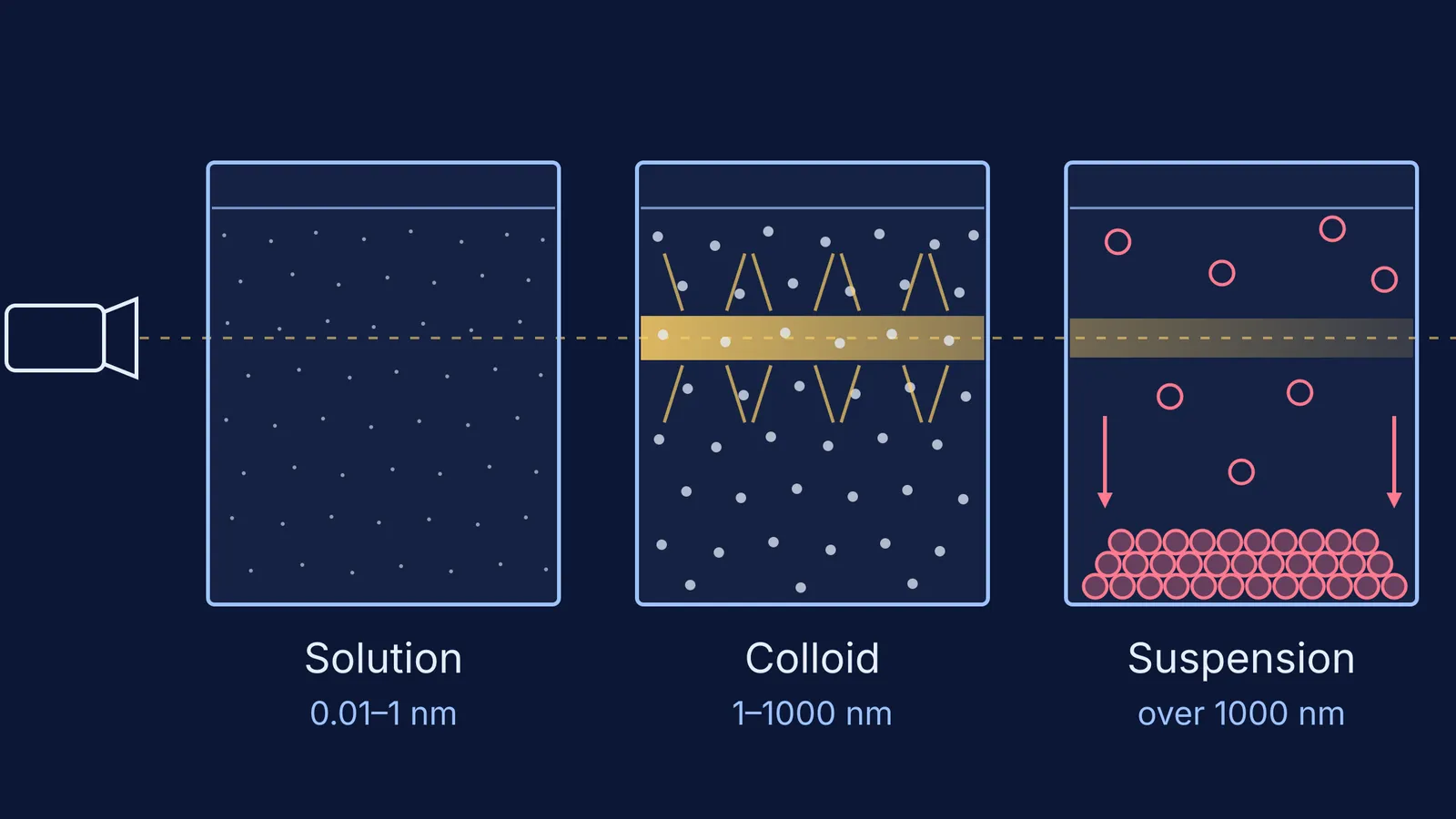
The Tyndall effect is the scattering of visible light by colloidal particles, which makes the path of a beam visible (Chemistry LibreTexts, CK-12 Introductory Chemistry/15:_Water/15.11:_Colloids)). The same source gives the three size bands: particles in a solution are about 0.01 to 1 nm, colloidal particles 1 to 1000 nm, and suspension particles over 1000 nm.
Those cut-offs are conventions, not hard walls. Another widely used textbook puts solutions below 2 nm and colloids at 2 to 500 nm (Chemistry LibreTexts, Brown et al./13:_Properties_of_Solutions/13.06:_Colloids)). Learn the numbers your syllabus uses.
Light separates a solution from a colloid, but not a colloid from a freshly stirred suspension, because both scatter. For that you need two more tests: suspension particles settle out on standing and can be filtered, while colloidal particles do neither (Chemistry LibreTexts, CK-12/15:_Water/15.11:_Colloids)).
Why does particle size decide whether the beam shows up?
For particles smaller than about a tenth of the wavelength, the scattered intensity is proportional to the sixth power of particle size and the inverse fourth power of wavelength (Rayleigh scattering, Wikipedia).
The sixth power does most of the work:
Double a particle's diameter and it scatters 2⁶ = 64 times as much light.
A 40 nm colloidal particle is 80 times wider than a 0.5 nm ion, so it scatters 80⁶, about 262 billion times, as much.
Blue light at 400 nm is scattered (700 ÷ 400)⁴, about 9.4 times, as strongly as red light at 700 nm.
Dissolved ions do scatter, just far too weakly to see. Once particles are much larger than the wavelength, as with cloud droplets, scattering becomes almost independent of colour, which is why clouds look white (HyperPhysics, Georgia State University).
John Tyndall reported this to the Royal Society in a paper on the blue colour of the sky and the polarisation of light by cloudy matter (Tyndall, Proceedings of the Royal Society of London, 1869). In his experiments, a light beam through a tube filling with smoke looked blue from the sides and red from the far end (Tyndall effect, Wikipedia). The same physics at sky scale is in our post on why the sky is blue and Rayleigh's 1/λ⁴ law.
What should you predict for each of the three tanks?
Picture a beam crossing three tanks and write a guess for each before reading on. The size bands are from Chemistry LibreTexts (CK-12)/15:_Water/15.11:_Colloids).
Tank 1, solution (salt or sugar in water): the beam is invisible from the side and makes a spot on the far wall. Particles under 1 nm scatter too little to see.
Tank 2, colloid (diluted milk, starch in water): a glowing rod runs all the way across, faintly bluish from the side, and the spot on the far wall is dimmer and warmer. Short wavelengths scatter most (Rayleigh scattering, Wikipedia).
Tank 3, suspension (muddy water, chalk powder): bright and whitish just after stirring, then the beam fades as particles sink, leaving a dimmer path above a layer of sediment.
If a guess and the physics above disagree, that gap is the lesson.
How do you try the Tyndall test at home?
Use a torch with a narrow beam or a low-power laser pointer. Never look into a laser or point it at anyone's eyes.
Fill three clear glasses: water with salt stirred until it vanishes, water with a few drops of milk, and water with a spoon of chalk powder or soil.
Darken the room, shine the beam through each glass and look from the side.
Leave the third glass undisturbed for half an hour and test it again.
Pour a little of each through filter paper and test what comes through.
Read your results like this:
Beam invisible, nothing settles: solution.
Beam visible, nothing settles, passes the filter: colloid.
Beam visible at first, particles settle or stay on the filter: suspension.
If milk and starch confuse you, our guide to types of colloids: aerosol, emulsion, foam and gel sorts them by dispersed phase and medium.
Scattering is one of those ideas that is easier to see than to read. The Fermi Simulation Lab has interactive simulations for ideas like that, and Fermi's AI tutor can work through a topic with you, deciding whether to explain, ask or show, and checking your understanding as it goes.
Next, carry the same idea outdoors with the red sunset scattering simulation.


