On this page
In 1902 Adrian J. Brown, writing from the British School of Malting and Brewing at the University of Birmingham, showed that invertase does not. A fixed amount of the enzyme split about the same weight of cane sugar in an hour whether the solution held 5 g or 40 g per 100 mL. His explanation, an enzyme–sugar compound that lasts a short time, is the saturation idea behind Vmax, eleven years before Michaelis and Menten.
The paper is A. J. Brown, "Enzyme Action", Journal of the Chemical Society, Transactions, volume 81 (1902), pages 373 to 388 (scan on the Internet Archive). Numbers were read from the page images and recomputed.
What did everyone believe about invertase before 1902?
Invertase splits sucrose into glucose and fructose: C₁₂H₂₂O₁₁ + H₂O → C₆H₁₂O₆ + C₆H₁₂O₆. Both sides have 12 C, 24 H and 12 O.
In 1890 C. O'Sullivan and F. W. Tompson concluded that the reaction obeys the law of mass action. In today's words it is first order: a constant fraction of the sugar is split in each unit of time. Their study is told in how O'Sullivan and Tompson found that sugar shields invertase from heat.
Brown doubted it. In 1892 he had found that yeast ferments "an approximately constant weight of sugar in unit time" in solutions of different strength. Once Buchner showed that fermentation is also enzyme action, the two results could not both be the rule for enzymes.
How did Brown test whether invertase is first order?
He used the Class 12 test. For a first-order reaction, k = (1/θ) log 1/(1 − x), where θ is the time in minutes and x is the fraction of sugar inverted, stays constant. Brown used log to base 10, so his k is the JEE value divided by 2.303.
Acid, Table III. Sucrose inverted by dilute sulphuric acid at 48 °C gave k from 0.00261 to 0.00281, mean 0.00275. That is flat, as first order should be.
Invertase, Table II. A 19.28% sugar solution at 30 °C gave k = 0.00201 at 30 minutes and 0.00344 at 581 minutes. It climbed steadily, by 71%.
A rising "first-order constant" means invertase was not following simple mass action.
Why was the same weight of sugar split at every concentration?
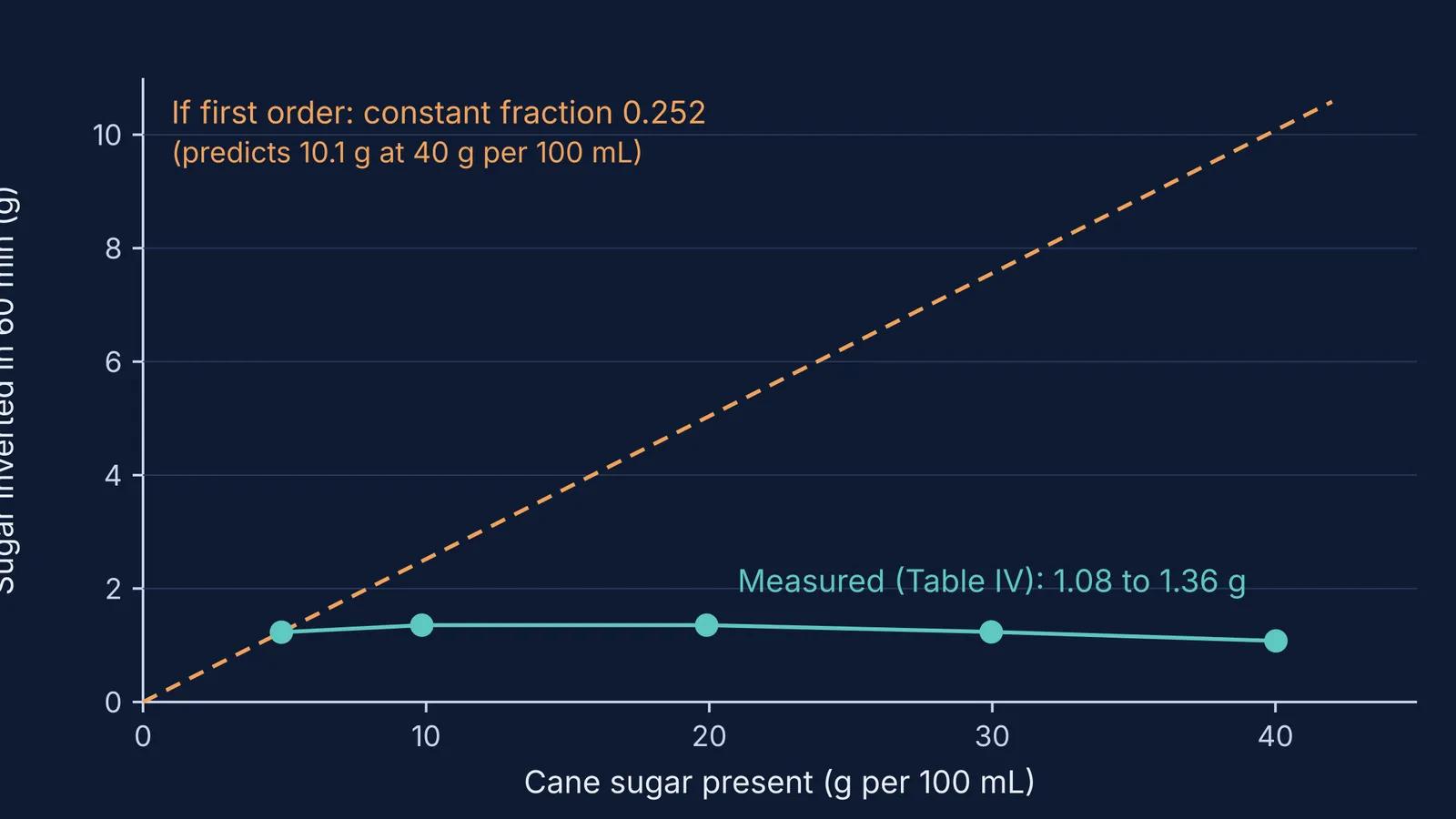
In Table IV he added 1 mL of the same invertase solution to 100 mL of sugar solutions of five strengths and measured the sugar inverted in 60 minutes at 28 °C.
4.89 g per 100 mL: 1.230 g inverted
9.85 g: 1.355 g
19.91 g: 1.355 g
29.96 g: 1.235 g
40.02 g: 1.076 g
Sugar rose 8 times; the amount inverted stayed between 1.08 and 1.36 g. In his words, "instead of a constant fraction, a constant (or approximately constant) weight of the cane sugar is inverted." That is zero order in sugar.
Worked example: zero order or first order?
Fraction inverted. Divide grams inverted by grams present: 1.230 ÷ 4.89 = 0.252, then 0.138, 0.068, 0.041 and 0.027.
First-order k. k = (1/60) log 1/(1 − x) gives 0.00210, 0.00107, 0.00051, 0.00030 and 0.00020. Brown printed 0.00031 for the fourth; the rest match. If the reaction were first order, these would be equal. They fall tenfold.
What first order predicts. At a constant fraction of 0.252, the 40.02 g solution should have lost 0.252 × 40.02 = 10.1 g in an hour. It lost 1.08 g.
Zero-order rate. The mean, 1.25 g per 100 mL per hour, is 12.5 g/L ÷ 342.3 g/mol = 0.0365 mol L⁻¹ h⁻¹, whether [sucrose] is 0.143 or 1.17 mol/L.
Plotted, this is a flat line, not one through the origin: the saturated part of the curve in zero-order reactions: the graph, half-life and examples.
If the true rate is constant, why does a single run slow down?
In Table II the rate did fall as the sugar was used up. Was the enzyme tiring, or were the products in the way, as Duclaux had suggested?
He added invert sugar (the glucose–fructose product) to a fixed 4.06 g of sucrose (Table V, 80 minutes, 30 °C). With none added, 2.27 g was inverted. With 17.87 g of invert sugar added, only 1.25 g was inverted, a fall of 1 − 1.25 ÷ 2.27 = 45%.
Could that just be viscosity? He repeated it with lactose, which invertase does not touch and whose solutions he said have almost the same viscosity (Table VI, 60 minutes, 28 °C). Even 20 g of lactose cut the sucrose inverted only from 2.072 to 1.893 g, which is 9%. The conditions of the two tables are not identical, but the gap between 45% and 9% is large.
So the curve in one run comes mainly from product inhibition, which is why Michaelis and Menten later measured initial rates, as told in Michaelis, Menten and the equation for enzyme speed.
What was Brown's enzyme–sugar compound?
Citing O'Sullivan and Tompson's heat-protection result, Wurtz on papain and E. Fischer's ideas on enzyme configuration, he wrote: "Let it be assumed, therefore, that one molecule of an enzyme combines with one molecule of a reacting substance, and that the compound molecule exists for a brief interval of time".
His thought experiment:
Suppose each enzyme–sugar compound lasts 1/100 of a time unit. Then one enzyme molecule can complete at most 100 changes per unit time.
If sugar molecules reach the enzyme 20 times per unit time, 20 changes happen. If 40, then 40. Rate follows concentration: first order.
If collisions reach 150 or 1000, the rate still stops at 100. Rate no longer depends on concentration: zero order.
That is saturation. In the Michaelis–Menten equation, v = Vmax[S] ÷ (Km + [S]), Brown's ceiling of 100 changes per unit time plays the part of Vmax. Brown did not discover the equation: he gave the mechanism in words, and the rate law came from Henri and from Michaelis and Menten.
Did his theory predict anything new?
Yes: very dilute sugar should bring first order back. In Table VIII he used 2.0, 1.0, 0.5 and 0.25 g per 100 mL at 31 °C. At 2 g, he said, the dilution "appears to have been hardly sufficient". In the three weaker solutions the amounts inverted "decrease in direct proportion with the concentrations", and "the value k in these experiments is a constant number".
To see rate against [S] change shape, the Simulation Lab has interactive simulations for ideas that are easier to see than read. For order-of-reaction questions in exam form, Fermi Test Prep is JEE Main and Advanced preparation with an AI tutor.
Where does this meet your syllabus?
Class 12 Chemical Kinetics: zero and first order, and finding the order by checking which k stays constant.
Class 11 Biology, Biomolecules (NEET): the enzyme–substrate complex, saturation, Vmax and Km. On the rate against [S] graph, Brown's Table IV sits on the flat part.
Quick checklist
Acid: k constant. Invertase in one run: k rises 71%.
Five sugar strengths, 4.89 to 40.02 g per 100 mL: about 1.1 to 1.4 g inverted per hour. Zero order.
Invert sugar cut the rate by 45%, lactose by 9%: product inhibition, not viscosity.
Very dilute sugar brought first order back.