On this page
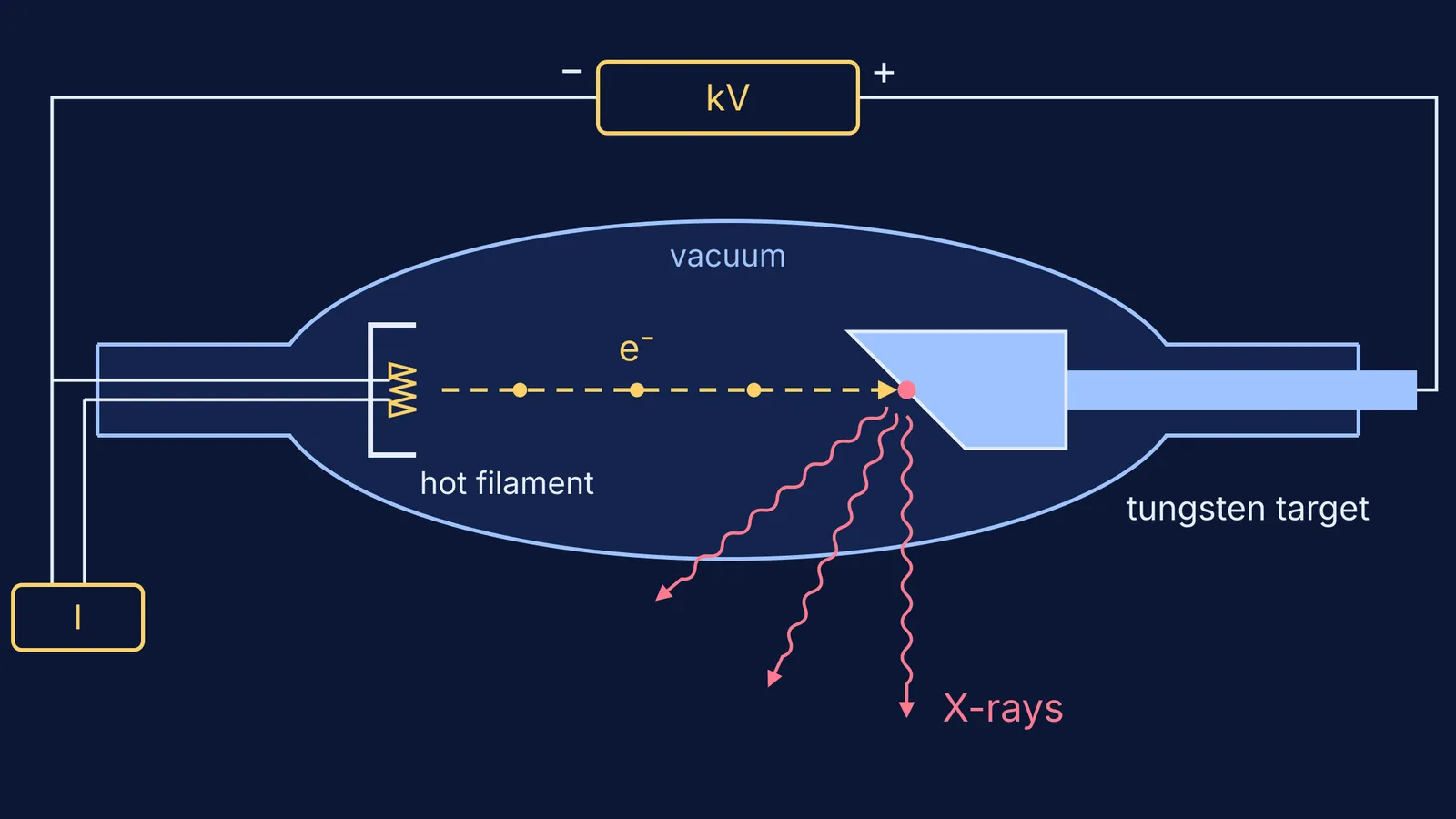
In December 1913, William D. Coolidge published "A Powerful Röntgen Ray Tube with a Pure Electron Discharge" in Physical Review. Its key idea, a hot wire as the electron source, is what your Class 12 X-ray tube diagram shows.
Who was William Coolidge, and what problem did he solve?
Coolidge was born on 23 October 1873 in Hudson, Massachusetts, was recruited by General Electric in 1905 and stayed there for the rest of his career, according to the Franklin Institute. Before X-rays he worked on ductile tungsten. He died on 4 February 1975.
Earlier X-ray tubes held a little gas, which the high voltage ionised. Over time, the walls of the tube absorbed the residual air and the pressure fell; this raised the voltage across the tube and gave "harder" X-rays, until the tube stopped working, as the X-ray tube article on Wikipedia explains. The beam a doctor got depended on the state of the gas, not only on the settings.
The Franklin Institute lists what Coolidge changed: a tungsten filament as the cathode, tungsten as the target anode, a high vacuum, and a cooled anode. The Oak Ridge Associated Universities health physics museum notes there is so little gas left inside that it plays no part in making the X-rays.
How does a Coolidge tube produce X-rays?
Follow the labelled diagram above from left to right.
Heat the filament. A separate circuit drives a current through the tungsten filament, which releases electrons by thermionic emission (Franklin Institute).
Accelerate the electrons. A high voltage between the filament (cathode, negative) and the target (anode, positive) pulls the electrons across the vacuum. HyperPhysics puts typical accelerating potentials at tens to hundreds of kilovolts.
Brake them in the target. The fast electrons slam into the tungsten target and slow down. This "braking radiation", or bremsstrahlung, comes out as a continuous spread of X-ray wavelengths (HyperPhysics).
Let the X-rays out. They leave the target face through the glass.
For why heat frees electrons, see thermionic versus photoelectric emission.
Why could doctors control intensity and hardness separately?
The ORAU museum puts it plainly: the intensity and energy of the X-rays can be controlled independently.
Filament current sets intensity. A hotter filament releases more electrons each second, so more X-ray photons come off the target.
Tube voltage sets hardness. A higher voltage gives each electron more energy, so the X-rays are more penetrating.
The ORAU museum adds that early radiologists could do with one Coolidge tube what before had required "a stable of finicky cold cathode tubes".
How do you find the cut-off wavelength of a Coolidge tube?
An electron accelerated through a voltage V arrives with energy eV. At most it gives all of that to one photon, so the spectrum stops sharply at a shortest wavelength.
The Duane–Hunt law, found by William Duane and Franklin Hunt in 1915, gives that cut-off as λmin = hc/eV (Duane–Hunt law).
Worked example. A Coolidge tube runs at 50 kV. (a) Find λmin. (b) The filament current is doubled at the same voltage. What happens? (c) The voltage is raised to 100 kV. Find the new λmin.
Use h = 4.135667696 × 10⁻¹⁵ eV s (NIST) and c = 299 792 458 m/s, an exact value (NIST). Multiplying them gives hc = 1.2398 × 10⁻⁶ eV m.
(a) Each electron gains 50 keV, so the largest photon energy is 5.0 × 10⁴ eV. Then λmin = (1.2398 × 10⁻⁶ eV m) / (5.0 × 10⁴ eV) = 2.48 × 10⁻¹¹ m, which is 24.8 pm or 0.248 Å.
(b) λmin stays at 24.8 pm; the formula has no term for current. More electrons arrive each second, so intensity rises at every wavelength.
(c) λmin = (1.2398 × 10⁻⁶ eV m) / (1.0 × 10⁵ eV) = 1.24 × 10⁻¹¹ m, or 12.4 pm. Doubling the voltage halves the cut-off wavelength.
For more numericals of this type, see our post on why λmin = hc/eV.
What do students mix up about the Coolidge tube?
Run through this checklist before a test:
The hot filament is the cathode (negative); the target is the anode (positive).
The X-rays come from the target, not the filament.
Only the voltage moves λmin; λmin = hc/eV has no term for current or target metal.
An electron accelerated through V kilovolts gains V kiloelectronvolts; keep kV and keV straight.
The tube is evacuated. The gas-filled tube is the older design it replaced.
If you keep landing on the wrong λmin, the Fermi Problem Library has worked problems with a step-by-step solver that explains the reasoning rather than printing an answer. If thermionic emission or bremsstrahlung is the shaky part, the Fermi Concept Library gives each physics concept its own lesson and its place in the map.
Next, read how Wilhelm Röntgen discovered X-rays.