On this page
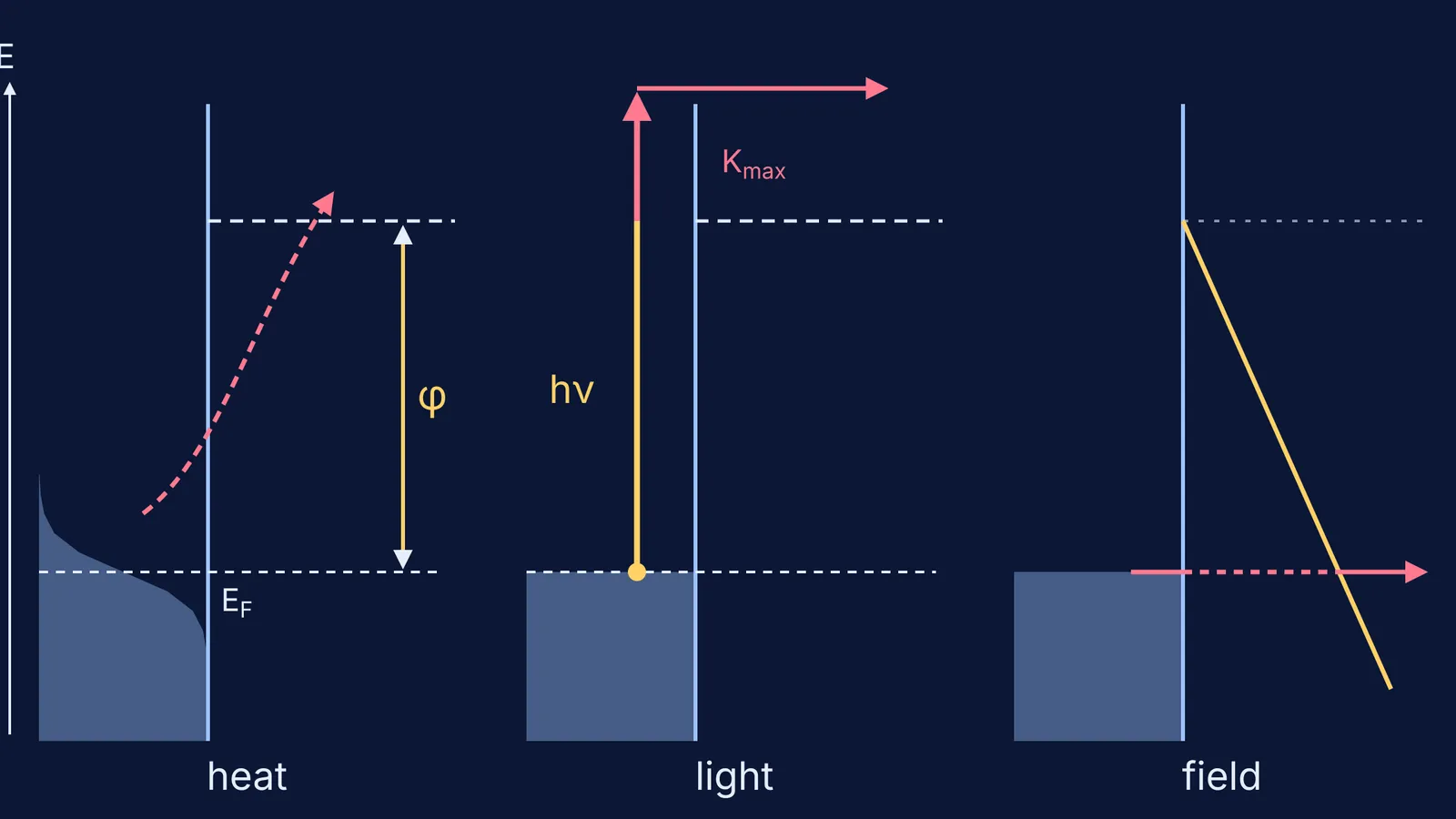
A metal's free electrons stay inside because the positive ions pull them back. The minimum energy an electron needs to escape the metal surface is called the work function, written φ0 and measured in electron volts, according to NCERT Class 12 Physics, Chapter 11. The same chapter lists three ways to supply that energy: heat, a strong electric field and light. What separates them is how the energy reaches the electron.
What is the difference between thermionic emission and photoelectric emission?
NCERT's Dual Nature of Radiation and Matter chapter defines all three:
Thermionic emission: heating the metal gives the free electrons enough thermal energy to come out.
Field emission: a very strong electric field, of the order of 10^8 V/m, pulls electrons out of the metal, as in a spark plug.
Photoelectric emission: light of suitable frequency falling on the metal surface ejects electrons, called photoelectrons.
Heat spreads energy around. At room temperature the typical thermal energy kT is only about 0.026 eV, since the Boltzmann constant is 8.617 × 10^-5 eV/K. Metal work functions are several electron volts: the work function table gives 4.32 to 4.55 eV for tungsten and 1.95 eV for caesium. So the metal must be very hot, and even then only electrons in the high-energy tail escape.
Light works one photon at a time. In Einstein's picture, one electron absorbs one quantum hν and comes out with at most K_max = hν − φ0. Emission is only possible above the threshold frequency ν0 = φ0/h. Brighter light means more photons, so you get more electrons, but not faster ones (NCERT, section 11.6).
How does the work function appear in each equation?
Thermionic: Richardson's law gives the current density as J = A T^2 e^(−φ/kT), where the universal constant A0 = 1.20 × 10^6 A m^-2 K^-2 (Thermionic emission). Because φ sits in an exponent, a small drop in φ raises the current enormously. That is why coating tungsten with a lower work function substance, such as thorium or barium oxide, greatly increases emission (Work function).
Photoelectric: here φ0 is simply subtracted, K_max = hν − φ0, so it sets a sharp threshold. Our post on threshold wavelength from work function shows the λ0 = 1240/φ shortcut.
Field: Millikan and Lauritsen found that log I plotted against 1/F (F is the field strength) gives a straight line, I = C e^(−a/F); in 1928 R. H. Fowler and L. Nordheim explained it with quantum mechanics (Proc. R. Soc. A 119). Rather than adding energy, the field tilts the barrier until it is thin enough for electrons near the top of the filled levels to tunnel through.
Owen Richardson won the 1928 Nobel Prize in Physics, especially for this law (Thermionic emission); read more in Owen Richardson and electrons leaving hot metals.
Worked numerical: tungsten heated versus tungsten lit
Take φ = 4.5 eV, inside the 4.32 to 4.55 eV range listed for tungsten (Work function). Use k = 8.617 × 10^-5 eV/K (Boltzmann constant) and A0 = 1.20 × 10^6 A m^-2 K^-2 (Thermionic emission).
Threshold wavelength: λ0 = 1240/4.5 ≈ 276 nm, in the ultraviolet. Visible light, however bright, ejects nothing.
200 nm ultraviolet light: the photon energy is 1240/200 = 6.2 eV, so K_max = 6.2 − 4.5 = 1.7 eV and the stopping potential is 1.7 V.
Heated to 2500 K: kT = 0.215 eV, so φ/kT ≈ 20.9 and e^(−20.9) ≈ 8.5 × 10^-10. Then J ≈ 1.20 × 10^6 × (2500)^2 × 8.5 × 10^-10 ≈ 6.4 × 10^3 A/m^2.
Heated to 2000 K: kT = 0.172 eV and φ/kT ≈ 26.1, so J ≈ 22 A/m^2. A 25% rise in temperature multiplies the current by about 290.
Room temperature, 300 K: φ/kT ≈ 174, so J comes out near 10^-65 A/m^2, which is zero for every practical purpose.
Real tungsten gives somewhat less current, because its constant is A0 times a material factor of order 0.5 (Thermionic emission).
If the exponent step is where your working goes wrong, the Fermi Problem Library has worked problems with a step-by-step solver that explains the reasoning rather than printing an answer.
How do you avoid the common exam traps?
Run through this checklist before a comparison question:
Source of energy: heat, an electric field or light. Name it first.
What raises the number of electrons: temperature (thermionic), field strength (field), intensity above threshold (photoelectric).
What raises their maximum energy: in the photoelectric case, only frequency. Intensity never does.
Threshold: a sharp cut-off frequency exists only for photoelectric emission. Thermionic current just becomes vanishingly small as the metal cools.
Lower work function: helps all three. It is also why caesium responds even to visible light while zinc needs ultraviolet (NCERT, section 11.3).
If the idea of the work function itself still feels shaky, the Fermi Concept Library gives every physics concept its own lesson and shows its place in the map.
For more practice, try these photoelectric effect problems for JEE and NEET.