On this page
You pour chai at close to boiling, get pulled into a phone call, and come back to something lukewarm. Wrapping the cup in a cloth or a hand towel is the everyday fix. It helps, but cloth only blocks some of the ways heat leaves. Here is a kitchen test to measure it: 0, 1, 2 and 4 layers, read every two minutes.
Where does the heat in a cup of tea go?
A hot cup loses heat in four ways: evaporation from the open surface, convection as air warms against the sides and rises, radiation from the outer wall, and conduction into the table. João Paulo Ferreira of Universidade Católica Portuguesa measured several of these routes with a ceramic mug of hot water. The numbers below come from his 2025 Physics Education study of the coffee cup.
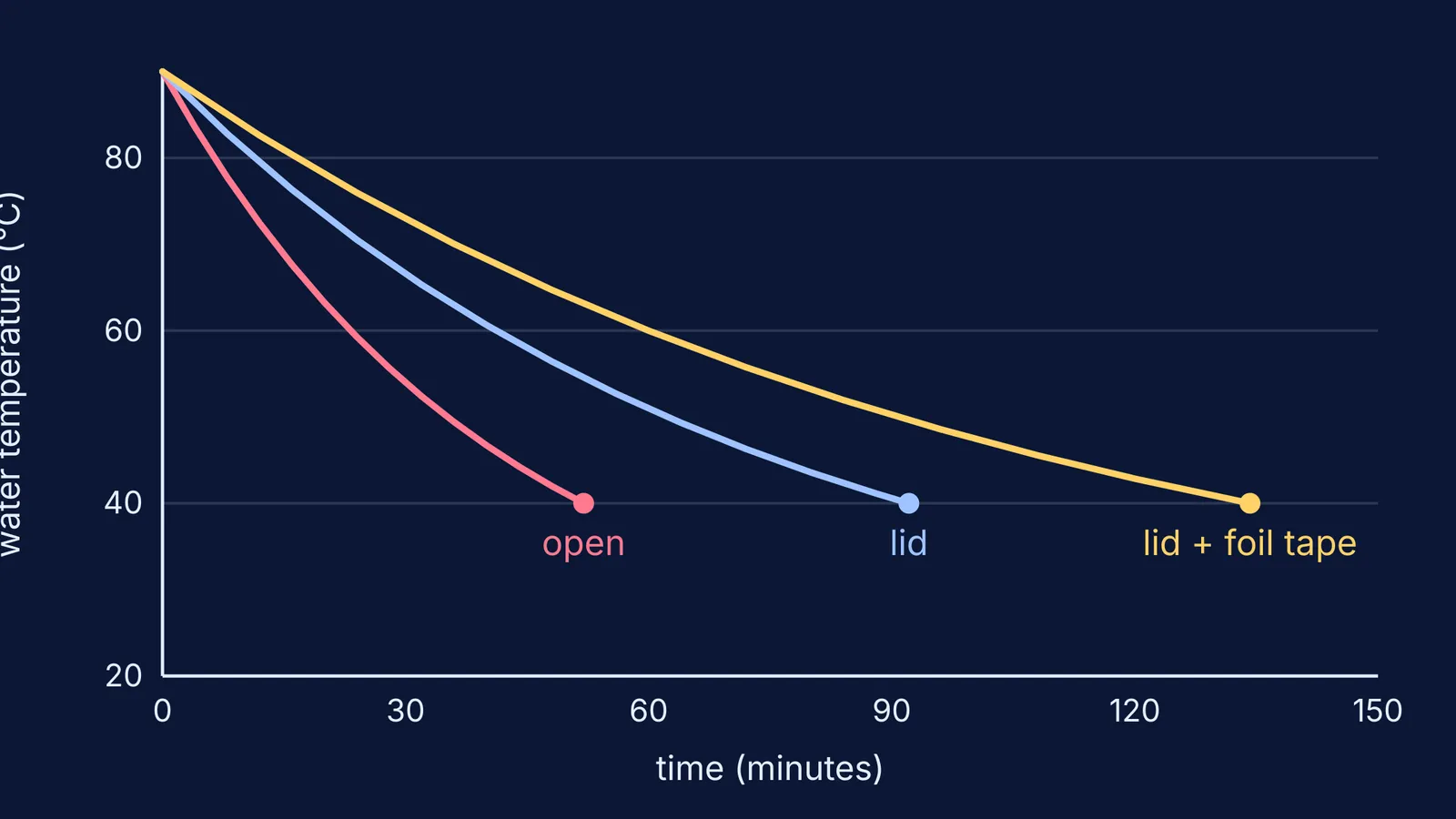
With a foam lid on, the mug took about 100 minutes to cool from 90 to 40 °C. With the lid off it took about 55 minutes: the open top, mainly through evaporation, roughly halved the cooling time.
Through the sides, in still air, about 67% of the heat left by convection and 33% by radiation. Covering the mug in aluminium tape, which barely radiates, stretched the 90-to-40 time to about 140 minutes.
A desk fan blowing air at 3.8 m/s cut the lidded cooling time from about 100 to about 30 minutes. He concluded that the main resistance to heat flow is on the air side of the wall.
His earlier paper on radiation in the coffee cup found that radiation takes a real share even below boiling point.
Which heat-loss route does each layer of cloth block?
Cloth insulates because it traps still air. Still air conducts heat poorly: about 0.026 W/(m·K), against about 0.61 W/(m·K) for water, according to the Engineering ToolBox thermal conductivity table.
What we expect (predictions to test, not measured results):
0 layers: all four routes are open.
1 layer: moving air at the glaze is swapped for still air in the weave, so convection from the sides drops. The cloth's outer surface runs cooler than bare ceramic would, so it also radiates less. The open top is untouched.
2 layers: more trapped air adds more resistance, and the sides leak less again.
4 layers: the sides are now well sealed, so evaporation from the top carries most of the remaining loss. Layers 3 and 4 should add less than layer 1 did.
How do you run the 0, 1, 2 and 4 layer test?
Take five identical cups. Give four of them 0, 1, 2 and 4 layers of the same cotton cloth, held with a rubber band. Leave the fifth bare, with a saucer on top as a lid.
Stand all five on the same surface, away from fans and windows. Note the room temperature.
Pour the same amount of just-boiled water into each. Use water, not tea, so milk and sugar do not vary. An adult should pour.
Stir gently and read each cup's temperature every two minutes for 40 minutes. A kitchen probe thermometer works.
Log the readings with one column per cup, then plot all five cooling curves on one graph.
How do you read the cooling curves?
Newton's law of cooling says the gap between cup and room shrinks by the same fraction every minute: T − T_room = (T_start − T_room) × e^(−t/τ), where τ (tau) is the time constant, as set out in the same Ferreira paper. If you plot ln(T − T_room) against time, you get a straight line with slope −1/τ. A bigger τ means slower cooling.
Worked example. Ferreira's lidded mug gave a fitted slope of 0.0136 per minute, so τ = 1 ÷ 0.0136 ≈ 74 minutes. In a 20 °C room, cooling from 90 to 40 °C takes τ × ln(70 ÷ 20) = 74 × 1.25 ≈ 92 minutes, close to the roughly 100 minutes he measured.
Work out τ for each of your five cups and line them up:
If τ jumps from 0 to 1 layer but barely moves from 2 to 4, the open top is now your main leak, and a lid will do more than extra cloth.
If the log plot of an open cup falls more steeply in the first few minutes than later, that is likely evaporation, which matters most while the water is hottest. Ferreira's open-cup points strayed from a straight line in the same way.
If the saucer cup beats the 4-layer open cup, that is your answer for tomorrow's chai: lid first, then cloth.
If the e^(−t/τ) step feels slippery, the Fermi Concept Library has a lesson for every physics and maths concept, and the Fermi Simulation Lab has interactive simulations for ideas that are easier to see than to read.
Next, read how a thermos flask keeps tea hot, why a kulhad does not burn your hands, or whether to add milk early or late to keep coffee hot.