

On this page
Pour tea into a steel tumbler and it soon turns lukewarm. Pour the same tea into a thermos and it is still hot when you open it after school. The flask is slowing down every route heat uses to escape, and those routes are the three modes of heat transfer you meet in school physics.
What are the three ways heat escapes from hot tea?
-Conduction: vibrating particles pass energy to their neighbours, through the cup wall or the air touching it.
Convection: warm air or liquid rises and carries heat away with it, and cooler fluid moves in to take its place.
Radiation: every warm surface gives off infrared waves, which need no material at all to travel.
For a refresher with everyday examples, see our explainer on conduction, convection and radiation for Class 7. A thermos tackles all three at once.
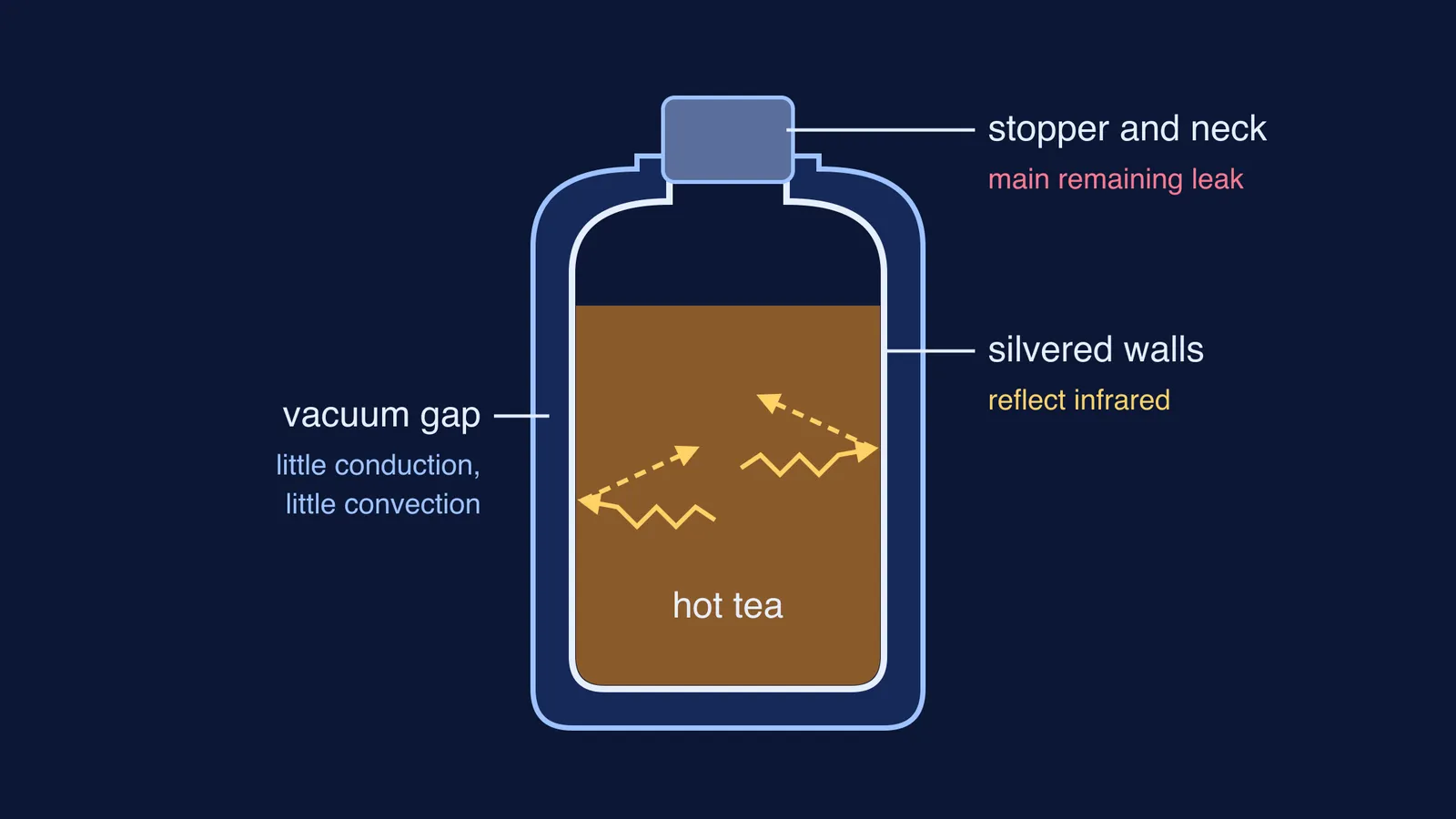
How does the vacuum stop conduction and convection?
A thermos is two bottles, one inside the other, sealed together at the neck. The gap between them is partly emptied of air, creating a near-vacuum which significantly reduces heat transfer by conduction or convection, as the Wikipedia article on the vacuum flask summarises.
Conduction and convection both need particles: something to vibrate, or something to flow. Take most of the air out of the gap and the hot inner wall has very little to hand its energy to.
The idea came from a lab. The Royal Institution in London describes the vacuum vessel James Dewar created in 1892 to hold liquefied gases at extremely low temperatures, and calls it the forerunner of the Thermos flask. Keeping things cold or hot is the same physics: the flask slows heat flow in either direction.
Why are the inner walls silvered?
A vacuum does nothing to stop radiation: infrared crosses empty space, the way sunlight reaches Earth. So the second trick is a mirror finish. The same Royal Institution page notes that Dewar's design was later improved by putting a silvered coating on the outside of the glass to minimise heat loss.
How strongly a surface gives off and takes in radiation is measured by its emissivity, a number from 0 (perfect reflector) to 1 (perfect black body). In the Engineering ToolBox emissivity table, polished silver is listed at 0.02 to 0.03, smooth glass at 0.92 to 0.94, and polished stainless steel at 0.075. A silvered wall gives off very little infrared and reflects most of what reaches it; steel flasks rely on polished metal in a similar way.
Different surfaces at the same temperature really do radiate differently; our story on John Leslie's cube and how surfaces radiate tells how this was first shown.
How much does silvering actually help?
You can estimate this with the Stefan-Boltzmann law. For two large parallel walls facing each other across a vacuum, the heat radiated per square metre is σ(T₁⁴ − T₂⁴) ÷ (1/ε₁ + 1/ε₂ − 1), where ε is each wall's emissivity. The Stefan-Boltzmann constant σ is 5.670 × 10⁻⁸ W m⁻² K⁻⁴ according to NIST, and the emissivities below come from the Engineering ToolBox table.
Take tea at 90 °C (363 K) in the inner wall and a 30 °C Indian afternoon (303 K) on the outer wall.
T₁⁴ − T₂⁴ = 1.736 × 10¹⁰ − 0.843 × 10¹⁰ = 0.893 × 10¹⁰ K⁴.
Multiply by σ: about 507 W per square metre for perfect black walls.
Smooth glass, ε = 0.93 on both walls: divide by 2/0.93 − 1 = 1.15, giving about 440 W/m².
Silvered, ε = 0.02 on both walls: divide by 2/0.02 − 1 = 99, giving about 5 W/m².
Silvering cuts the radiation leak by a factor of about 86 in this example, or about 57 if you use silver's upper value of 0.03. Real walls are curved, but the size of the effect holds.
Why does tea in a thermos still go cold eventually?
The two walls must join at the neck, and that join is solid material that conducts, as does the stopper. Most heat transfer in a flask happens through the neck and opening, where there is no vacuum, as the vacuum flask article notes. How fast the tea then cools depends on how much hotter it is than the room, which is Newton's law of cooling.
Habits that follow from the physics:
Pre-heat the flask with hot water, so the inner wall does not soak up heat from your tea.
Open the lid as rarely as you can.
Don't drop it: a crack can let air into the gap, and conduction and convection return.
Heat transfer is easier to see than to read. In the Fermi Simulation Lab you can work with interactive simulations of ideas like this, and if one of the three modes still feels shaky, the Fermi Concept Library gives each concept its own lesson.


