

On this page
In a book published in 1804, the Scottish physicist John Leslie described filling a tin cube with hot water to answer a simple question: does the surface of a hot object change how much heat it gives off? His answer, set out in An Experimental Inquiry into the Nature and Propagation of Heat, is the idea you now meet in textbooks as emissivity. The book earned him the Royal Society's Rumford Medal in 1804.
How did Leslie's cube experiment work?
Leslie (1766 to 1832) needed a large mass of hot water, because small objects cool too fast to measure. He describes hollow cubes of block tin, hammered smooth and bright, three, four, six and ten inches wide, with a thermometer dipping into the water (Leslie, 1804).
He chose a cube on purpose: every part of a face meets the detector at the same angle, and the four sides can be treated differently. One side stayed clean and bright. The opposite side was covered with writing paper or painted with lampblack (soot mixed with as little glue as possible). The other two were kept for tinfoil, coloured papers, pigments or surfaces changed by scratching or chemicals.
The detector was a curved tin reflector that focused the heat onto one bulb of a differential thermometer, a U-shaped tube whose liquid moves when one bulb gets warmer than the other (Leslie cube). The cube stood on a square stool, so turning the stool brought each face into exactly the same spot in front of the mirror.
Which surface emits the most heat radiation?
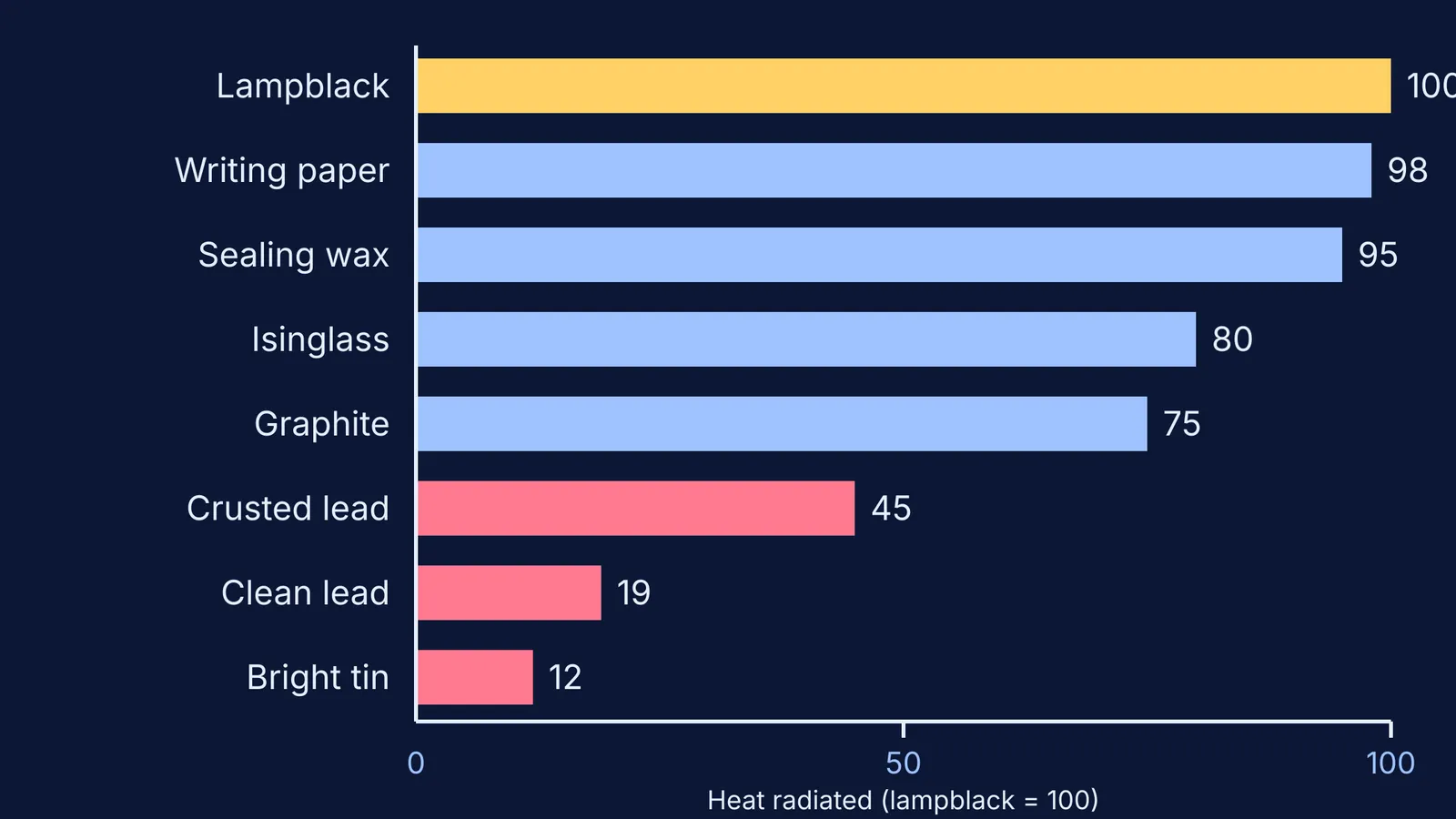
Leslie called the lampblack reading 100 and scored every other surface against it in the same set-up (Leslie, 1804). His numbers:
Lampblack: 100
Writing paper: 98
Sealing wax: 95
Isinglass (a fish glue) coat: 80
Black lead (graphite): 75
Lead with a dark grey weathered crust: 45
Clean but rough lead: 19
Iron saw blade: 15
Bright tin: 12
Look at the second line. Writing paper is white, yet it radiated almost as much as soot. The real divide in Leslie's table is dull, non-metallic surfaces against bright metal.
Why does a rough or tarnished metal radiate more?
Leslie found that surface texture mattered only at the metal end of his list. Removing the gloss from glass, paper or blacking made no noticeable difference. But when he filled a metal surface with many fine parallel furrows, he wrote, "its effect in discharging heat may be more than doubled" (Leslie, 1804). Tarnish helped too: the weathered lead scored 45 against 19 for clean lead.
Emissivity is the ratio of the heat a surface radiates to what a perfect black body of the same size and temperature would radiate, so it runs from 0 to 1 (Kirchhoff's law of thermal radiation). Gustav Kirchhoff showed in 1859 to 1860 that, in thermal equilibrium, a body's emissivity equals its absorptivity, which is why good emitters are also good absorbers (same source). A polished metal reflects most of the radiation that falls on it, so it absorbs little and emits little.
For the wider story, see Prevost's theory of exchanges and why cold objects radiate and how Josef Stefan found the fourth power radiation law. Emissivity is the surface factor that multiplies that law.
Worked example: how much faster does the black face lose heat?
Use Leslie's own readings (Leslie, 1804). The black face gave 100 and the bright tin face gave 12, so by radiation alone the black face loses heat about 100 / 12, or 8.3 times, as fast.
Careful, though: the cube also loses heat by convection, which does not care about paint, so overall the black face cools faster by less than 8 times. In an exam question, check for "by radiation only" before using the ratio. In the simple model where each surface keeps a fixed emissivity, the ratio stays the same whether the water is at 90 °C or 60 °C, because that emissivity multiplies the net loss at every temperature, as explained in why net radiation loss is proportional to (T⁴ − T₀⁴).
If the mirror, cube and thermometer are hard to picture, the Fermi Simulation Lab has interactive simulations for ideas that are easier to see than to read.
A four-step check for any emitter question
Is the surface a bright, polished metal? Expect low emission and low absorption.
Is it dull and non-metallic, such as paint, paper, wax or soot? Expect high emission, whatever its colour to your eye.
Is the metal scratched or tarnished? Expect more emission than the polished version.
Apply Kirchhoff: whatever emits well at a wavelength also absorbs well at it. Then ask whether conduction or convection also matter.
If terms like absorptivity or black body still feel shaky, the Fermi Concept Library gives each physics concept its own lesson.


