

On this page
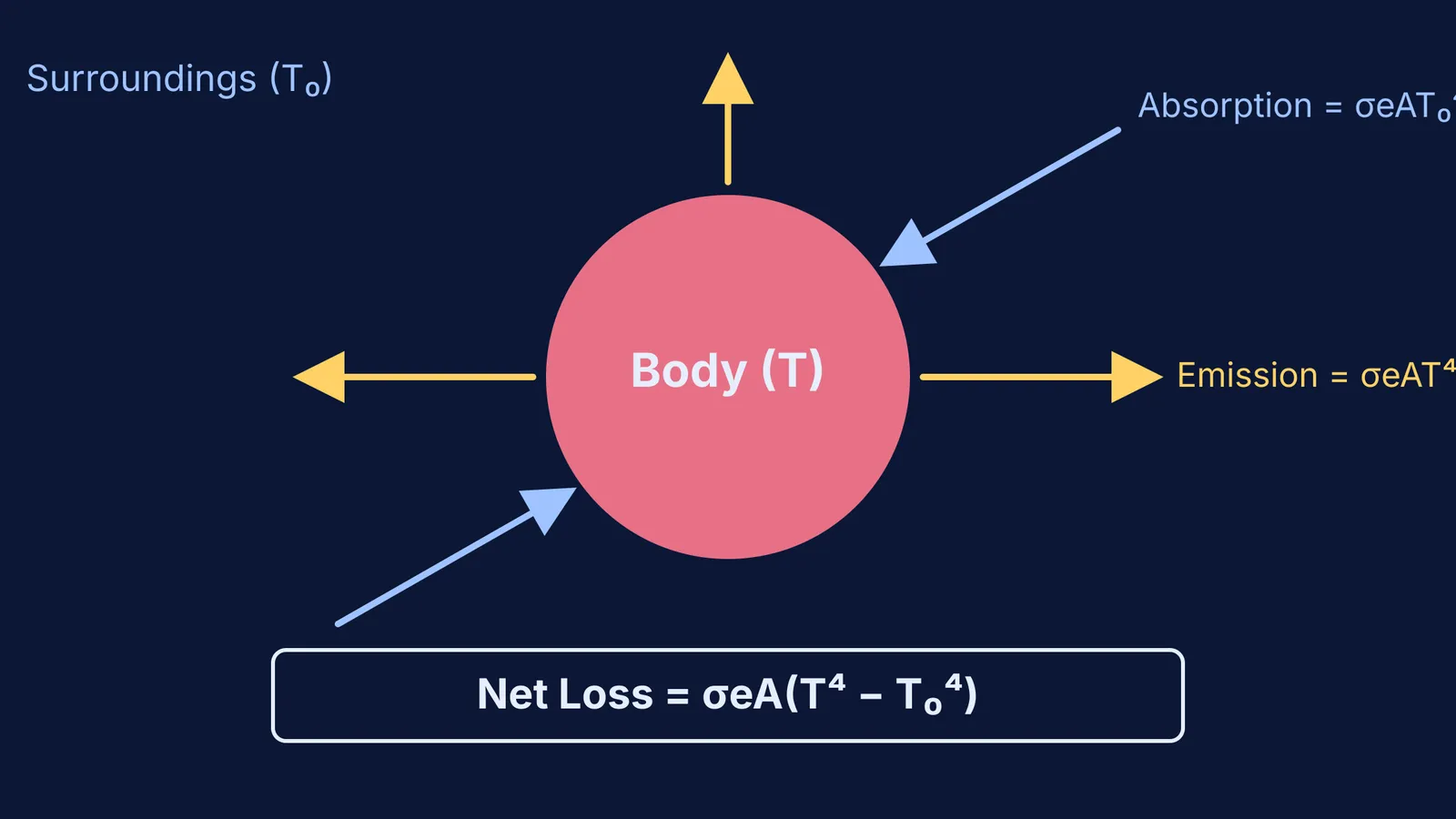
Many students wonder why the formula for radiation heat loss has a (T⁴ − T₀⁴) term rather than just T⁴. It comes down to the simple fact that thermal radiation is a two-way street: your object is glowing, but the rest of the universe is glowing right back at it.
What is the Stefan-Boltzmann law?
Every object in the universe with a temperature above absolute zero emits electromagnetic radiation. According to the Stefan-Boltzmann law, the total power an ideal black body radiates is proportional to the fourth power of its absolute temperature. For a real object with surface area A, emissivity e (a number between 0 and 1) and temperature T, the rate of emission is σeAT⁴.
The Stefan-Boltzmann constant (σ) is exactly 5.670374419... × 10⁻⁸ W m⁻² K⁻⁴ (Wikipedia). This core formula tells you only what the object is sending out into the universe, ignoring everything else around it.
Why do we subtract the surroundings?
While your object is radiating energy outward, the environment is also radiating energy back at it. If the surroundings are at an absolute temperature T₀, they emit radiation that your object absorbs.
The rate at which the object absorbs energy from its environment is σeAT₀⁴.
Therefore, the net rate of heat loss to the surroundings is the object's emission minus its absorption: Net loss = σeA(T⁴ − T₀⁴)
If T > T₀, the body loses heat to the room. If T < T₀, the body gains heat and warms up.
What is the difference between black and gray bodies?
The e in the formula stands for emissivity. A perfect black body is an idealized physical body that absorbs all incident electromagnetic radiation, regardless of frequency or angle of incidence. For a black body, e = 1, meaning it is a perfect emitter and absorber. In this perfect scenario, the net rate of heat loss simplifies to σA(T⁴ − T₀⁴).
Real objects, however, are called "gray bodies." They emit and absorb less efficiently, so their emissivity is a decimal between 0 and 1. A highly polished silver surface might have an emissivity of just 0.02 (Wikipedia), meaning it barely radiates heat and barely absorbs it from its surroundings. This is why emergency space blankets are shiny—they minimize the net rate of heat loss by radiation to keep a person warm.
How does this lead to Newton's law of cooling?
You might be familiar with Newton's law of cooling, which states that the rate of heat loss is proportional to the simple temperature difference (T − T₀). It is often written as dQ/dt = k(T − T₀). But how does a fourth-power radiation law become a linear one?
Newton's law of cooling is actually a first-order Taylor expansion of the Stefan-Boltzmann law, and it is valid only when the temperature difference is small compared to the absolute temperature (Wikipedia).
Let ΔT = T − T₀. If T is very close to T₀, we can factor the fourth-power term: T⁴ − T₀⁴ = (T − T₀)(T + T₀)(T² + T₀²)
Because T ≈ T₀, we can approximate the other terms as (T + T₀) ≈ 2T₀ and (T² + T₀²) ≈ 2T₀². Multiplying these together gives 4T₀³(T − T₀).
Substitute this back into the net radiation formula, and the rate of heat loss becomes approximately 4σeAT₀³(T − T₀). Because 4σeAT₀³ is just a constant (k) for a given object in a given environment, the net loss simplifies to k(T − T₀).
This mathematical trick explains why cooling via exponential models works so well for everyday objects cooling in a room, but fails completely for extremely hot objects like a red-hot iron poker.
How do you calculate the net heat loss of an iron sphere?
Imagine a solid iron sphere of radius 10 cm (0.1 m) at 400 K sitting in a room at 300 K. Assuming an emissivity of 0.8, what is its net rate of heat loss by radiation?
Calculate the surface area A = 4πr² = 4 × 3.14159 × (0.1)² ≈ 0.126 m².
Use the Stefan-Boltzmann constant σ ≈ 5.67 × 10⁻⁸ W m⁻² K⁻⁴.
Find the fourth powers of the temperatures: T⁴ = 400⁴ = 2.56 × 10¹⁰ K⁴ and T₀⁴ = 300⁴ = 8.1 × 10⁹ K⁴.
Calculate the difference: T⁴ − T₀⁴ = 1.75 × 10¹⁰ K⁴.
Multiply it all together: Net loss = 5.67 × 10⁻⁸ × 0.8 × 0.126 × 1.75 × 10¹⁰ ≈ 100 W.
The sphere is losing heat at a net rate of roughly 100 joules per second.
While calculating net heat loss tells you how fast energy leaves the system, finding out how that energy changes the system's temperature requires knowing its heat capacity, much like when you calculate heat in isobaric and isochoric processes for gases.
If you find yourself struggling to remember when to use T⁴ and when to use a simple ΔT, the Fermi Concept Library can help you step back and see how these heat transfer laws connect. For step-by-step guidance on setting up these equations—especially for mixed radiation and convection problems—try working through examples in the Fermi Problem Library. Our AI tutor will help you spot whether your temperature difference is small enough to justify Newton's law, rather than just printing the final answer.


