

On this page
In April 1791 the Geneva physicist Pierre Prevost published a short memoir, "Mémoire sur l'équilibre du feu" (On the equilibrium of fire), with a simple claim: every body sends out radiant heat and takes it in all the time, however hot or cold it is. When two things reach the same temperature, the radiation does not stop. The exchange just balances.
Prevost (1751–1839) was a Genevan who later took the chair of physics at Geneva in 1810 and wrote the 1809 book "Du calorique rayonnant" (On radiant heat), according to his Wikipedia biography).
What is Prevost's theory of exchanges?
Prevost's theory of exchanges states that each body radiates to the bodies around it and receives radiation from them, and that what it emits does not depend on whether those other bodies are there (Radiative equilibrium, Wikipedia). The same article cites his memoir in the Journal de Physique, volume 38, pages 314–322.
He pictured radiant heat as a very thin fluid he called "free heat". In a translation quoted in that article, he defined absolute equilibrium as "the state of this fluid in a portion of space which receives as much of it as it lets escape."
So equilibrium is not "nothing happening". It is two equal flows going opposite ways, like a railway platform where as many people arrive as leave.
Why did a flask of snow seem to radiate cold?
Prevost was answering a puzzle from his Geneva colleague Marc-Auguste Pictet. Around 1790, Pictet faced two concave mirrors towards each other, with a thermometer at one focus. A hot object at the other focus warmed it: radiant heat, even without light, could be focused like light (Pictet's experiment, Wikipedia). When he put a flask of snow at the focus instead, the thermometer fell, as if cold were being beamed across the room.
James Evans and Brian Popp explained it in modern terms in the American Journal of Physics in 1985.
Prevost's answer: there are no cold rays. The thermometer keeps radiating, but the snow sends back less than a room-temperature object would, so the thermometer cools. As Encyclopedia.com puts it, Prevost showed that all objects give off heat regardless of their temperature.
How does the theory of exchanges appear in Class 11 formulas?
In Class 11 thermal radiation you meet the Stefan–Boltzmann law: a black body at absolute temperature T radiates σT⁴ per square metre. The Stefan–Boltzmann constant σ is 5.670 374 419… × 10⁻⁸ W m⁻² K⁻⁴, a value the NIST CODATA table lists as exact.
Prevost's idea sits inside the net formula. For an object of emissivity e and area A at temperature T in surroundings at Ts, the net rate of heat loss by radiation is eσA(T⁴ − Ts⁴). (OpenStax College Physics 2e writes it as the net gain, σeA(T₂⁴ − T₁⁴).) The T⁴ term is what the body sends out, the Ts⁴ term is what it soaks up, and the minus sign is the exchange. Emissivity runs from 1 for a black body to 0 for a perfect reflector (same source).
How much radiation does Pictet's thermometer exchange?
Treat everything as a black body (e = 1), work per square metre and use NIST's value of σ.
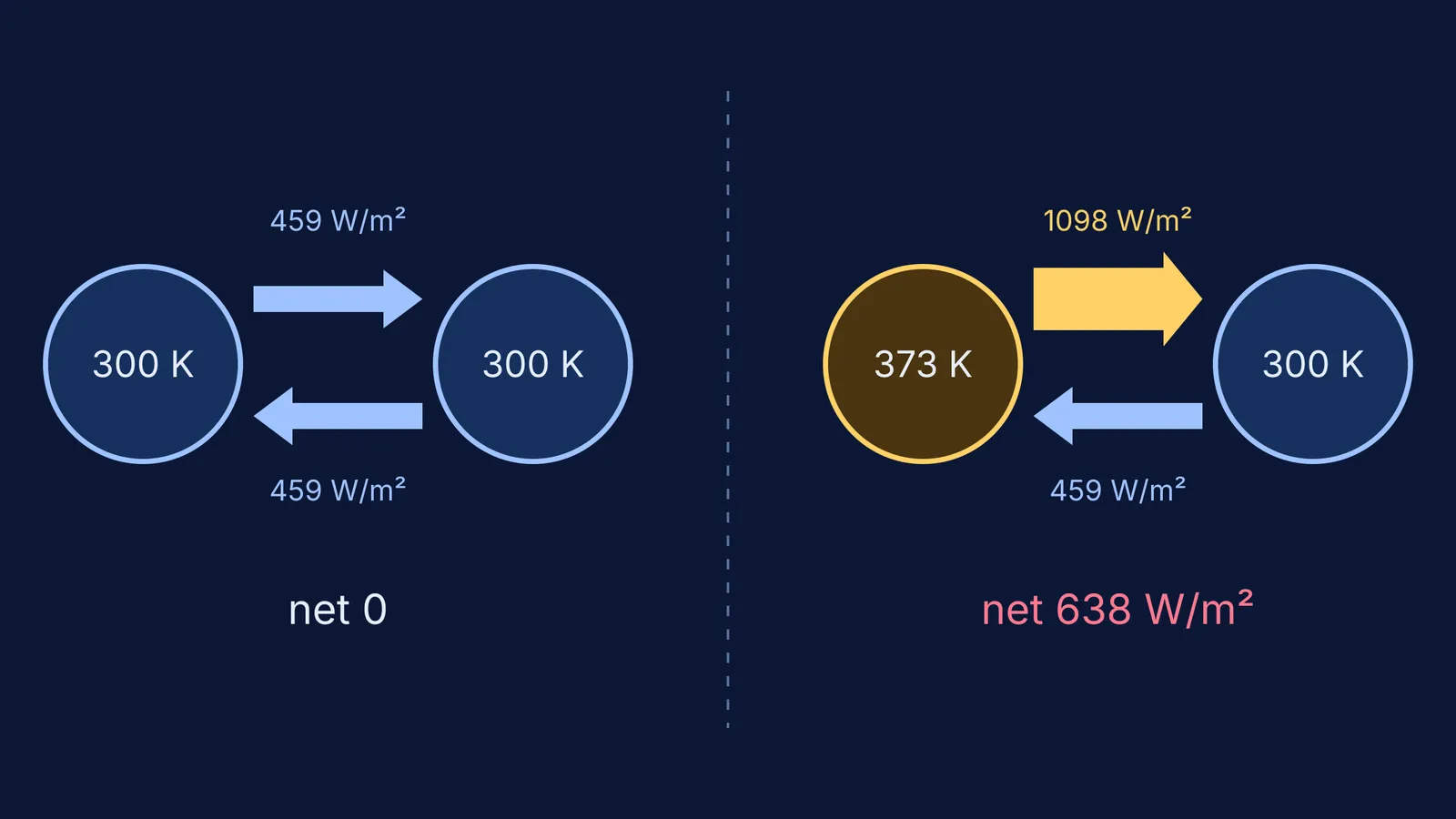
A thermometer bulb at 300 K (27 °C) emits σ × 300⁴ ≈ 459 W/m².
Facing a wall at 300 K, it also receives about 459 W/m². Net: zero. That is equilibrium, with radiation still flowing both ways.
Point it at a flask of ice at 273 K (0 °C) instead. The ice sends σ × 273⁴ ≈ 315 W/m².
The bulb still emits 459 W/m² but receives only 315 W/m² from that direction, a net loss of about 144 W/m². It cools. That is Pictet's apparent reflection of cold.
Swap the ice for a surface at 373 K (100 °C). It sends about 1098 W/m², so the bulb gains about 638 W/m² net.
These are idealised numbers; a real bulb also sees the mirrors and the room, so the measured effect is smaller. The pattern is what matters: the net flow comes from comparing two flows.
How do you use the theory of exchanges in exam problems?
Before your final answer, check:
Convert every temperature to kelvin before raising it to the fourth power. Putting 27 into T⁴ instead of 300 gives nonsense.
Write emitted and absorbed radiation as two separate terms first, then subtract. This stops sign mistakes.
Test the equilibrium case: if T equals Ts, your expression must give zero net flow.
Read any "radiates cold" wording as "less radiation coming in".
For practice, try our black-body radiation problems on Stefan's and Wien's laws and Newton's law of cooling, or read what came next in Gustav Kirchhoff and the birth of spectroscopy.
If you keep slipping on the kelvin step or the sign, the Fermi Problem Library has a step-by-step solver that explains the reasoning rather than printing an answer.
Next time your chai cools on the desk, remember Prevost: the mug and the room are both radiating, and the mug is losing the trade.


