On this page
You pour a cup of coffee, and someone calls you away for five minutes. You want it as hot as possible when you come back. Should you pour in the cold milk now, or wait and add it when you return?
Before reading on, make a prediction and write it down. Committing to an answer first, then checking it, is how a puzzle like this turns into physics you remember.
Does adding milk early keep coffee hotter?
Yes, in most cases. Two Cambridge researchers, W. G. Rees and C. Viney, studied this with deliberately everyday equipment and published the results in the American Journal of Physics in 1988. Their abstract reports that black coffee cools faster than white coffee under the same conditions. It also says that "under most (but not all) circumstances", if you want coffee as hot as possible several minutes after making it, any milk or cream should be added immediately rather than just before drinking.
What does Newton's law of cooling say?
Newton's law of cooling says that an object cools at a rate proportional to the difference between its temperature and the temperature of its surroundings (OpenStax Calculus Volume 1, section 6.8). As an equation, T' = -k(T - Ta), where Ta is the room temperature and k is a constant for that cup.
So very hot coffee loses heat quickly, and warm coffee loses it slowly. Adding cold milk early drops the temperature at once, and from then on the cup cools more slowly for the whole five minutes. Wait instead, and the black coffee spends those five minutes at a high temperature, losing heat fast, before the milk takes its share at the end.
Worked example: milk now or after five minutes?
We need a value for k. The OpenStax example has coffee cooling from 200 °F to 180 °F in 2 minutes in a 70 °F room (same OpenStax section). That gives k = (1/2) ln(130/110), about 0.084 per minute. We borrow that k and use Celsius numbers that suit an Indian kitchen:
coffee at 90 °C
room at 25 °C
milk from the fridge at 5 °C
milk makes up 20% of the final cup
We treat milk and coffee as having the same specific heat, so mixing gives a weighted average.
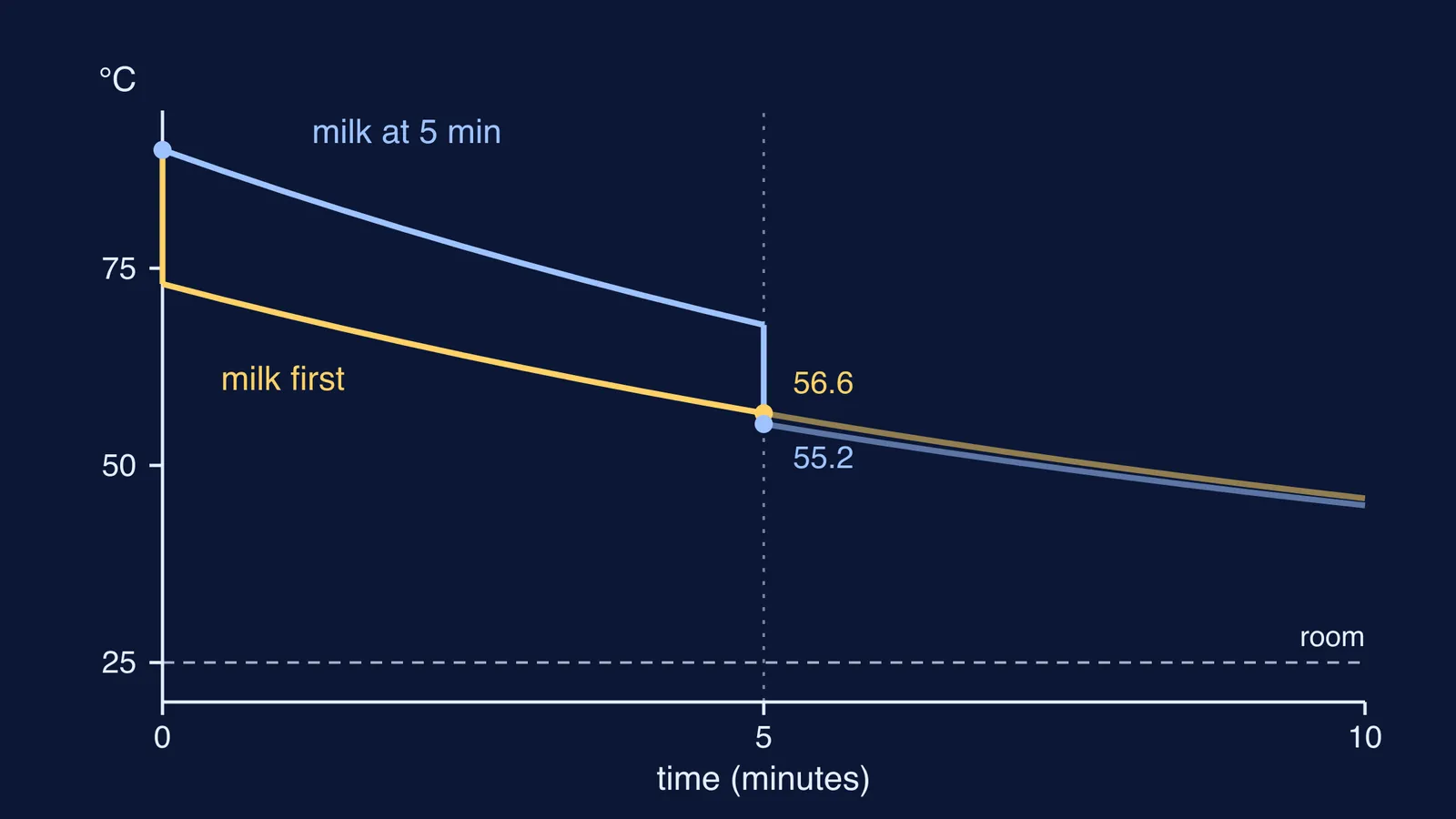
Milk first. The mix starts at 0.8 x 90 + 0.2 x 5 = 73 °C. After 5 minutes: 25 + 48 x e^(-0.42), about 56.6 °C.
Milk at 5 minutes. The black coffee falls to 25 + 65 x e^(-0.42), about 67.8 °C. Add the milk: 0.8 x 67.8 + 0.2 x 5, about 55.2 °C.
Milk first wins by about 1.4 °C.
With a little algebra, the gap becomes one formula: gap = f x (room temperature - milk temperature) x (1 - e^(-kt)), where f is the fraction of milk. Here that is 0.2 x 20 x 0.34, about 1.4 °C.
What if your milk is hot, as in chai?
The formula covers this too. In many Indian homes the milk is boiled, so it may be hotter than the room. Then (room - milk) is negative, and the sign flips: adding hot milk later keeps the cup hotter. Milk at exactly room temperature gives a gap of zero. So even this simple model shows the rule is not universal, which fits Rees and Viney's "most (but not all)".
Our model is also simpler than a real cup: it ignores evaporation, the larger volume after you add milk, and the mug warming up.
How can you test it at home?
You need two identical mugs, a kitchen or aquarium thermometer, a timer and cold milk.
Write down your prediction and how big you expect the gap to be.
Pour equal amounts of hot coffee or water into both mugs, from the same jug.
Add measured cold milk to mug A at once. Leave mug B black.
Note mug A's temperature every minute for five minutes.
At five minutes, add the same amount of milk to mug B and stir. Then measure both mugs.
Repeat three times, swapping which mug gets milk first.
If the gap is smaller than your thermometer can reliably measure, that is a result too: the effect is small.
Some ideas, like two cooling curves pulling apart, are easier to see than to read. The Fermi Simulation Lab has interactive simulations for ideas like that. If an exam question on cooling trips you up, the Fermi Problem Library has a step-by-step solver that explains the reasoning rather than printing an answer.
Next time you have five minutes, run the two-mug test and see whether your prediction holds.