On this page
Here is the surprise: the Moon is falling towards Earth right now. Gravity pulls it in. But it is also moving sideways very fast, so by the time it has fallen a little, it has moved far enough sideways to still be the same distance from Earth.
Why doesn't the Moon fall on Earth if gravity pulls it?
Two motions happen at once.
Sideways: the Moon moves at a mean speed of 1.022 km/s, at an average distance of 384,400 km from Earth, according to NASA's Moon fact sheet.
Inwards: Earth's gravity pulls it towards Earth's centre, so it keeps dropping below the straight line it would otherwise follow.
If gravity switched off, the Moon would carry on in a straight line and leave (Newton's first law). If the Moon stopped moving sideways, it would fall straight down. With both, it falls along a curve that bends around Earth. An orbit is falling and missing, over and over.
The orbit is not a perfect circle (NASA gives mean closest and farthest distances of about 363,300 km and 405,500 km), but the idea is the same.
What was Newton's cannonball idea?
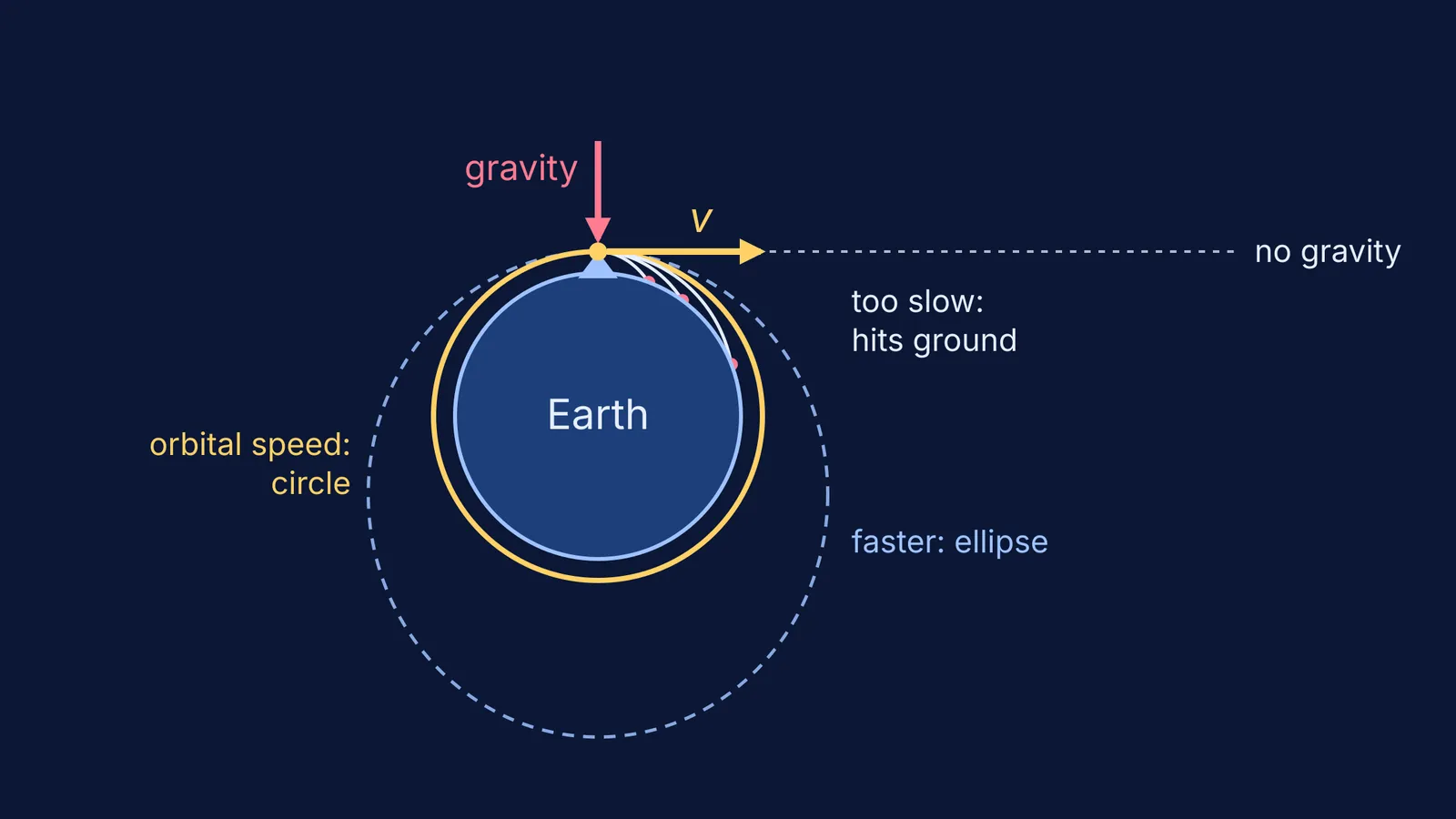
Isaac Newton imagined a cannon on top of a very high mountain, firing sideways, with no air to slow the ball. The thought experiment appears near the start of A Treatise of the System of the World, published in 1728 after his death (background on Newton's cannonball).
A slow ball curves down and hits the ground near the mountain.
A faster ball lands further away.
At just the right speed, the ground curves away as fast as the ball falls. It never lands; it circles Earth.
Faster still, it swings out on a bigger oval, an ellipse.
NASA's guide to space flight puts it the same way: fired fast enough, the cannonball "falls completely around Earth" and is in orbit (NASA, Basics of Space Flight). Newton's leap was to say the Moon is that cannonball, only much further away. The same idea explains why a satellite keeps falling but never lands.
How far does the Moon fall in one minute?
Check it with Class 9 maths, using the Moon figures from NASA's Moon fact sheet. Earth's mean radius is 6,371 km and its mean surface gravity is 9.82 m/s², according to NASA's Earth fact sheet.
The Moon's pull towards Earth. For circular motion, a = v²/r = (1,022 m/s)² ÷ (3.844 × 10⁸ m) ≈ 0.0027 m/s².
Sideways in one minute. 1.022 km/s × 60 s ≈ 61 km.
Fall in the same minute. d = ½at² = ½ × 0.0027 × 60² ≈ 4.9 m below the straight line.
Why it doesn't get closer. Over 61 km, a circle of radius 384,400 km bends away from a straight line by 61² ÷ (2 × 384,400) km ≈ 4.9 m. The fall and the bend match.
Compare a stone. Dropped near the ground, a stone falls ½ × 9.82 × 1² ≈ 4.9 m in its first second.
So the Moon falls in a minute what a stone falls in a second. The Moon is about 60 Earth radii away (384,400 ÷ 6,371 ≈ 60.3), and gravity weakens with the square of distance, so there it should be 9.82 ÷ 60.3² ≈ 0.0027 m/s². That matches step 1: one force explains the falling stone and the orbiting Moon.
What is the short answer for Class 9?
A short answer you can write in an exam:
The Earth does attract the Moon, and the Moon is falling towards the Earth all the time. But the Moon also moves with a large speed at right angles to the Earth's pull. Gravity does not stop this motion; it keeps changing its direction, bending the path into a nearly circular orbit. Gravity provides the centripetal force, so the Moon goes around the Earth instead of falling onto it.
Three things to include:
Draw the Moon on a circle with v along the tangent and F pointing to Earth's centre.
Use the words centripetal force and direction of velocity.
Don't say a centrifugal force balances gravity. In this Earth–Moon picture, the only force on the Moon is Earth's pull, pointing inwards, with nothing pushing outwards; that is why the path curves.
For the rest of the chapter, see our Class 9 gravitation guide.
How can you see it for yourself?
Whirl a ball on a string in an open space, then let go. The string was the gravity; the moment it goes, the ball flies off along the tangent, not outwards. That is what the Moon would do if Earth's pull vanished.
Orbits are easier to see than to read. The Fermi Simulation Lab has interactive simulations for ideas like this, and our walkthrough of an orbits and gravity simulation shows what to try. Predict first: what happens if you halve the sideways speed? Then run it. If you get stuck, Fermi's AI tutor can draw the figure and check your understanding as it goes.
So does the Moon fall? Yes. It just keeps missing.