On this page
Look closely at a plane window and you will see a pinprick of a hole. It is not a defect and it does not open to the sky. It decides which pane does the hard work of holding the cabin's air in, and it helps keep your view clear.
Why is there a small hole in airplane windows?
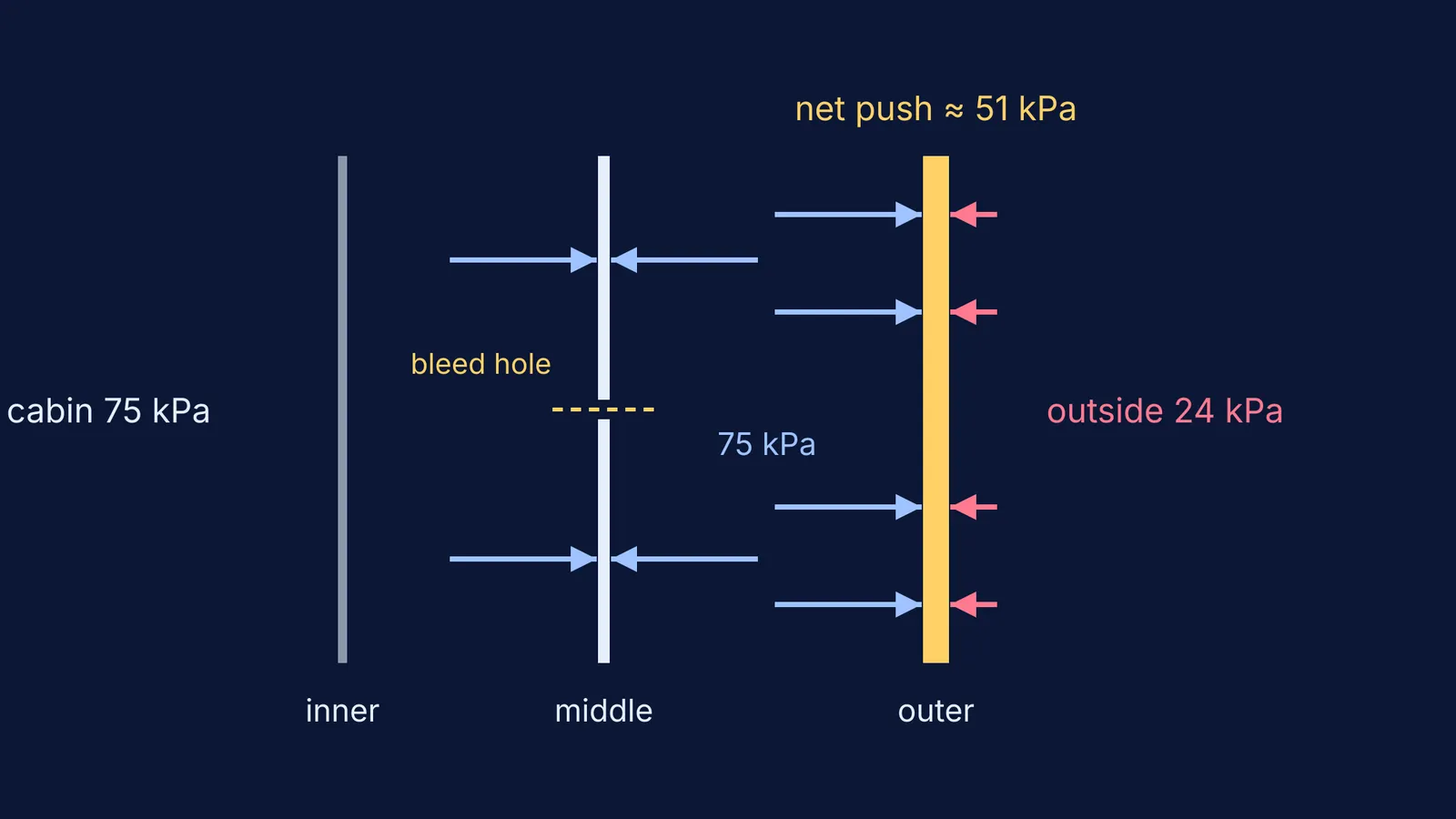
A passenger window is not one sheet but three panes, according to this ScienceAlert explainer, which quotes Marlowe Moncur, director of technology at window maker GKN Aerospace, speaking to Slate.
The inner scratch pane is the one you can touch.
The middle pane has the small hole, called a bleed hole.
The outer pane protects you from the pressure difference between the cabin and the thin air outside.
The hole lets the pressure equalise, so during flight the cabin pressure is applied only to the outer pane, the same ScienceAlert article explains. Cabin air reaches the gap between the middle and outer panes, so the middle pane has cabin pressure on both faces and feels almost no net push. The article adds that if the outer pane were ever broken by debris, the middle pane would still be there to protect passengers.
How big is the pressure difference across a plane window?
US rules say a pressurised cabin must provide a cabin pressure altitude of not more than 8,000 feet under normal operating conditions (14 CFR 25.841). So in normal flight, cabin air is no thinner than air 8,000 feet up a mountain. Boeing says the 787 keeps its cabin at a 6,000-foot altitude, 2,000 feet lower than conventional jets (Boeing).
To turn altitudes into pressures, use NASA Glenn's standard atmosphere model: T = 15.04 − 0.00649h and p = 101.29 × [(T + 273.1)/288.08]^5.256, with h in metres and T in °C.
Cabin at 8,000 feet (2,438 m): T ≈ −0.8 °C, so p ≈ 75.4 kPa.
Outside at 35,000 feet (10,668 m), a typical example cruising height: T ≈ −54.2 °C, so p ≈ 23.9 kPa.
Difference: Δp ≈ 75.4 − 23.9 = 51.4 kPa, or about half of sea-level air pressure.
How much force does the outer pane hold back?
Force from a pressure difference is F = Δp × A. For the area, take a Boeing 777-300ER window, which Simple Flying lists as 10 inches by 15 inches. Using the pressures worked out above from the NASA model:
Convert to metres: 10 in = 0.254 m and 15 in = 0.381 m.
Area: A = 0.254 × 0.381 ≈ 0.0968 m².
Pressure difference: Δp ≈ 51.4 kPa = 51,400 Pa.
Force: F = 51,400 × 0.0968 ≈ 4,980 N, so about 5,000 N.
Sense check: 4,980 N ÷ 9.81 m/s² ≈ 507 kg. The outer pane of a window this size holds back about the weight of half a tonne for the whole cruise.
For a bigger window, Simple Flying lists the 787's at 10.7 by 18.4 inches, and Boeing says its cabin is held at a 6,000-foot altitude.
Only the difference in pressure matters, not its size. If picturing pressure as molecules hitting a surface helps, the Fermi Simulation Lab has interactive simulations for ideas that are easier to see than to read.
Why does the hole stop the window fogging up?
The ScienceAlert explainer says the hole also helps keep the panes from fogging up, which is a result of the temperature difference between inside and outside the cabin. By NASA Glenn's model, the air outside at 35,000 feet is about −54 °C, so the outer pane is very cold while the cabin is comfortable.
Fog forms when moist air touches a surface colder than its dew point and water vapour condenses into tiny droplets, the same reason your bathroom mirror fogs after a hot shower. The article does not spell out exactly how the hole helps, so treat it as one part of the window's design against fogging rather than the whole story.
What should you remember for physics exams?
This is a pressure numerical in disguise. Keep these points:
Force from a pressure difference is F = Δp × A, not p × A.
Convert lengths to metres and pressures to pascals before multiplying.
A sheet with equal pressure on both faces feels no net force.
Divide a force by g to get a mass you can picture; it catches unit slips.
The same spreading-the-load logic appears in why heavy trucks have so many wheels, and the cold, thin air at cruising height also explains why planes leave white trails in the sky.
If you want more pressure numericals worked through, the Fermi Problem Library has worked problems with a step-by-step solver that explains the reasoning rather than printing an answer.
Next time you fly, find the hole and work out the force on your own window.