On this page
Count the tyres on a loaded truck on an Indian highway: two at the front, then pairs and pairs behind. The reason is the first formula you meet in Class 8 physics, pressure = force ÷ area. A truck's weight is set by its cargo, so the main thing the designers can change is the area it presses on. More tyres means more area, and less pressure on the tyres and on the road.
What does pressure = force ÷ area actually say?
Pressure is the force pushing on each square metre of a surface. Its unit is the pascal, and, as NIST explains, a pascal is one newton spread over one square metre. One pascal is tiny, so tyre pressures are usually given in kilopascals (kPa) or megapascals (MPa, a million pascals).
Double the force on the same area and the pressure doubles; double the area under the same force and it halves. A truck can't make its load lighter, so it adds area: more tyres.
How much weight can one truck axle carry in India?
The Ministry of Road Transport and Highways sets the limits. Its notification S.O. 3467(E) of 16 July 2018 gives a maximum safe weight of 11.5 tonnes for a single axle with four tyres, with 1 tonne more allowed if the vehicle has pneumatic suspension. The same notification caps the gross weight of a rigid (non-articulated) vehicle at 49 tonnes.
The ministry says it set these limits "having regard to the size, nature and number of tyres". The law rests on the same idea as your textbook.
How much pressure does each truck tyre put on the road?
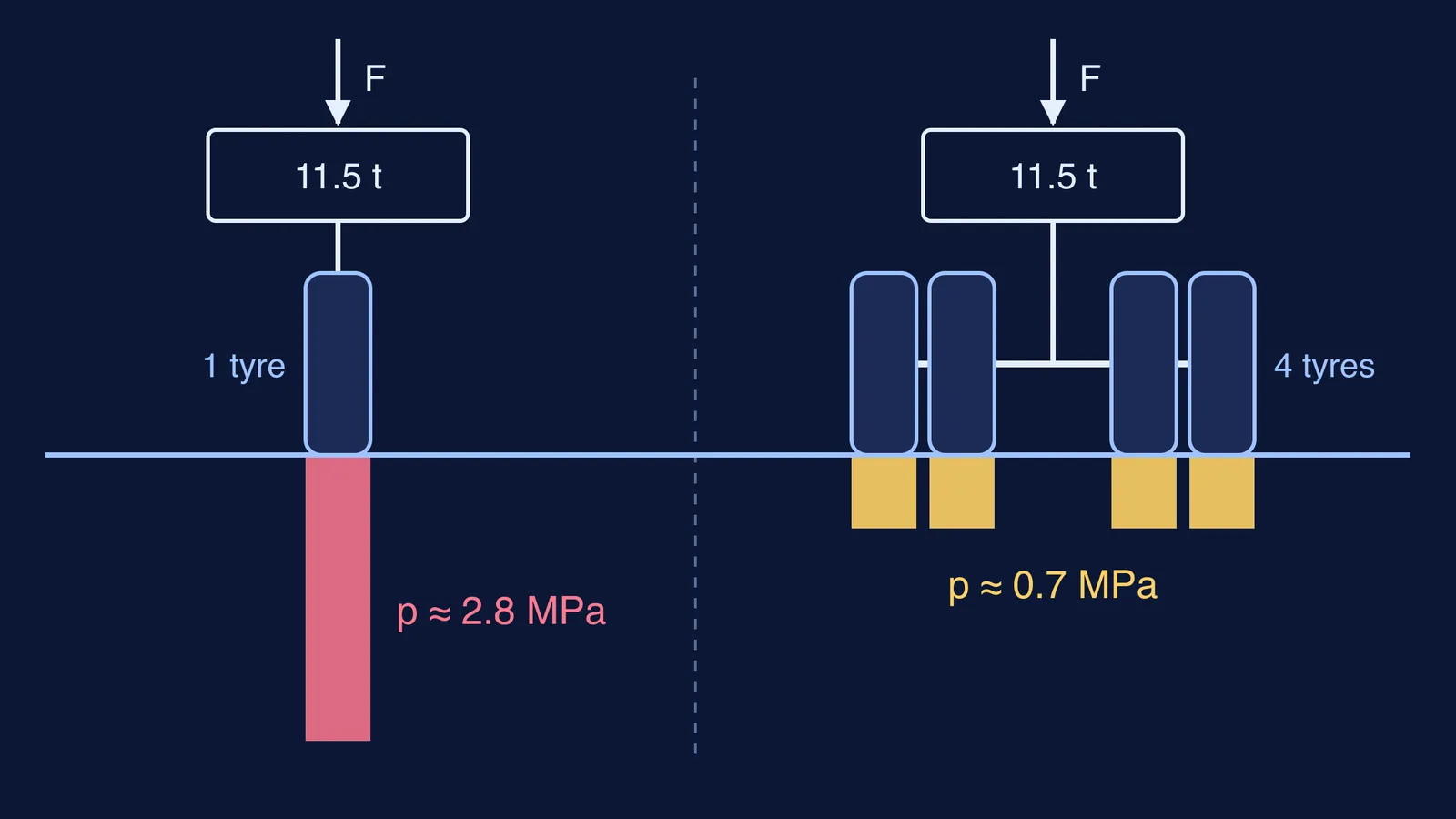
Take one fully loaded four-tyre axle at the MoRTH limit and work out what each tyre presses on the road. Use g = 9.8 m/s².
Force. Mass on the axle = 11.5 t = 11,500 kg. Weight = 11,500 × 9.8 = 112,700 N.
Area. Each tyre touches the road over a flattened patch. Assume each patch is about 20 cm × 20 cm = 0.04 m² (a round figure for this example). Four tyres give 4 × 0.04 = 0.16 m².
Pressure. p = F ÷ A = 112,700 ÷ 0.16 = 704,375 Pa, or about 0.7 MPa.
Fewer tyres. On two tyres (0.08 m²), p ≈ 1.4 MPa. On one tyre (0.04 m²), p ≈ 2.8 MPa, four times as much.
Is 0.7 MPa a sensible answer? A Texas Transportation Institute summary report says existing practice typically assumes the tyre pressure is uniform over the contact area and equal to the inflation pressure, while noting that real contact stresses are not uniform. Its measurements used an 11R24.5 truck tyre inflated to 100 psi, about 0.69 MPa, so our answer is in the right range. By that rule of thumb, a single tyre carrying 2.8 MPa would need roughly 400 psi inside it, about four times the pressure used in those tests.
A 2023 study in Materials measured a light-truck tyre at 670 kPa carrying 12.15 kN over about 19,265 mm². Divide and you get an average of about 0.63 MPa, close to the air pressure inside the tyre. The same study found that local peaks on asphalt can be several times higher than that average, so 0.7 MPa is a typical value, not a maximum.
Now scale up to a whole truck. A 49-tonne rigid truck weighs 49,000 × 9.8 = 480,200 N. At about 0.7 MPa per patch it needs 480,200 ÷ 704,375 ≈ 0.68 m² of rubber on the road. That is 0.68 ÷ 0.04 ≈ 17 patches of our size. That is why you count so many tyres.
Why do more axles protect the road?
There is a second reason, about axles. In the AASHO Road Test of the late 1950s, engineers found that road damage does not grow in step with load. A City of Spokane engineering paper sums up the rule of thumb: damage rises roughly with the fourth power of axle load, so doubling the load on an axle does about sixteen times the damage. The same paper notes this is an approximation, and that a later re-analysis put the power nearer 3.5.
Try the maths. Put a load on one axle and call its damage 1. Split the same load across two axles: each carries half, so each does (1/2)⁴ = 1/16 of the damage. Together that is 2/16, or one-eighth. Same cargo, about an eighth of the wear (closer to a sixth if you use the 3.5 power). Once a road is damaged, water finishes the job, as in our explainer on why potholes appear after heavy rain.
Where else does spreading a load show up?
Railway ballast spreads a train's weight over the ground, as we explain in why railway tracks have stones. The tyres also have to grip, which is separate physics: see why tyres have treads.
For more practice, the Fermi Problem Library has worked problems with a step-by-step solver that explains the reasoning rather than printing an answer, so you can see where a unit conversion went wrong.