

On this page
Many roads that looked fine before the monsoon are full of holes by the end of it. A pothole is the end of a chain: water gets under the road, the layers below go soft, and tyres do the rest. Each link is physics you study.
It also matters for safety. The Ministry of Road Transport and Highways' Road Accidents in India 2022 report counts 4,446 road accidents at potholes in 2022, in which 1,856 people were killed.
What is a road actually made of?
A typical asphalt road is a stack of layers. On top is the asphalt surface: stones held together by bitumen, the black binder. Below it is the base, a thick layer of crushed stone. Below that is the subgrade, the natural soil the road sits on.
The layers underneath carry the weight of traffic, and they do it well only when they are dry. A technical sheet for road crews from PennDOT's Local Technical Assistance Program puts the rule simply: if you want to prevent potholes, you must keep water out of your pavements.
Why do potholes appear after heavy rain?
Four things happen, in order.
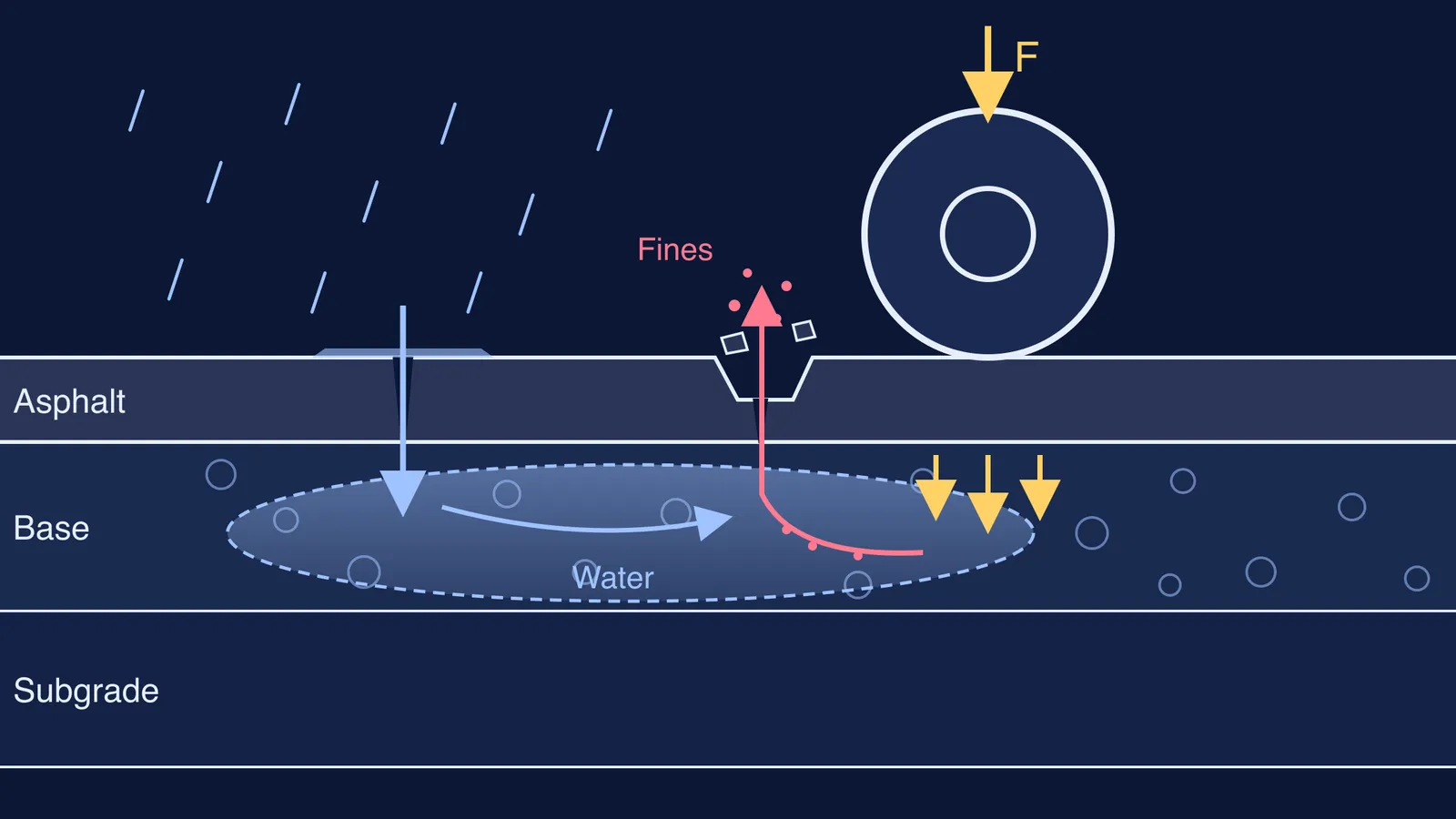
Water gets in. Rain finds the cracks and joints in the surface. A US Federal Highway Administration instructor's guide on drainable pavements, written for concrete roads, names infiltration through joints and cracks as the number one source of water entering the pavement structure.
The layers below go soft. The PennDOT sheet, written for Pennsylvania's wet, freezing winters, explains that accumulated water can soften the subgrade and base, weakening their capacity to support traffic, and the stones of the base can sink into the soft soil.
Tyres pump the water around. When a heavy wheel presses down, the trapped water has nowhere to go but sideways and up. For concrete roads, the FHWA guide describes loads sending a pressure wave or water jet through the saturated base, which erodes fine particles and pumps some of them out through joints and cracks. Over time, that can leave gaps under the surface.
The surface breaks. With weak support underneath, the top layer bends with every vehicle until it cracks apart. PennDOT calls this fatigue failure: in thin pavement it produces the classic bowl-shaped pothole, and the damaged area breaks into 1- to 2-inch (about 2.5 to 5 cm) pieces that traffic easily knocks loose.
Warm weather does not protect a road either. A 2019 review in Construction and Building Materials by Wang and colleagues explains that under repeated vehicle loads, water inside an asphalt pavement builds up a pressure that switches between positive and negative. It squeezes and pumps water along tiny channels in the asphalt and strips the bitumen film off the stones, damage the authors link to warm seasons and warm regions.
What physics is hiding in a pothole?
A pothole ties several chapters of school physics together:
Pressure. Pressure is force divided by area, so the weight of a vehicle is concentrated on the small patch where each tyre meets the road.
Fluids that cannot be squashed. Water is nearly incompressible, so water trapped in a pore pushes outwards on the walls around it when a load squeezes it.
Erosion. Fast-moving water carries small particles with it, so fine soil and grit leave the base and take its support with them.
Adhesion and cohesion. Bitumen holds a road together by sticking to stone. Water that gets between the two breaks that bond.
Fatigue. A material can fail under a stress far smaller than its breaking strength if that stress is repeated again and again.
Pressure in a trapped fluid is the kind of idea that is easier to see than to read about. The Fermi Simulation Lab has interactive simulations for ideas like that.
How can you spot a pothole before it forms?
Try this small field study on your street the morning after rain.
Damp patches. The PennDOT sheet notes that pavement prone to ravelling, where stones break away from the surface, stays damp after the rest of the road has dried.
Edges and joints. PennDOT says ravelling holes form at seams, edges, joints, unsealed cracks and other places where the pavement may lack density.
Mud or grit around a crack. Fine material washed up at a crack may be a sign of the pumping the FHWA guide describes.
A slight dip. A sag in the surface suggests the support under it has already moved.
If you find a hole forming on a public road, report it to your municipal corporation or local road authority with a photo and location. Do not stand in traffic to take the photo.
If one link in the chain feels fuzzy, the Fermi Concept Library has a lesson for every concept in physics, chemistry, biology, mathematics and computing, so you can revisit pressure or adhesion on its own.


