On this page
The first monsoon shower ends, a light comes on, and within minutes the tube light is wrapped in fluttering insects. By morning the floor is covered in wings. Many of these visitors are winged termites.
What are the insects that come after the first rain?
They are alates: the winged, reproductive adults of a termite colony, whose job is to leave, find a partner and start a new colony. A 2023 study in PLoS One describes how, during mass swarming events, hundreds of alates from different colonies gather in swarm clouds, and notes that termites mate for life.
In India, researchers studying the mound-building termite *Odontotermes obesus* on the IISER Mohali campus collected alates during a swarm that began after the first rains in June 2018, according to their 2024 paper in Communications Biology.
The alates at your window come from the same kind of colonies that build mounds that stay cool inside and rely on gut microbes to digest wood.
Why do termites swarm when the soil is wet?
A new pair has to find a nest site and start a colony on its own, living on its body reserves until its first young grow up (PLoS One). Mississippi State University Extension notes that swarmers are not likely to survive indoors for long, because homes are cooler and drier than they like, and that they almost always need soil to start a colony. Damp soil and humid air after rain probably make that easier, though these sources do not test it.
Timing matters too: a flier needs partners from other colonies in the air at the same moment. Swarming has usually been put down to colonies responding to environmental cues, but a 2024 study in Biology Letters found that alates of *Reticulitermes kanmonensis* from the same colony synchronised their flights even at a constant 20 °C in the lab, and synchronised better in larger groups.
Why do flying insects come around lights after rain?
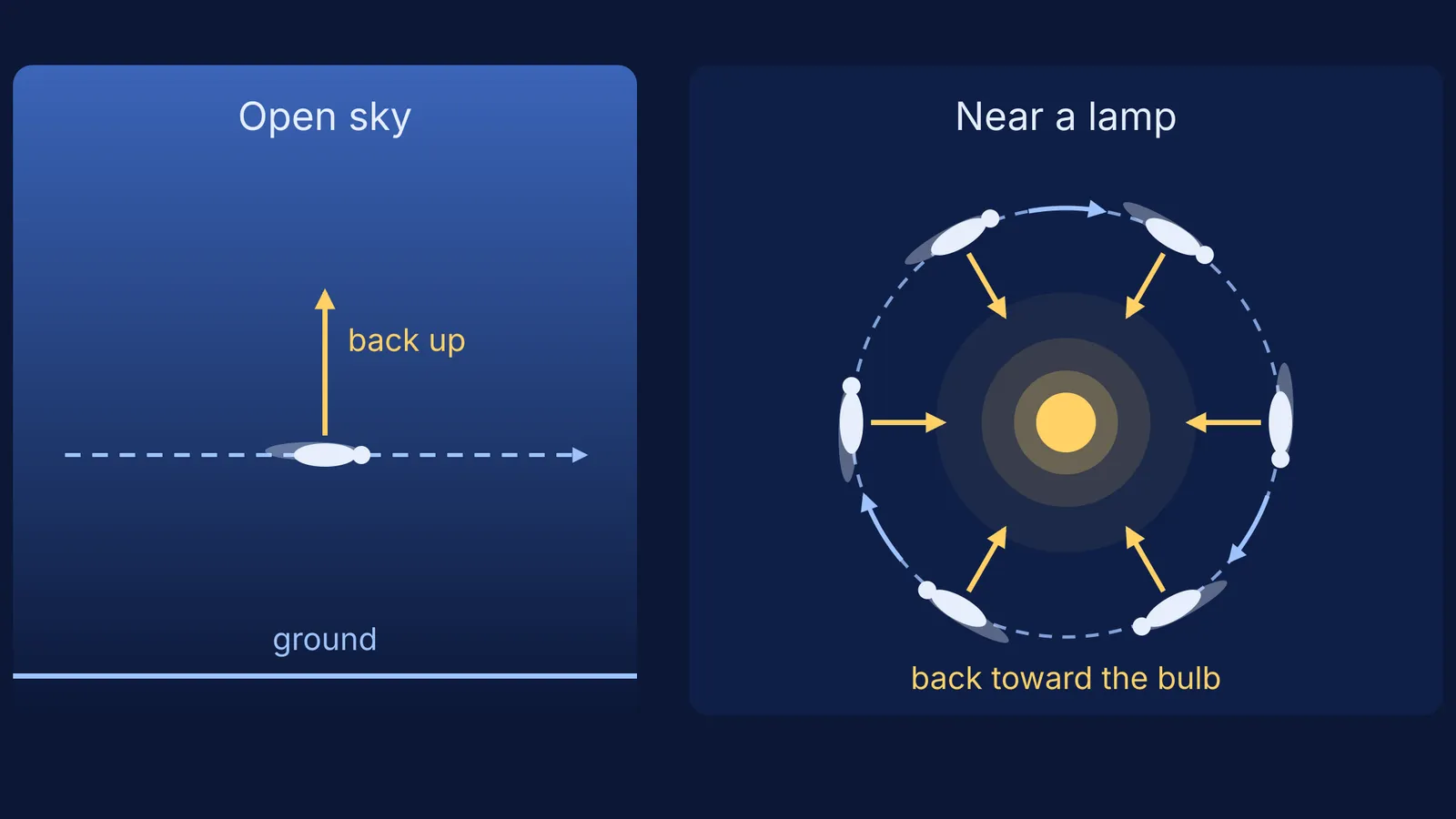
A 2024 study in Nature Communications by Samuel Fabian and colleagues reconstructed insect flights in 3D and found that, contrary to older ideas such as moonlight navigation, insects do not steer straight at the light. They turn their back toward it.
The dorsal light response is a reflex that keeps a flying insect's top side toward the brightest part of its view, which until humans lit up the night was usually the sky (Imperial College London). Near a bright bulb, the brightest point can be beside or below the insect, not above it. Tilting its back toward the bulb led to three behaviours the team recorded: orbiting the light, climbing steeply until they stalled, and flipping upside down and crashing.
The lab tests used dragonflies and moths, not termites, so this is the likely general explanation rather than a termite-specific result. It fits what entomologists see: NC State Extension says swarmers may be attracted to light and readily die on window sills. Our post on why moths fly around lights looks at the same reflex in moths.
Why do winged termites shed their wings?
The wings are only needed for the dispersal flight. A 2026 study in Proceedings of the Royal Society B explains that in most termites, dispersed adults shed their wings before pairing, because wings interfere with communication between females and males. The preprint of the same study describes how alates shed their wings by using the abdomen to push upward on a basal suture, a line near the base of each wing. On the ground, wings hinder movement and can make capture by predators more likely.
Then, in most species, the pair sets off in a tandem run, female in front, male close behind, looking for a nest site. That is why you often find piles of wings and few insects.
What should you do when termites swarm at home?
Switch off outdoor lights and close blinds or curtains; MSU Extension gives this as the best way to deter Formosan subterranean termite swarmers.
Check it is a termite, using NC State's three tests: all four wings the same length and shape, a tube-like body with no pinched waist, and straight, beaded antennae.
Swarmers themselves do not cause structural damage; worker termites do.
If swarmers keep appearing inside, NC State says that is likely a sign of an infestation, so ask a pest-control professional to inspect.
How can you watch a termite swarm like a scientist?
The next swarm is free fieldwork:
Note the time of the first heavy rain and of the first swarm.
Count insects at a lit window and an unlit one for five minutes each.
Watch one insect near the bulb: does it circle, stall or flip?
Next morning, look at the base of a fallen wing with a magnifier to see where it broke off.
Look for pairs walking one behind the other.
To connect this to your syllabus, the Fermi Concept Library has a lesson for every concept in biology, each with its place in the map, so you can see where social insects fit.
Next time the lights fill with wings, you are watching a wedding flight, not an invasion.