

On this page
A termite spends its life eating wood, yet wood is mostly cellulose, the same tough fibre that passes through you undigested (our post on why humans cannot digest cellulose, but cows can explains why). The termite's answer is a crowd of microbes in its hindgut that do most of the chemistry for it, and get a home and food in return. That trade makes termites a textbook example of mutualism.
How do termites digest wood?
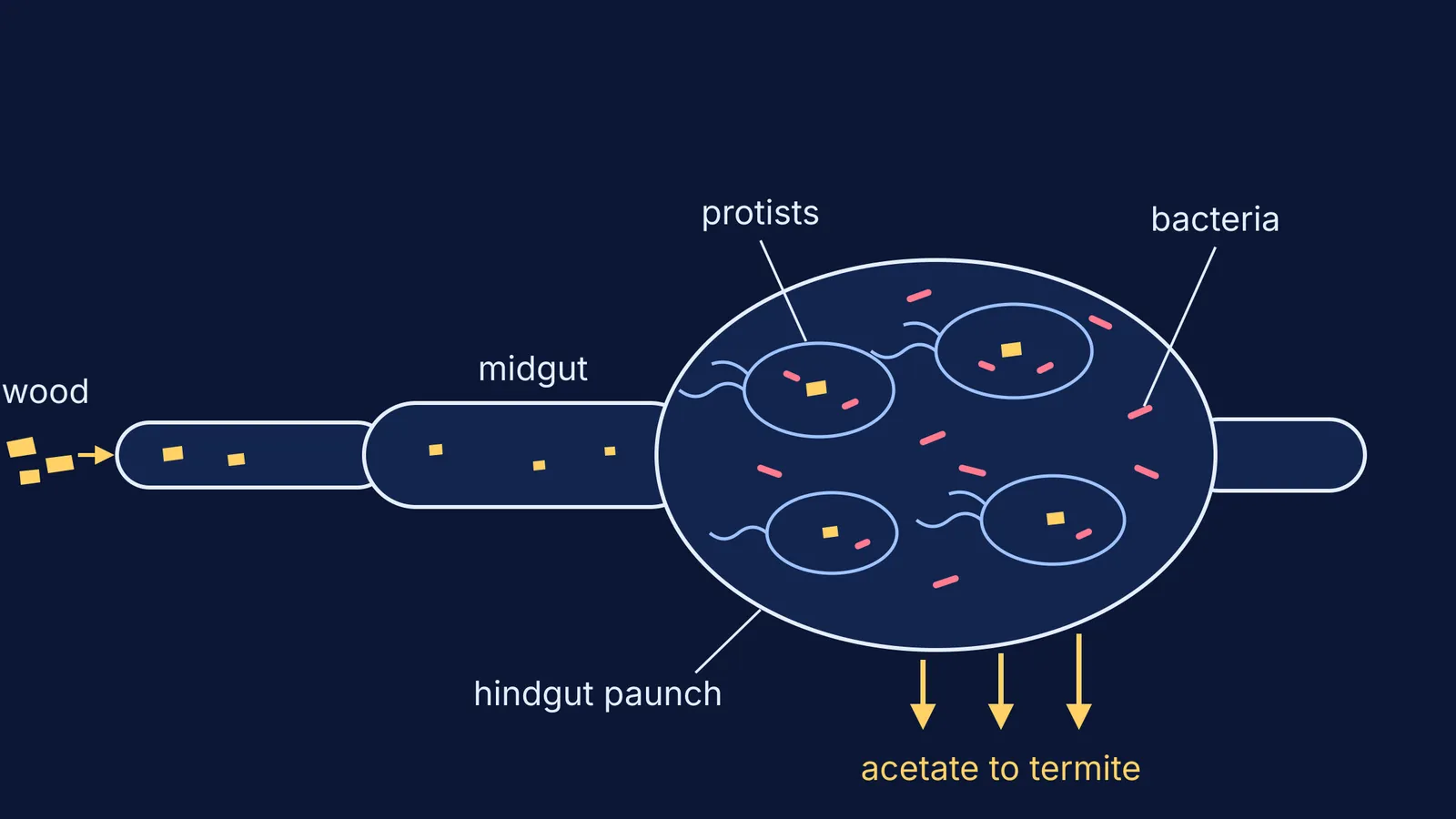
Follow one splinter through a wood-eating termite:
Chewing and the termite's own enzymes. The termite breaks wood into small fragments. It is not completely helpless: in 1998 Watanabe and colleagues reported a cellulase gene of termite origin, so the insect carries its own gene for a cellulose-cutting enzyme.
Into the hindgut paunch. Most of the fibre ends up in an enlarged part of the hindgut packed with microbes. In “lower” termites the major players are cellulose-digesting flagellates, a kind of protist, according to a 2015 review in the Annual Review of Microbiology.
Breakdown and fermentation. Bacteria, archaea and protists break down the plant fibre and ferment the products to acetate and some methane, with hydrogen as a central intermediate, as Andreas Brune summarised in Nature Reviews Microbiology in 2014.
The termite absorbs the acetate. Its tissues oxidise this small fatty acid for energy.
The best numbers on step 4 come from a 1983 study by Odelson and Breznak in Applied and Environmental Microbiology. In the hindgut fluid of the eastern subterranean termite, *Reticulitermes flavipes*, and two other species, acetate made up 94 to 98% of the volatile fatty acids. In *R. flavipes*, the acetate made by the gut microbes could cover 77 to 100% of the termite's respiratory needs. About 85% of that acetate came from cellulose; the rest came from hemicellulose. Acetate turned up in the termite's blood (haemolymph) but not in its faeces, so the insect really does use it. Removing groups of microbes pointed to the protists as the main acetate producers, with bacteria also contributing.
Which microbes live in a termite's gut?
Three groups are worth knowing:
Protists (flagellates). Lower termites carry unique lineages of cellulose-digesting flagellates; higher termites harbour only bacteria and archaea (Brune and Dietrich, 2015).
Free-living bacteria and archaea. In higher termites, which lack the protists, bacteria take over the microbial side of the work. A 2007 study of a wood-feeding *Nasutitermes* termite found a large, diverse set of bacterial genes for breaking down cellulose and xylan, and implicated spirochaetes and fibrobacters (Warnecke and colleagues, Nature).
Bacteria living inside the protists. In *Coptotermes formosanus*, one such bacterium lives inside the protist *Pseudotrichonympha grassii* and accounts for 70% of the bacterial cells in the gut (Hongoh and colleagues, Science, 2008). Its genome shows it can fix nitrogen gas and recycle what are likely the host's nitrogen wastes into amino acids; the authors concluded this system probably underlies the ability of *Coptotermes* to use wood as its sole food.
So it is mutualism nested inside mutualism: bacteria inside protists inside a termite.
Why is the termite and gut microbe relationship mutualism?
Mutualism means both partners benefit, the (+, +) row in the population interactions signs table. Here is the trade:
The termite gets usable energy (acetate) and, as Brune notes, nutrients made by the microbes themselves (Nature Reviews Microbiology, 2014).
The microbes get a constant supply of chewed wood and a sheltered gut to live in. A 2024 review by Gillian Gile adds that the protists are passed from one termite generation to the next by anal feeding (proctodeal trophallaxis), and that the partnership was established in the termites' cockroach ancestors by the late Jurassic (Biological Reviews, 2024).
The classic proof came from L. R. Cleveland, starting with a 1923 paper in PNAS. Termites deprived of their protists starved when fed only wood or cellulose, and could be saved by giving the protists back (summary of Cleveland's work). Gile describes the partnership as “mutually obligate”: each partner depends on the other.
How do you write this in an exam answer?
Use this three-part check for any mutualism, from termites to lichens:
Who gives what? Name each partner and what it supplies.
Who gets what? Name the benefit to each side. If one side gains nothing, it is commensalism, not mutualism.
What happens if you separate them? Give the evidence. For termites, that is Cleveland's experiment.
A worked 3-mark answer: “Termites cannot fully digest the cellulose in wood. Protists and bacteria in the termite's hindgut break cellulose down and ferment it to acetate, which the termite absorbs as its main energy source. In return the microbes receive food and a protected habitat, so both partners benefit (+, +). Termites from which the protists were removed starved when fed only wood.”
If the interaction words still blur together, the Fermi Concept Library gives every concept in biology its own lesson and its place in the map. For practice, the Fermi Problem Library has worked problems with a step-by-step solver that explains the reasoning rather than printing an answer.
Next, read how termites keep their mounds cool.


