On this page
The starch in a chapati and the cellulose in a sheet of paper are both chains of glucose. You can live on the first and not the second, and the reason comes down to one bond. This question turns up in Class 11 biomolecules and in board and entrance exams, so it is worth understanding properly rather than memorising one line.
What makes cellulose different from starch?
Both are long chains of glucose. The difference is how the glucose units are joined.
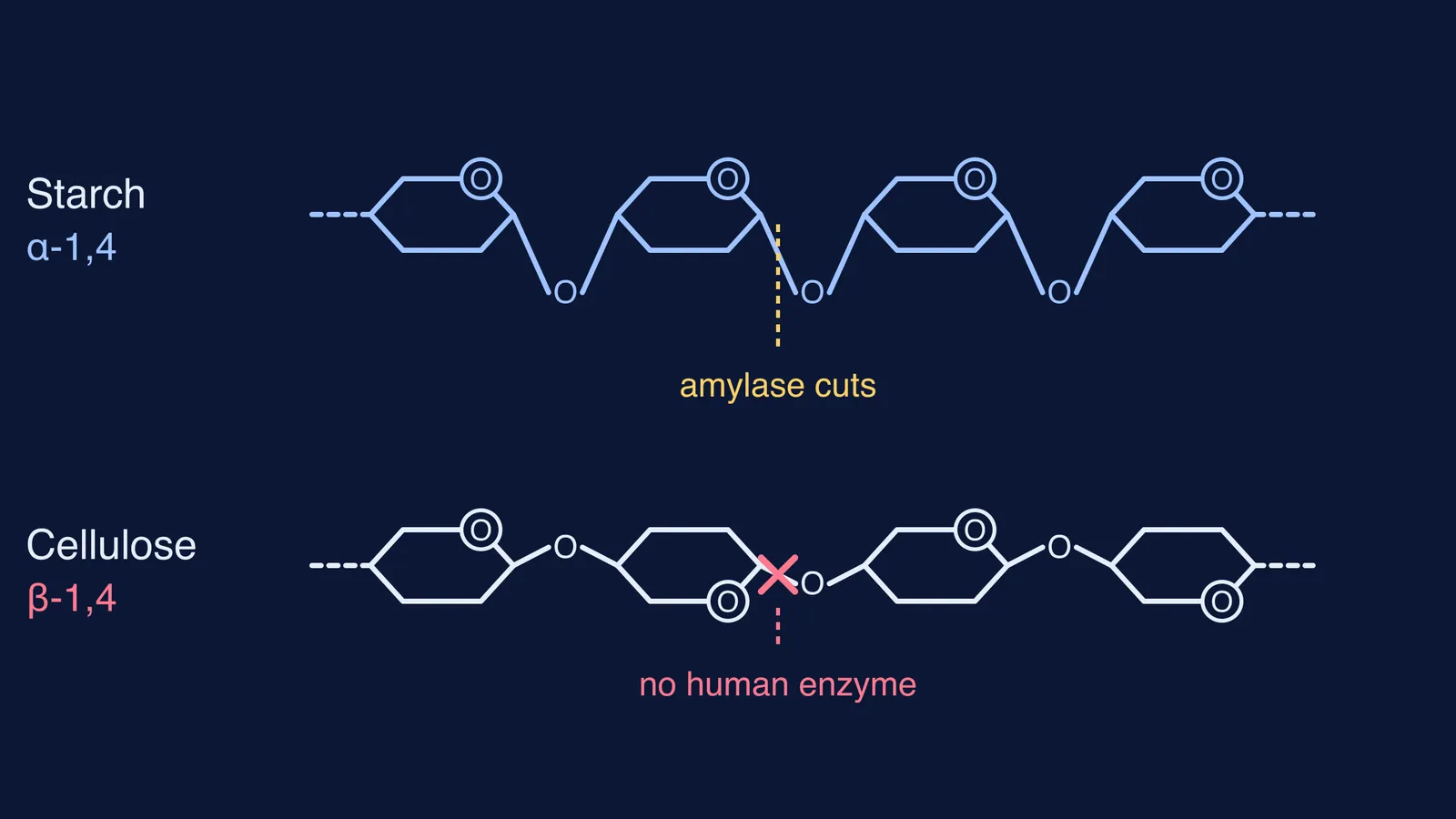
In starch, glucose units are joined by α 1-4 (and, at branch points, α 1-6) glycosidic bonds, according to OpenStax Biology 2e.
In cellulose, glucose units are joined by β 1-4 glycosidic bonds, and every other glucose is flipped over, so the chains run straight and pack tightly, the same OpenStax chapter explains.
That flip is the whole story in miniature. Starch is a fuel store the plant can break down again. Cellulose chains lie straight and side by side, which suits a plant cell wall that has to stay rigid. If the α and β labels still blur together, our post on peptide, glycosidic and phosphodiester bonds sets the three main biological bonds side by side, and why starch turns blue-black with iodine but cellulose does not shows the same shape difference in a lab test.
Why can't humans digest cellulose?
Enzymes are fussy. An enzyme's active site fits one shape of bond, and a near miss is still a miss.
Human digestive enzymes cannot break the β 1-4 linkage in cellulose, while an amylase in saliva breaks starch down into smaller molecules such as maltose and glucose, per OpenStax Biology 2e. The enzymes that do cut cellulose are called cellulases, and our bodies do not make them.
So the cellulose in your sabzi passes through the stomach and small intestine without being broken into glucose. It counts as dietary fibre, but it is not a sugar source for you.
There is a twist. A 2024 study in Science by Sarah Moraïs and colleagues notes that humans, like all mammals, depend on gut microbes for cellulose digestion, and that evidence for cellulose fermentation in the human gut is scarce (Moraïs et al., Science, 2024). The team identified cellulose-degrading ruminococcal bacteria in the gut microbiota of human populations; these were abundant in ancient humans, hunter-gatherers and rural populations but rare in industrialised ones. For exams, the answer stays the same: humans lack cellulase.
How do cows and termites digest cellulose?
They do not do it alone. They give microbes a place to live and live on what the microbes make.
In cows and other ruminants, cellulose is broken down and fermented by anaerobic microbes in the rumen, mostly specialist bacteria with help from protists and fungi, says a 2022 review by Paul Weimer (Weimer, Microorganisms, 2022). The fermentation produces volatile fatty acids, which the review describes as the main nutrient source for the host. The review adds that rumination (chewing the cud) speeds up fibre breakdown.
Termites rely on a mixed community of bacterial, archaeal and eukaryotic gut symbionts that break down plant fibre and ferment the products to acetate, according to a review by Andreas Brune (Brune, Nature Reviews Microbiology, 2014).
Termites are not entirely helpless on their own, though. In 1998, Hirofumi Watanabe and colleagues reported a cellulase gene of termite origin, called RsEG, from the termite Reticulitermes speratus (Watanabe et al., Nature, 1998). Good to know, but the textbook point holds: termites depend heavily on their gut partners.
How do you write this answer in an exam?
Here is a worked answer to a typical 3-mark question: "Why can a cow digest grass but a human cannot?"
Name the bond: in cellulose, β-glucose units are joined by β-1,4 glycosidic bonds.
Name the missing enzyme: humans do not produce cellulase, and amylase acts on the α bonds of starch, not the β bonds of cellulose.
Name the helpers: the cow's rumen holds bacteria, protists and fungi that break down and ferment cellulose; the cow lives on the volatile fatty acids they produce.
Before you submit, check your answer for these common slips:
Writing "cellulose is not made of glucose" (it is; only the bond differs).
Saying the cow itself makes cellulase (its microbes do).
Mixing up α and β, or writing 1,6 for cellulose (that is starch's branch point).
Forgetting the word "hydrolysis" when describing how the bond is broken.
If carbohydrate questions keep costing you marks, go back to the structures before the facts. The Fermi Concept Library gives each biology and chemistry concept its own lesson, so you can revisit glycosidic bonds before moving on. For practice, the Fermi Problem Library has worked problems with a step-by-step solver that explains the reasoning rather than printing an answer.
Next, see how plants and animals store glucose differently in starch vs glycogen.