

On this page
A termite mound looks like a lump of baked mud, but it has the problem every crowded building has: stale air. Their mound uses the Sun and the night instead, through the same convection you meet in school physics.
How do termites keep their mounds cool?
Hunter King, Samuel Ocko and L. Mahadevan studied mounds of the termite Odontotermes obesus within walking distance of the NCBS campus in Bangalore in a 2015 PNAS paper. They instrumented 25 mounds, each at least about a metre tall, according to the open version of the paper.
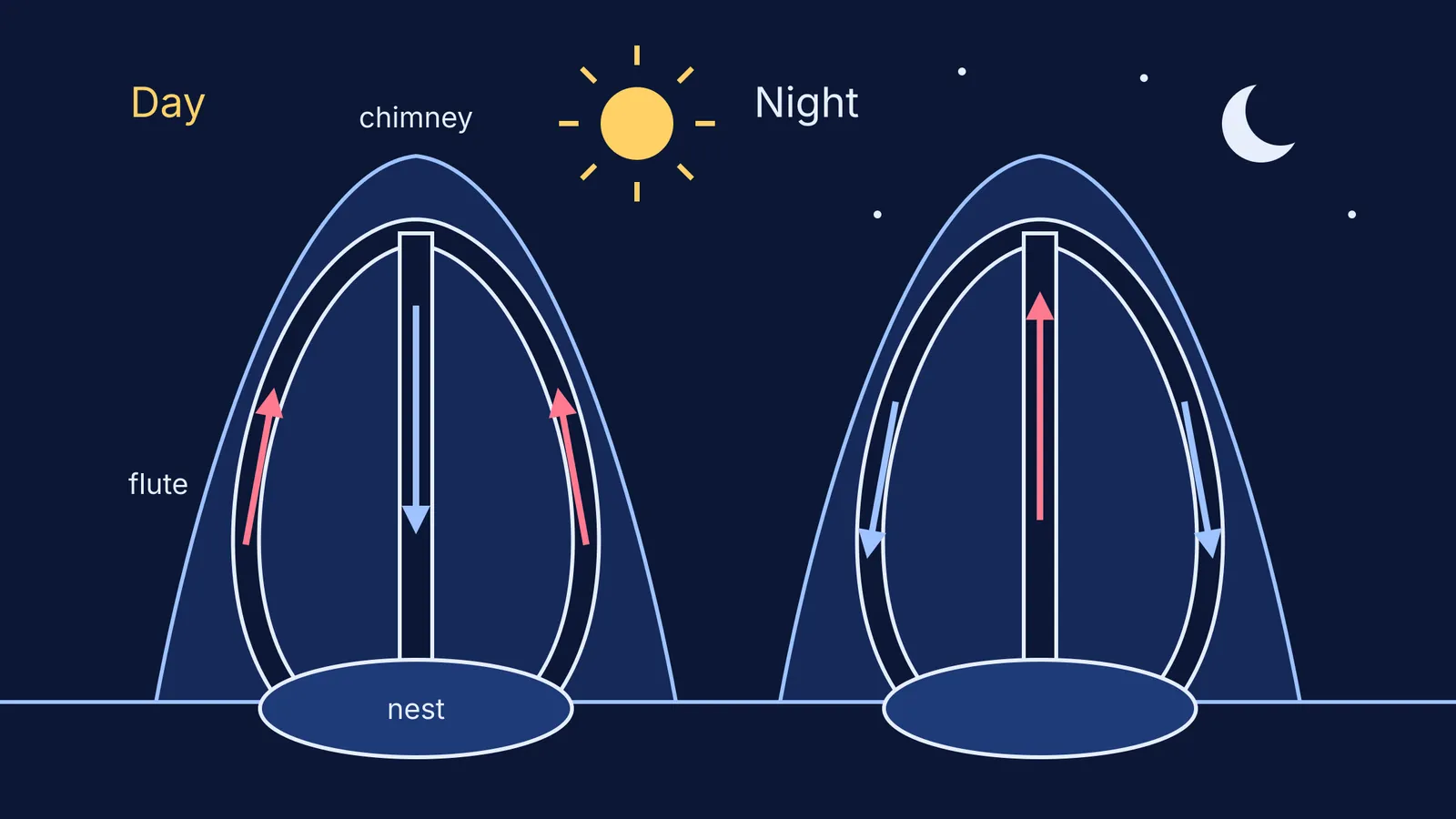
Each mound has two kinds of air passage. Thin vertical conduits run just under the ridged outer wall; the researchers call these flutes. A wide central chimney runs up the middle. Flutes and chimney are connected near the top and near the nest at the bottom, so together they form a loop.
Mounds also damp the outside swing. A 2018 study of Macrotermes natalensis mounds in the southern African savanna by Ndlovu and Pérez-Rodríguez found that internal temperature rose and fell each day with the outside air, but over a much smaller range, and that larger mounds held steadier temperatures than smaller ones.
What happens inside a termite mound during the day and at night?
By day, the thin outer flutes heat up faster than the deeper chimney, as the PNAS paper reports. Warmer air is less dense, so it rises in the flutes and pushes cooler air down the chimney. At night the outer wall cools first, the flutes become the colder side, and the loop runs the other way.
The temperature difference behind this is small. The team used a flute-to-centre difference of about 3 °C in their estimates, and flows were only of the order of centimetres per second, according to the open version of the paper.
The paper also ruled out two other drivers. An abandoned mound showed the same kind of temperature gradients and flow pattern as a live one, so the termites' own body heat is not the main driver. Wind around the mounds, about 0 to 5 metres per second, was judged too weak to push much air through the walls.
The point of the loop is breathing. During the day carbon dioxide built up to nearly 6% in the nest, while the chimney held a fraction of 1%, the paper reports. In a Wyss Institute release, Mahadevan described the mound as working "like a slowly breathing lung, flushing CO2 out once a day."
Is this the same convection you study in physics?
Yes. Convection is heat carried by a moving fluid: warm, less dense fluid rises and cooler, denser fluid sinks to take its place. The sea breeze that blows towards land by day works the same way, with land and sea in place of flute and chimney, and it also reverses at night.
The key idea is uneven heating. Thin walls have little mass to warm, so they change temperature quickly; thick, deep earth lags behind. That lag creates the temperature difference that drives the flow. The same density rule decides what floats, which you can test in this buoyancy and density simulation. If loops like this are hard to picture, the Fermi Simulation Lab has interactive simulations for ideas that are easier to see than to read.
How strong is the push? A worked example
You can estimate the driving pressure with one line of physics. The pressure difference from a warm column of height h is about Δp = ρ g h (ΔT / T).
Air density at 30 °C is about 1.17 kg/m³, from NASA's Earth atmosphere model.
Take h = 1.5 m (the team placed a chimney sensor 1.5 m above ground) and ΔT / T = 3/300 = 0.01, from the values used in the paper.
Δp ≈ 1.17 × 9.8 × 1.5 × 0.01 ≈ 0.17 pascal.
Sea-level air pressure is about 101,300 pascal, from the same NASA model, so the push is under two millionths of it.
That tiny push, forced through narrow and uneven tunnels, explains the slow flows. The authors' own idealised estimate gave about 35 cm/s, roughly 10 times faster than they observed, which they put down to oversimplifying the mound's internal shape.
A three-step check for any convection question
Which part heats or cools faster, and why (thin or thick, sunlit or shaded)?
Where is the air warmer, and so less dense?
Warm air rises there and cool air sinks elsewhere; trace the loop, then flip it for night.
What can buildings learn from termite mounds?
A 2017 follow-up measured mounds of the African termite Macrotermes michaelseni. Details such as carbon dioxide levels differed, but the authors concluded that termite mounds in very different environments harness periodic solar heating for ventilation, working as an "external lung". The Wyss release suggests the same idea could inspire buildings that use daily temperature swings to ventilate themselves.
If convection still feels fuzzy, the Fermi Concept Library gives each physics concept its own lesson, so you can go back to density and buoyancy before trying the next problem.


