

On this page
On warm evenings across India, from balcony tube lights in Bengaluru to porch lamps in Delhi, you have likely watched moths fluttering frantically around bare bulbs. For centuries, folklore claimed insects were fatally attracted to flames, while early naturalists assumed they possessed positive phototaxis, an instinctive drive to fly directly toward illumination.
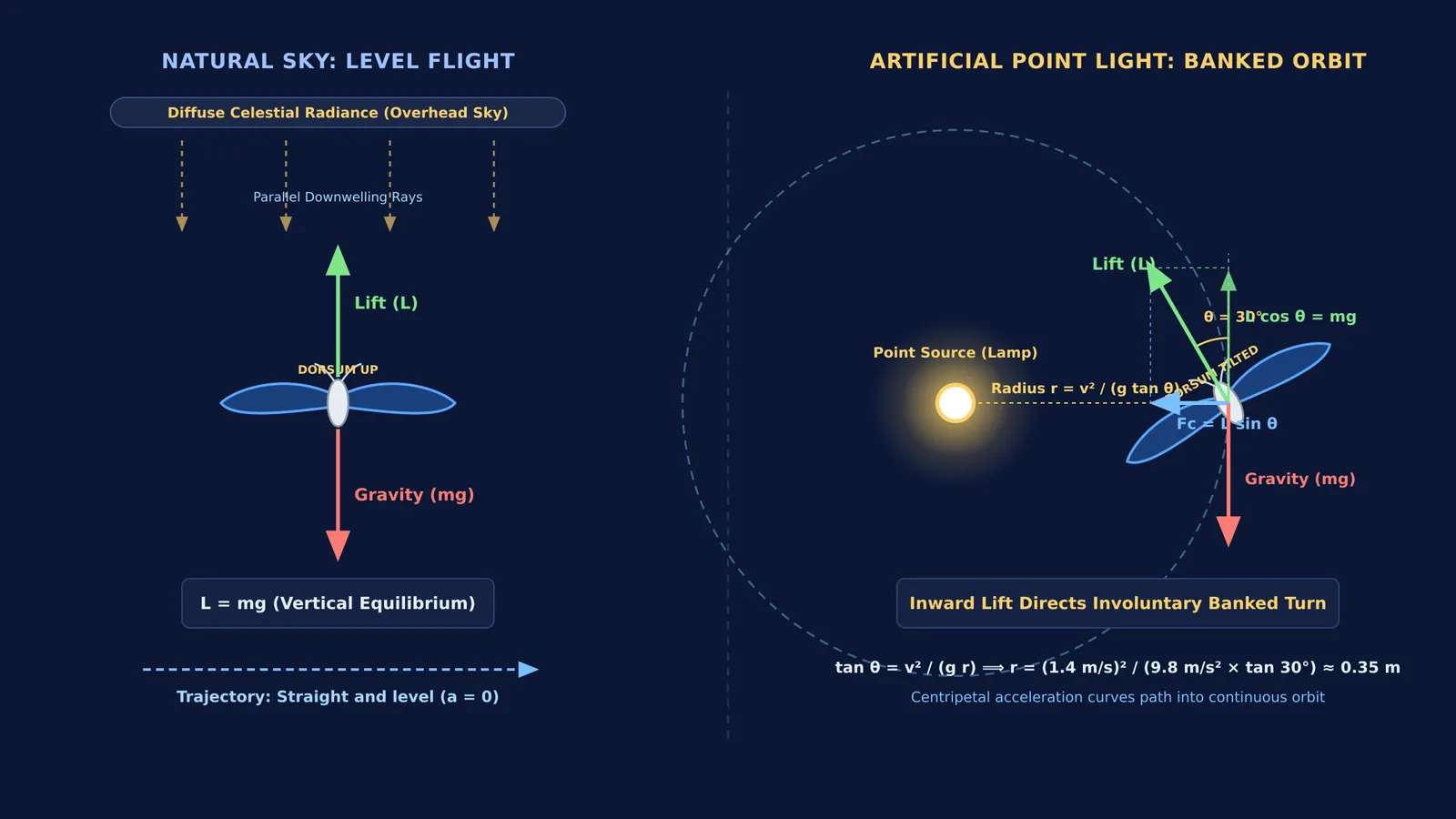
Recent experimental evidence has overturned that assumption. A 2024 study published in Nature Communications by Samuel Fabian, Yash Sondhi, and colleagues demonstrated that nocturnal insects do not steer toward lights at all. Instead, artificial illumination triggers an ancient sensory mechanism called the dorsal light response. The dorsal light response is an innate visual reflex in which a flying insect turns its back toward the brightest hemisphere to maintain an upright flight attitude (Nature Communications). In nature, that hemisphere was always the sky.
Why doesn't the lunar navigation theory explain moth flight?
Before high-speed digital tracking, the dominant explanation was transverse orientation, proposed by Felix von Buddenbrock and examined in Animal Behaviour90015-0) by S. Sotthibandhu and R. R. Baker in 1979. Under this celestial compass model, insects maintain a constant optical angle relative to distant lunar rays to fly straight. Because artificial lamps radiate light outward in spheres, maintaining a fixed angle should theoretically pull the insect inward along a spiral.
However, three-dimensional kinematic tracking disproved logarithmic spirals (Nature Communications). Recording at 500 frames per second with eight infrared cameras in the laboratory and stereo videography in Costa Rica, Fabian and his team observed no long-range steering toward lights. Insects only became trapped within a few metres of a lamp, where they maintained stable circular orbits or suffered aerodynamic stalls.
How does the dorsal light response trap an insect?
Why do insects use light rather than gravity to tell up from down? Because an insect has tiny body mass, the rapid accelerations from its flapping wings overwhelm internal gravity sensors (Nature Communications). Throughout insect evolutionary history, the open sky remained brighter than the ground at night, making visual light the most reliable proxy for vertical orientation.
Near an artificial point source, this orientation reflex triggers three distinct flight errors documented by Fabian and colleagues (Nature Communications):
Orbiting: Passing beside a lamp, an insect rolls its back toward the bulb. Because wings generate aerodynamic lift perpendicular to the body, tilting directs lift sideways, forcing a continuous banked circle.
Stalling: Flying beneath an overhead bulb, an insect pitches upward to face its back toward the light, bleeding airspeed until it stalls.
Inversion: Flying above an upward-directed beam, an insect flips upside down to keep its back illuminated, diving straight into the ground.
Across motion-tracked flight recordings near lamps, insects consistently turned their dorsum toward the light source, flying perpendicular to the rays rather than heading into the bulb (Nature Communications). When researchers placed a diffuse white canopy overhead to restore an even visual ceiling, the insects resumed steady, level flight without orbiting or crashing.
What does insect flight physics teach STEM students?
For students studying mechanics and kinematics, insect flight offers a direct physical demonstration of banked turns. In physics courses, students analyze how an aircraft tilts at an angle θ to direct its aerodynamic lift and navigate a curve, matching the guidance model published in Nature Communications. The exact same mechanical equations govern a moth orbiting a patio light.
Consider the aerodynamic force balance:
Vertical equilibrium: L cos θ = mg, balancing gravity with the vertical component of lift L.
Centripetal force: L sin θ = m v² / r, where forward speed v and orbit radius r define horizontal acceleration.
Dividing these equations yields the standard banking relation: tan θ = v² / (g r).
Rearranging gives the orbit radius: r = v² / (g tan θ). For a moth cruising at v = 1.4 m/s with a bank angle of θ = 30° under gravitational acceleration g = 9.8 m/s² (Nature Communications): r = (1.4)² / (9.8 × tan 30°) = 1.96 / (9.8 × 0.577) ≈ 0.35 metres.
This calculated 35-centimetre radius matches the tight orbits observed around household fixtures. Connecting sensory biology to Newtonian mechanics shows how evolutionary adaptations interact with physical laws. For ideas that are easier to see than to read, interactive simulations in the Fermi Simulation Lab let you adjust speed and bank angles to watch flight trajectories curve in real time. To practice resolving components and circular motion equations, the Fermi Problem Library provides worked problems with a step-by-step solver that explains the reasoning behind each step.
How can we reduce light traps around our homes?
This involuntary trapping severely threatens nocturnal biodiversity. A comprehensive review published in Insect Conservation and Diversity by Douglas Boyes and colleagues documented how artificial night lighting depletes insect energy stores, exposes them to predators, and disrupts nocturnal pollination across ecosystems.
You can take simple steps to protect nocturnal pollinators around your home:
Shield outdoor fixtures: Use fully shielded luminaires that direct beams downward, preventing upward light spill that triggers fatal flight inversions.
Choose warm LED spectrums: Select warm-white or amber bulbs with wavelengths above 500 nm, avoiding blue and ultraviolet emissions below 450 nm, which trigger the strongest dorsal reflex (Nature Communications).
Use timers and sensors: Keep outdoor lights switched off when not needed so nocturnal insects can forage safely.


