On this page
Bite into a green banana and your mouth goes dry, your tongue feels rough, and the pulp sits like chalk. Yet the same kacha kela turns soft and pleasant in a sabzi. Two different molecules explain this, and ripening and cooking deal with them differently.
What makes a raw banana feel dry and chalky?
Two sensations are mixed together. The chalky, floury grain comes from starch. The dry, rough, puckering feel is astringency, which is a sense of touch rather than a taste.
The American Society for Testing and Materials defines astringency as "the complex of sensations due to shrinking, drawing or puckering of the epithelium as a result of exposure to substances such as alums or tannins", as quoted in a 2020 review in the journal Foods. That review explains that tannins bind salivary proteins, especially proline-rich proteins, and form protein-tannin clumps. With those proteins tied up, saliva stops lubricating and friction inside your mouth goes up, so it feels rough and dry.
An FAO report on bananas puts it plainly: green bananas contain "active tannins, the factor that is responsible for the astringency of raw, green bananas".
How much starch is in an unripe banana?
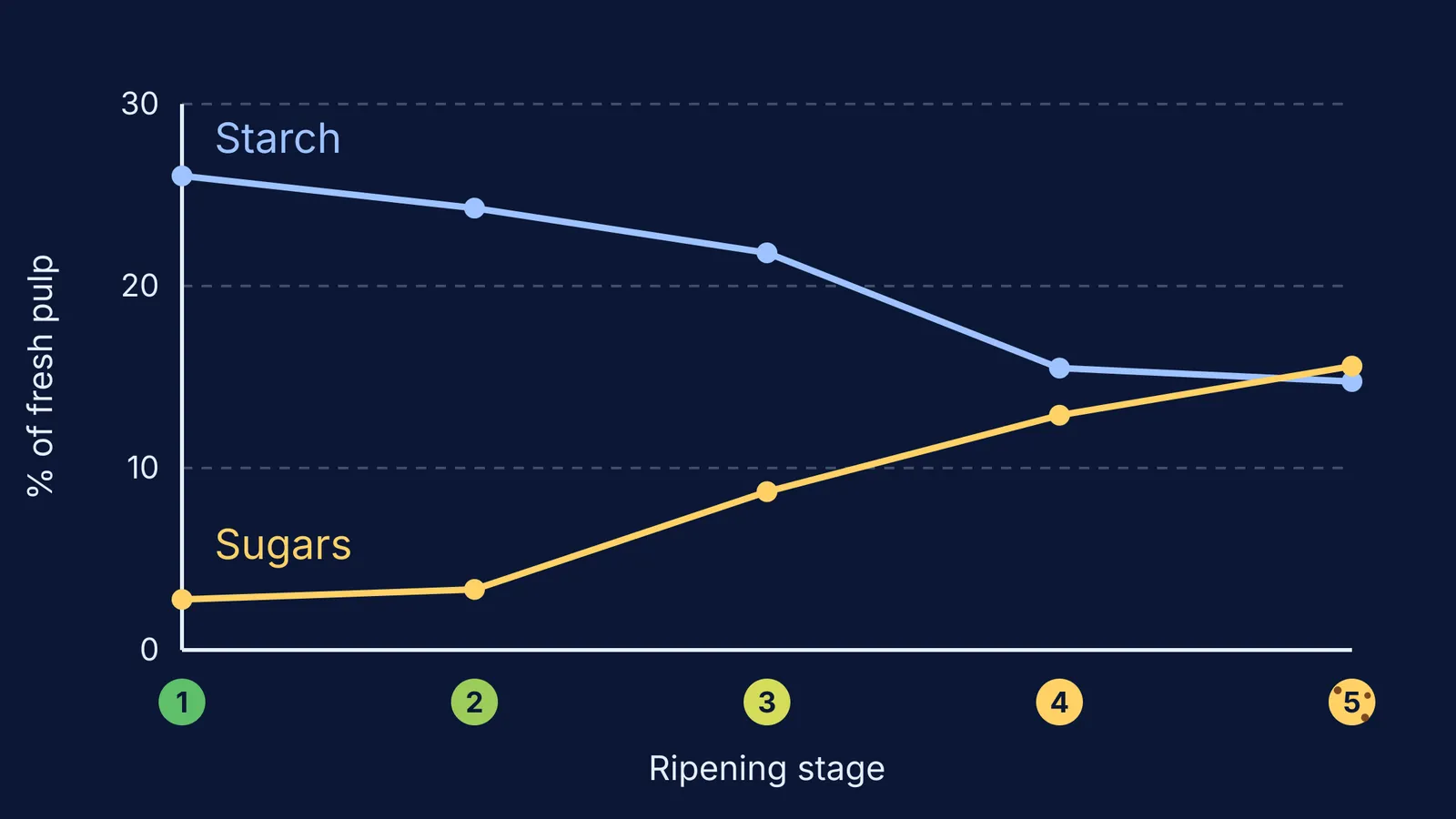
A lot. In a 2020 study in Scientific Reports on Saba bananas, fully green fruit was 26.05% starch by fresh weight. By the time the peel was yellow with brown flecks, starch had fallen to 14.75%, while total sugars (sucrose, glucose and fructose) had risen from about 2.8% to about 15.6%.
Other bananas can swing further. A 2019 review in Frontiers in Plant Science reports that bananas at the usual commercial harvest stage hold 12-35% starch, and late in ripening the figure usually ranges from 15% down to less than 1%. Sugars can reach up to 20% of the pulp's fresh weight, and sucrose makes up about 80% of them.
Enzymes do the switching. The same review explains that ethylene, the ripening hormone, regulates starch-degrading enzymes such as beta-amylases, phosphorylases and debranching enzymes, which cut the long starch chains down to sugars. For why the plant stored starch in the first place, read why plants store starch instead of glucose. Ripening can also be forced, which is the subject of our post on why calcium carbide ripening of mangoes is banned in India.
What happens to the tannins as a banana ripens?
They get locked away. Mura and Tanimura (2003) measured about 103 mg of polyphenols per 100 g of mature green banana pulp. Roughly 60% were very large proanthocyanidin molecules that caused astringency, and these disappeared during ripening, which the authors linked to polymerisation into insoluble forms. Tannins that cannot dissolve cannot grab your saliva proteins, so the dryness fades.
Work on the notably astringent Rastali banana found the same pattern: tannin content fell as the fruit matured and the tannin-storing cells became less visible (Ding and Tee, 2018). Tea gets its rough edge from the same family of molecules; see why tea turns bitter.
Why doesn't cooked raw banana taste chalky?
Cooking changes the starch completely. Raw starch sits in tight, ordered granules. Heated in water, the granules soak up water, swell and lose that order; this is called gelatinisation. Native green banana starch began to gelatinise at about 69°C in a 2018 study in Food Technology and Biotechnology, well below the 100°C of boiling water.
Cooking softens the tissue too. Qi, Moore and Orchard (2000) found that banana and plantain pulp lost firmness rapidly in the first 10 minutes in water above 70°C, as pectin dissolved and cells came apart.
The tannins are a different story. Researchers at Bharathiar University in Coimbatore pressure-cooked unripe Monthan bananas and measured more tannins in the extract afterwards, not fewer (Sasipriya and colleagues, 2014). The authors suggest heat may release phenolics bound to cell walls. That study measured tannins chemically, not taste, but it means cooking should not be counted on to remove them.
Try it: a ripening taste test at home
Buy four or five green bananas from the same bunch and keep them at room temperature.
Before tasting, write predictions: how chalky, how dry and how sweet, each out of 5.
Taste a thin slice of raw green banana, then a slice boiled for 10 minutes. Score both.
Put a drop of iodine solution on a separate slice you will throw away. Blue-black means starch. Never eat a slice with iodine on it.
Repeat when the peel turns greenish yellow, and again when it has brown flecks.
Compare: chalkiness should track the iodine colour, sweetness should rise as starch turns to sugar, and dryness should fade as tannins become insoluble.
A result that misses your prediction is the useful part: ask which molecule you got wrong. If amylase, gelatinisation or polysaccharide still feel hazy, the Fermi Concept Library has a lesson for every concept in chemistry and biology, and Fermi's AI tutor can go through your results with you, checking your understanding as it goes.
Next time a green banana dries your mouth, you will know it is two molecules at work, and which one the kitchen can fix.