On this page
Every student learns that ammonium salts behave like potassium salts. In 1903 A. E. H. Tutton put numbers on that likeness. He grew crystals of ammonium sulphate and measured twelve properties against the sulphates of potassium, rubidium and caesium. His paper, "Crystallised Ammonium Sulphate and the Position of Ammonium in the Alkali Series", is in the Journal of the Chemical Society, Transactions, volume 83, pages 1049 to 1074 (scan on the Internet Archive). The paper gives his name as Alfred Edwin Howard Tutton, D.Sc., F.R.S. Its answer: ammonium sits in the alkali series "immediately after rubidium".
Why compare ammonium with the alkali metals?
Tutton had already measured the crystals of K₂SO₄, Rb₂SO₄ and Cs₂SO₄, and many double salts of the same three metals. Across all that work, he wrote, "the entire morphological and physical properties of the crystals follow the order of progression of the atomic weights". K, then Rb, then Cs, every time.
NH₄⁺ is not a metal. It is five atoms held together by covalent bonds (our post on why all four N–H bonds in the ammonium ion are identical explains its shape). Yet it forms salts that crystallise in the same form as potassium salts. That is why it gets in the way in salt analysis: ammonium salts also give a yellow precipitate with sodium cobaltinitrite, so NH₄⁺ has to be removed before you test for K⁺ (see how Adie and Wood turned the cobaltinitrite test into a measurement of potassium). Tutton asked where, exactly, this ten-atom group fits in the list.
How did Tutton make and check his crystals?
Ammonium sulphate is "distinctly hygroscopic". On a damp day the crystal faces turned moist on the goniometer within hours, so he grew his crystals slowly from saturated solution in cold, dry weather. He also noticed that the saturated solution "does not wet metallic or other hard surfaces, but rolls about over them in spherical drops resembling globules of mercury".
He checked purity by weighing the sulphate as BaSO₄: 1.8295 g of crystals gave 3.2382 g of barium sulphate, which he worked out as 60.77% SO₃ against 60.61% calculated. For solubility, 55.8291 g of saturated solution at 8.2 °C left 23.7068 g of dry salt, so 100 g of water held 73.8 g. An older value by Alluard, read at 8.2 °C, gives 73.17.
Where does ammonium sulphate fall on solubility?
Tutton's summary table: "100 c.c. of water at the ordinary temperature dissolve 10 grams of K₂SO₄, 44 grams of Rb₂SO₄, 74 grams of (NH₄)₂SO₄, or 163 grams of Cs₂SO₄." In grams, ammonium sits between rubidium and caesium, nearer rubidium.
Here is a point the paper does not make. Divide by the molar masses (174.25, 266.99, 132.13 and 361.87 g/mol) and you get 0.057, 0.165, 0.56 and 0.45 mol. Counted in moles, ammonium sulphate is the most soluble of the four. Its light formula mass makes the gram figure look modest. So "position in the series" depends on the units you choose, which is a good reason to check them in any trend question.
Worked example: how big is NH₄⁺ compared with K⁺ and Rb⁺?
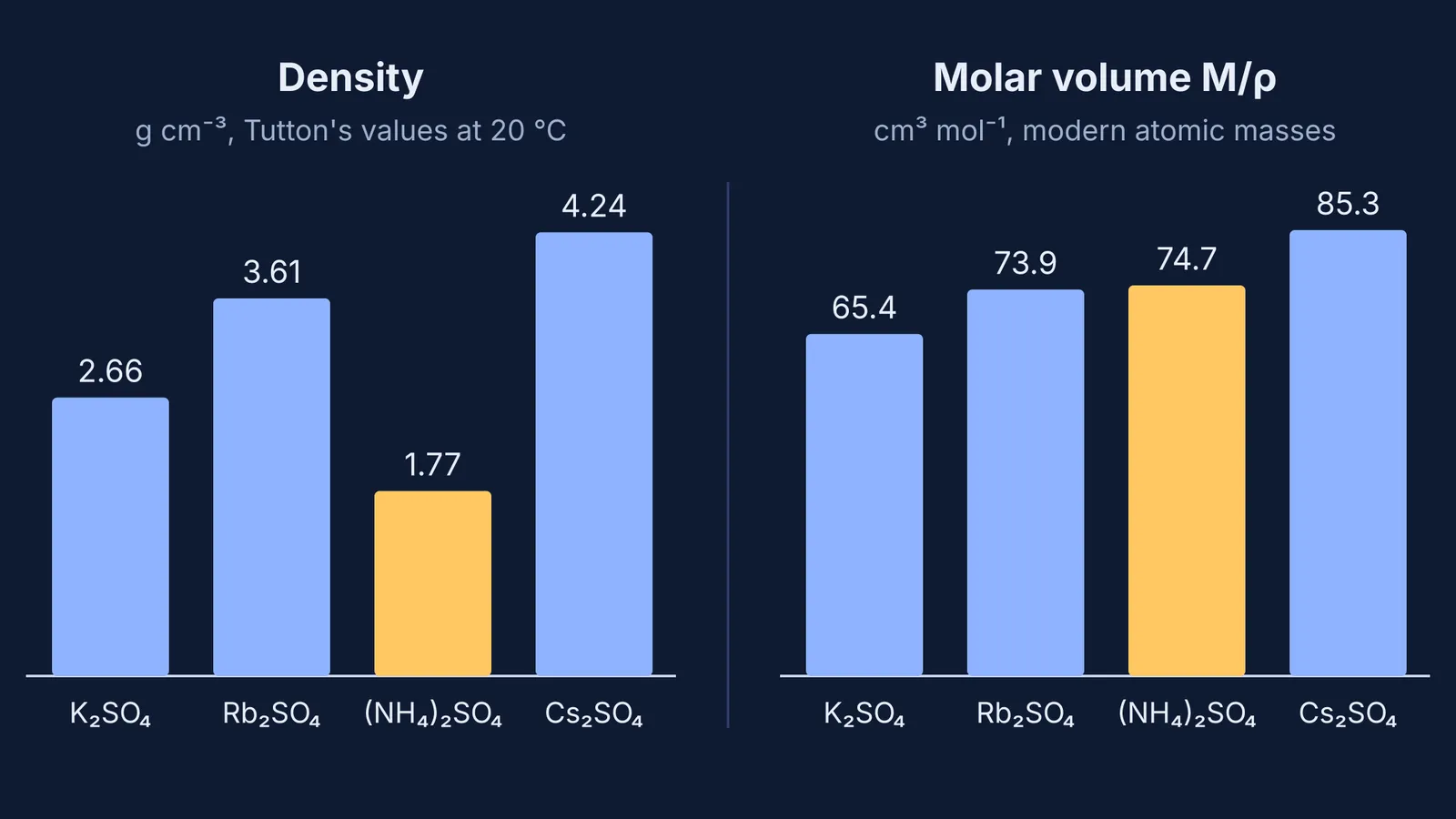
The cleanest result in the paper is the molar volume, the volume one mole of the solid occupies: V = M/ρ. Tutton measured the density of ammonium sulphate as 1.7687 g cm⁻³ at 20 °C, and wrote V = 132/1.7687 = 74.63.
Take his densities (g cm⁻³): K₂SO₄ 2.6633, Rb₂SO₄ 3.6113, (NH₄)₂SO₄ 1.7687, Cs₂SO₄ 4.2434.
Use modern molar masses: 174.25, 266.99, 132.13 and 361.87 g/mol.
Divide. K₂SO₄: 174.25/2.6633 = 65.43 cm³ mol⁻¹. Rb₂SO₄: 73.93. (NH₄)₂SO₄: 74.71. Cs₂SO₄: 85.28. Tutton's figures (65.33, 73.77, 74.63, 85.17) are about 0.1 lower because he used older atomic masses.
Subtract the potassium value. Swapping K for Rb adds 8.51 cm³ mol⁻¹, K for NH₄ adds 9.28, and K for Cs adds 19.85. Tutton gives 8.4, 9.3 and 19.8.
Each formula unit has two cations, so halve these: about 4.3 cm³ mol⁻¹ extra per Rb⁺, 4.6 per NH₄⁺ and 9.9 per Cs⁺, compared with K⁺.
The four salts have the same crystal form and the same anion, so the difference in volume tracks the room the cation takes up. On that measure NH₄⁺ is a little bigger than Rb⁺ and much smaller than Cs⁺.
Notice the twist. Ammonium sulphate is the lightest of the four solids (1.77 against 2.66 for K₂SO₄), yet it has the second-largest molar volume. A low density with a low molar mass does not mean a small ion. Light but big: that is the point about NH₄⁺.
Tutton found this "surprising": two potassium atoms replaced by "the ten atoms of the ammonium groups" made the crystal only slightly larger than rubidium did. He suggested either that the atoms have room to move inside the molecule, or that the molecules are loosely packed. Remember the date. X-ray crystallography arrived about a decade later, so his "structural units" and "distance ratios" are not the lattice constants you meet in unit cell density problems.
Where does the ammonium ion break the pattern?
Not everything fits. When rubidium or caesium replaces potassium, the crystal angles shift in a consistent direction. With ammonium, 18 of 29 angles moved "in the contrary sense", 8 moved the same way and 3 did not change. The average angle change was 0°9′ for rubidium, 0°14′ for ammonium and 0°16′ for caesium.
Cleavage differs too. K, Rb and Cs sulphates split along two planes, the better one parallel to {010}. Ammonium sulphate showed "no traces" of that cleavage, which Tutton put down to "the very different atomic arrangement" of the NH₄ group.
His summary: "in the cases of nine out of the twelve properties", ammonium sulphate stands "between rubidium and cæsium sulphates and very close to the rubidium salt". Those nine include solubility, molar volume, refractive indices and molecular refraction. In the other three (the angles, the axial ratios and the specific refraction), "the specifically different character of the ammonium radicle ... asserts itself".
How is this tested in exams?
Class 11 periodic trends: down group 1, ionic size grows, and for these sulphates density and molar volume rise from K to Cs. NH₄⁺ behaves as a large singly charged cation, close in size to K⁺ and Rb⁺.
Class 11 Some Basic Concepts: V = M/ρ, and gravimetric percentage checks like Tutton's BaSO₄ weighing.
Practical chemistry: why NH₄⁺ interferes with tests for K⁺.
To see how ionic size, density and lattice ideas connect across the s-block, the Concept Library covers every concept in chemistry, each with its own lesson. For timed practice on trend and mole questions, Fermi Test Prep is built for JEE Main and Advanced preparation, with an AI tutor.
Quick checklist
Tutton, 1903: (NH₄)₂SO₄ sits "immediately after rubidium" in the alkali sulphate series.
Molar volumes: K 65.4, Rb 73.9, NH₄ 74.7, Cs 85.3 cm³ mol⁻¹ (modern masses).
NH₄⁺ adds slightly more volume than Rb⁺ and much less than Cs⁺.
By mass, solubility puts NH₄ between Rb and Cs; by moles it is the most soluble.
Crystal angles and cleavage still show that NH₄ is a group, not an atom.