On this page
A pakora straight out of the kadhai crackles when you bite it. Pack it in a steel dabba for later and it turns soft and leathery. Nothing went wrong with the batter: water inside the pakora is moving to where it does the most damage, and how you store it decides how fast.
What is inside a freshly fried pakora?
A fried pakora has two zones. Hot oil boils water out of the batter at the surface, leaving a dry, porous crust, while the onion, potato or spinach inside stays hot and full of water. Our explainer on why deep frying makes food crispy shows how that crust forms.
The crunch depends on that crust staying dry, and it does not take much water to ruin it. Food scientists measure this with water activity, which the US Food and Drug Administration defines as the ratio between the vapour pressure of a food and that of pure water under the same conditions; pure water scores 1.
In a 1981 study, Katz and Labuza tested potato chips, popcorn, puffed corn curls and saltine crackers with sensory panels and a texture machine, and found the point where the panels judged them unacceptable generally fell between a water activity of 0.35 and 0.50. That is still a long way from wet, which is why a pakora can feel soggy without looking damp.
Why do pakoras become soggy after some time?
Two things happen at once.
First, water moves outwards. The core is wet and the crust is dry, so water spreads from where there is a lot of it to where there is little. A frying patent assigned to Aviko describes this for uncoated deep-fried products: they lose their crispness and become soft, tough and sticky because of moisture migrating from the inside into the dry, crispy crust. Food writer Kenji López-Alt, quoted in a 2016 NPR story on the double fry, described the same thing: "Moisture in the center of the food migrates to the surface after the food cools and the surface gets soggy again."
Second, that water changes the crust itself. A crisp crust is glassy: its starch is rigid, so it snaps. Water acts as a plasticiser, slipping between the starch chains and making them flexible, so the crust bends instead of breaking. In a 2021 conference study, Oloruntoba, Mba and Ngadi fried batter samples at 180°C for 3 minutes and held them at 30 to 50°C for 5 to 30 minutes. Samples with more moisture were less crisp and had a lower glass transition temperature, which they put down to the plasticising effect of water.
Why does a closed box make pakoras soggy faster?
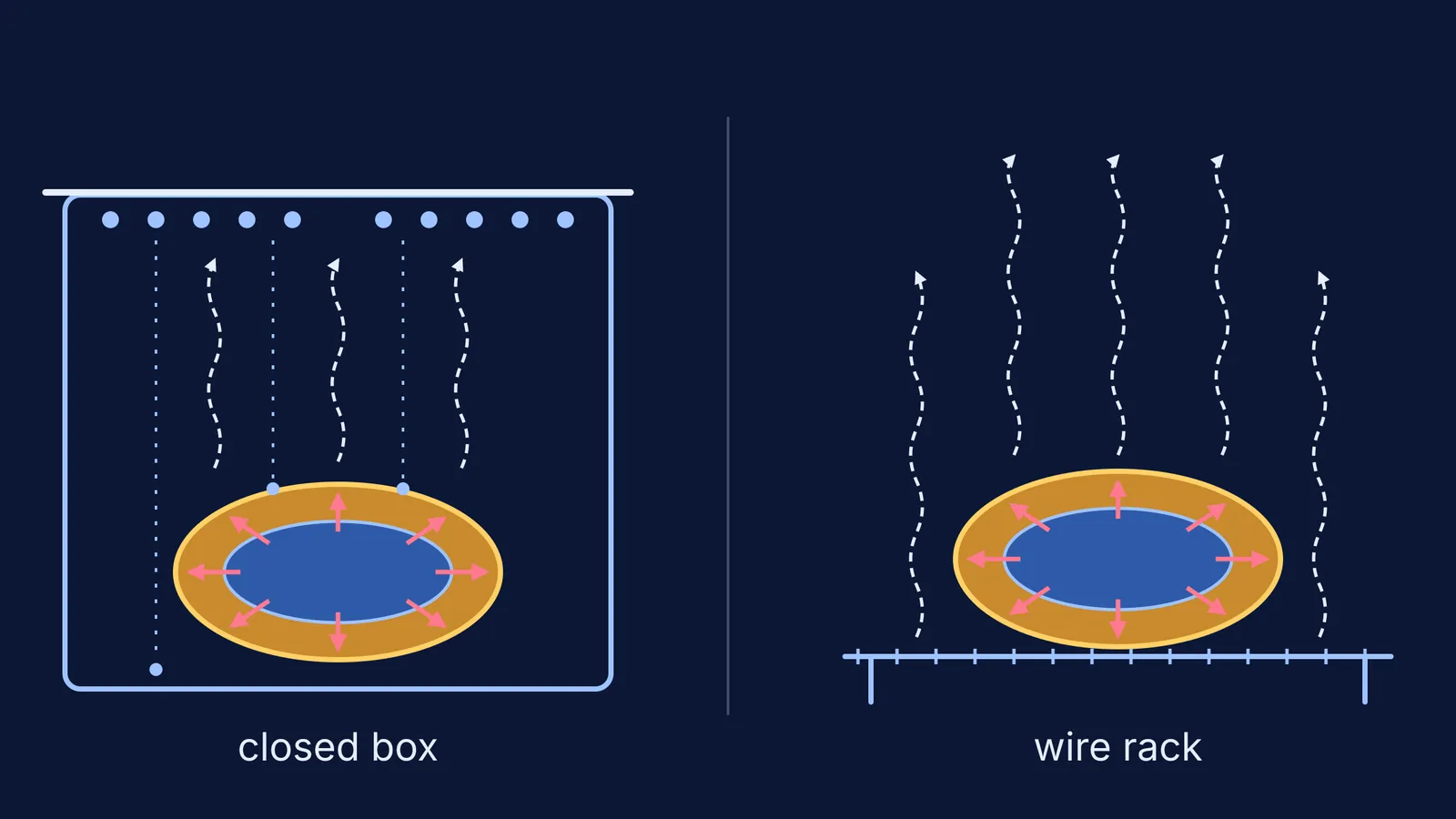
A hot pakora keeps giving off steam after it leaves the oil. In open air the vapour drifts away; inside a closed box the air fills up with it.
The lid is cooler than the pakoras. The US National Weather Service defines the dew point as the temperature to which air must be cooled to reach saturation. When the steamy air touches the lid and cools below its dew point, the vapour condenses into droplets, which drip back onto the food. It is the same physics as why a cold glass of water gets wet on the outside.
The humid air also stops the crust drying out, so water arriving from the core stays there. A flat plate does a smaller version of this underneath: steam is trapped against the plate and softens the bottom first.
Wire rack, paper towel or closed box: which keeps pakoras crisp?
Here is how the common options compare, from crispest to softest:
Wire rack in open air. Air reaches every side, so steam leaves from the top and the bottom instead of collecting and condensing around the crust. Moving air carries vapour away faster still, for the same reason clothes dry faster on a windy day.
Paper towel on a plate. The towel soaks up surface oil, but once it is damp with steam the bottom of the pakora sits on a wet layer. Use it for a minute, then move the pakoras to a rack.
Closed box, foil or a covered dabba. Warmest, but the softest crust. If you must carry pakoras, let them cool on a rack first and leave the lid slightly open.
Already soft? Reheat them uncovered on a hot tawa or in an oven to drive water out of the crust again, the idea behind the double fry.
Try it: a three-plate test in your kitchen
Predict which will be crispest after the chai is finished, and write it down.
Put one pakora on a wire rack, one on a paper towel and one in a closed steel box.
Later, look under the lid for droplets, then press and bite each one.
Explain each result with two ideas: water moving from core to crust, and steam condensing where it is trapped.
If dew point still feels slippery, the Fermi Concept Library has its own lesson for each concept in physics and chemistry, and Fermi's AI tutor checks your understanding as it goes.