On this page
Drop a pakora into a kadhai of hot oil and it fizzes at once. Each bubble is water from the batter turning into steam and leaving. The crisp shell you bite into is what the food looks like once that water has gone. It is evaporation, boiling and latent heat, straight from class.
Why does deep frying make food crispy?
Water boils at 100 °C at sea level (Engineering ToolBox). Cooking oil can be heated well past that. Our post on the smoke point of oil explains where its upper limit comes from.
When wet food meets oil at 150-180 °C, the two hottest settings in the study below, its surface heats to 100 °C quickly. Surface water then boils off as fast as heat arrives, leaving a layer that is dry, full of small holes and rigid. Dry and porous is what "crisp" means: the crust snaps instead of bending.
A 2025 study in Nature Communications filmed this happening inside wheat dough using fast synchrotron X-ray tomography (Verma et al., 2025). The authors write that the structure of fried foods forms in part "due to the rapid phase conversion of water to steam which causes gas cells to form and fill with steam."
What happens to food in the first minute in hot oil?
The same X-ray study measured temperatures inside dough fried at 180 °C (Verma et al., 2025):
Between 19 and 23 seconds, the crust sat at about 100 °C. Heat was going into boiling water.
As the crust lost its water, its temperature climbed, reaching about 135 °C by the end of frying.
The core stayed near 100 °C, because it still held enough water, with steam trapped inside.
A distinct crust-like layer appeared after 34 seconds of frying.
That plateau is latent heat at work. Our explainer on why latent heat of vaporisation is larger than latent heat of fusion shows why that step takes so much energy.
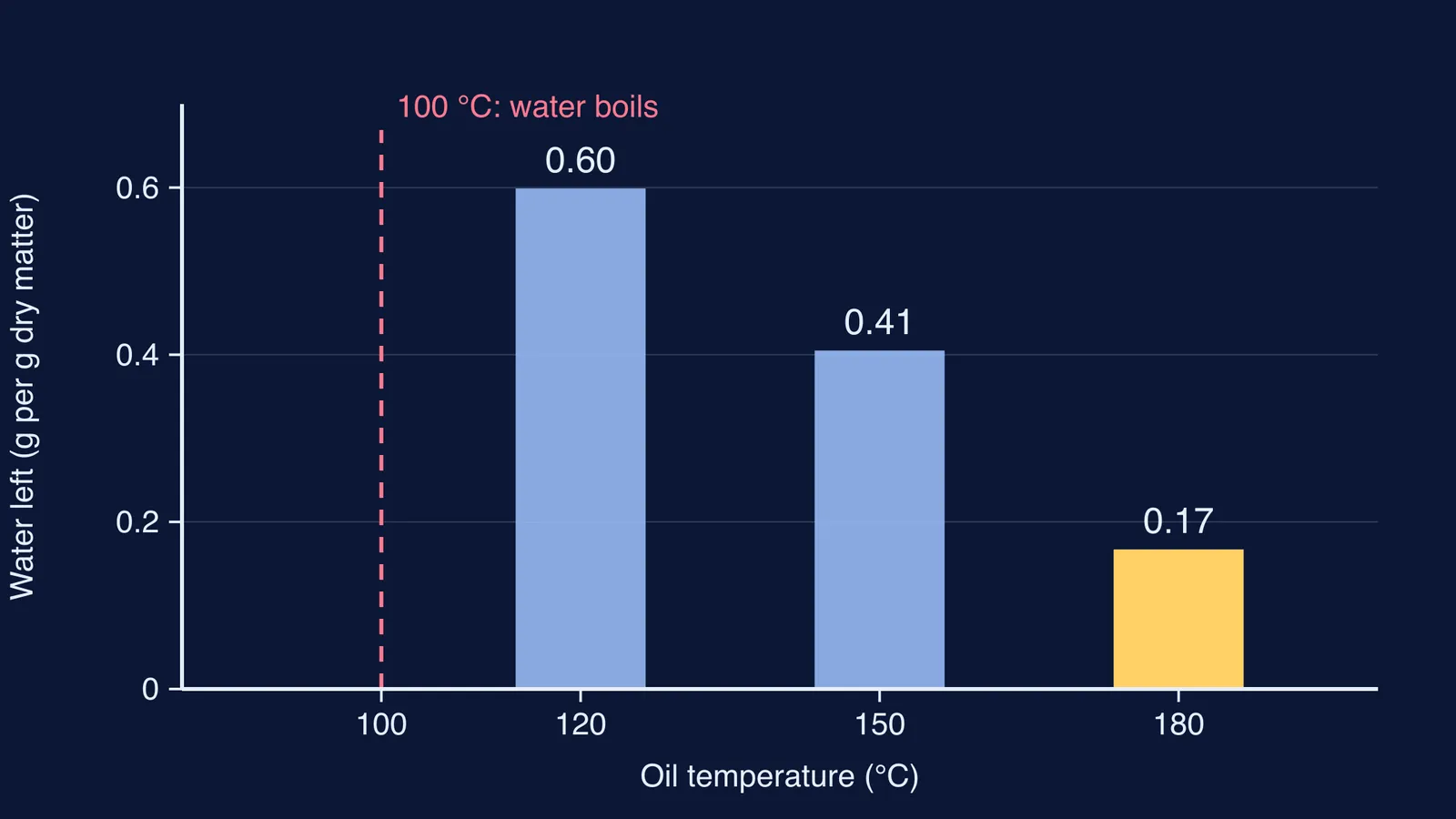
Temperature made the difference. After 60 seconds, dough fried at 180 °C held about 0.17 g of water per gram of dry matter, against about 0.41 g at 150 °C and 0.60 g at 120 °C (Verma et al., 2025). At 120 °C the inside of the dough never went above 95 °C, so the water inside never reached its boiling point.
How much energy does it take to dry out the crust?
Try this in your notebook. Turning water at 100 °C into steam takes about 2256 kJ per kilogram (Engineering ToolBox), or 2.256 kJ per gram.
Suppose a batch of pakoras has to lose 20 g of water to form its crust (an assumed figure, chosen for easy arithmetic).
Energy needed: 20 g x 2.256 kJ/g = 45 kJ, just for the change of state.
If you want that to happen in 60 seconds, the oil has to deliver 45 kJ / 60 s = 0.75 kW into the food.
Double the batch and you need double the energy in the same time. The oil cools, boiling slows, and the pakoras can turn out soggy.
That is why overcrowding a kadhai hurts crispness.
Why do fried foods soak up oil?
While steam is pushing out of the pores, its pressure keeps oil out. The X-ray study found that most of the oil uptake happened during cooling, after the food left the fryer (Verma et al., 2025). The authors found capillary action in the small crust pores was the main driver, with condensing steam adding to it once the inside dropped below 100 °C.
Hotter oil also leaves openings in the crust's surface, so more oil can get in. Final oil content was 14.4% at 180 °C, 12.2% at 150 °C and 1.3% at 120 °C, though at 120 °C the water inside never boiled.
There is also a top limit for crispness. In a study of potato fries, crispness rose as the crust became more porous with oil up to 180 °C, then fell again above it. The authors put this down to a more bendy crust, possibly because sugars break down at very high temperatures (van Koerten et al., 2015).
How do you get crisp pakoras at home?
A checklist (have an adult nearby whenever you use hot oil):
Pat wet food dry first. Surface water soaks up heat before a crust can form.
Fry in small batches. That keeps the oil hot enough to keep boiling water out.
Watch the bubbles. Vigorous fizzing means water is still leaving.
Lift and drain straight away. Most oil gets in while the food cools, so shake off surface oil and drain on a rack.
Hotter is not always better. Above about 180 °C, potato crusts got less crisp, and the oil gets closer to its smoke point.
Boiling and evaporation are easier to picture when you can watch them. The Fermi Simulation Lab has interactive simulations for ideas that are easier to see than to read. If this left you curious about bubbles, read why small bubbles appear in water before it boils.