On this page
On a foggy January morning in Delhi or Lucknow, you step out of the blanket and your body starts to tremble, teeth clicking. Your brain decided that, because those small, fast movements are a heater. It is a clean example of Class 11 thermoregulation, and a neat energy-and-power problem too.
What actually happens when you shiver?
Shivering is the rapid, involuntary contraction of skeletal muscles to produce heat. A review by François Haman and Denis Blondin in the journal Temperature calls shivering skeletal muscle "the most important contributor of heat production in cold-exposed adult humans".
The same review describes two patterns running together. Continuous shivering is a low-level tremor at 8 to 10 contractions per second (8-10 Hz), using about 2-5% of a muscle's maximum force. Burst shivering adds stronger pulses, about 7-15% of maximum, once every 5 to 10 seconds (0.1-0.2 Hz). As your skin and core cool, the review notes, shivering grows mainly in the trunk and upper-leg muscles, while the arms and lower legs contribute little.
Why heat? Use the first law of thermodynamics. Lifting a bag turns some of your muscles' chemical energy into work on the bag. Shivering moves nothing outside your body, so that energy stays in you as heat. A 2005 study in The Journal of Physiology describes shivering as "a muscle producing only heat" and found that muscle glycogen, the sugar stored inside muscles, supplies most of the extra fuel as shivering gets stronger.
Why do your teeth chatter when you are cold?
Your jaw muscles are skeletal muscles too, so the shivering command reaches them. As an oral health explainer from Colgate puts it, shivering makes muscles contract and relax rapidly, and when this happens in your jaw muscles it can cause your teeth to click together. The chatter is simply shivering you can hear.
How does the hypothalamus decide when to shiver?
Your NCERT Class 11 Biology chapter on neural control says the hypothalamus "contains a number of centres which control body temperature". A review by Shaun Morrison in Autonomic Neuroscience traces the path: cold sensors in the skin send signals through the brainstem to the preoptic area of the hypothalamus, then on to the dorsomedial hypothalamus, down to the medulla, and finally to spinal circuits that switch on heat production.
Shivering is one of three main responses this network controls, according to Morrison and Kazuhiro Nakamura: narrowing blood vessels in the skin to cut heat loss, shivering, and burning brown fat to make heat. You can read more about the first in our post on why your hands go pale and cold in winter, and about another cold reflex in why we get goosebumps.
The logic is negative feedback: temperature drops, the body acts to raise it, and the response fades once you warm up. Our explainer on what homeostasis means, with three body examples shows the same loop at work elsewhere.
If negative feedback still feels abstract, the Fermi Concept Library has every concept in physics, chemistry, biology, mathematics and computing, each with its own lesson and its place in the map, so you can see how thermoregulation links to homeostasis.
How much heat does shivering make?
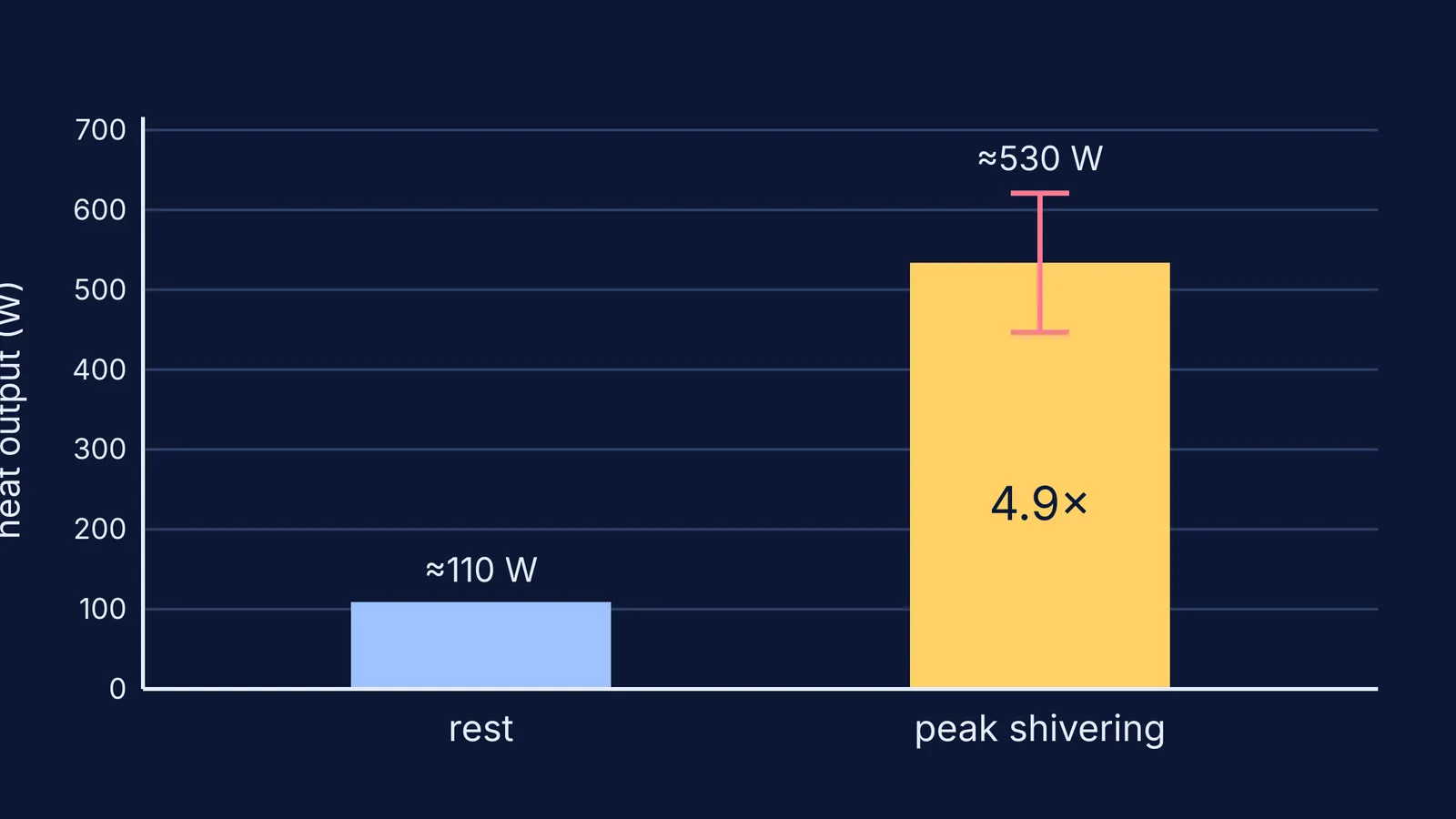
In a University of Manitoba study, 15 adults sat in water at 8 °C, which was then warmed to 20 °C to push shivering to its peak. At peak shivering they used 22.1 millilitres of oxygen per kilogram of body mass per minute, which was 4.9 times their resting metabolism. Their average body mass was 72.1 kg.
To turn oxygen into energy, use the standard figure that a mixed diet releases about 20.1 kJ per litre of oxygen consumed.
Oxygen per minute: 22.1 × 72.1 ≈ 1,593 mL, or about 1.59 L.
Energy per minute: 1.59 × 20.1 ≈ 32.0 kJ.
Power: 32,000 J ÷ 60 s ≈ 530 W.
Resting power: 530 ÷ 4.9 ≈ 110 W.
So a shivering adult goes from roughly one 100-watt bulb's worth of heat to about five. Treat it as an estimate: 20.1 kJ is an average for mixed fuel.
If unit conversions like millilitres to litres or kJ per minute to watts trip you up, the Fermi Problem Library has worked problems with a step-by-step solver that explains the reasoning rather than printing an answer.
Why do some people shiver more than others?
Haman and Blondin's review reports that people differ in which muscles they recruit and in how much of their heat comes from shivering. Brown fat, which makes heat without any movement, explains part of that gap: in men, more brown fat went with less shivering.
Next time your teeth chatter, you will know which part of your brain sent the order, and roughly how many watts it bought you.