

On this page
Every day, your body contends with shifting environmental temperatures, sporadic meals, and physical exertion. Yet inside your tissues, the fluid bathing your cells remains remarkably stable. This steady state is called homeostasis. Without it, cellular enzymes would denature from heat, neural transmission would stall from mineral imbalances, and vital organs would fail within minutes.
What does homeostasis mean in the human body?
Homeostasis is the biological process through which an organism maintains dynamic physiological stability despite fluctuating external conditions. The concept originated with French physiologist Claude Bernard in the 19th century, who noted that preserving a constant *milieu intérieur* (internal environment) is the prerequisite for free life.
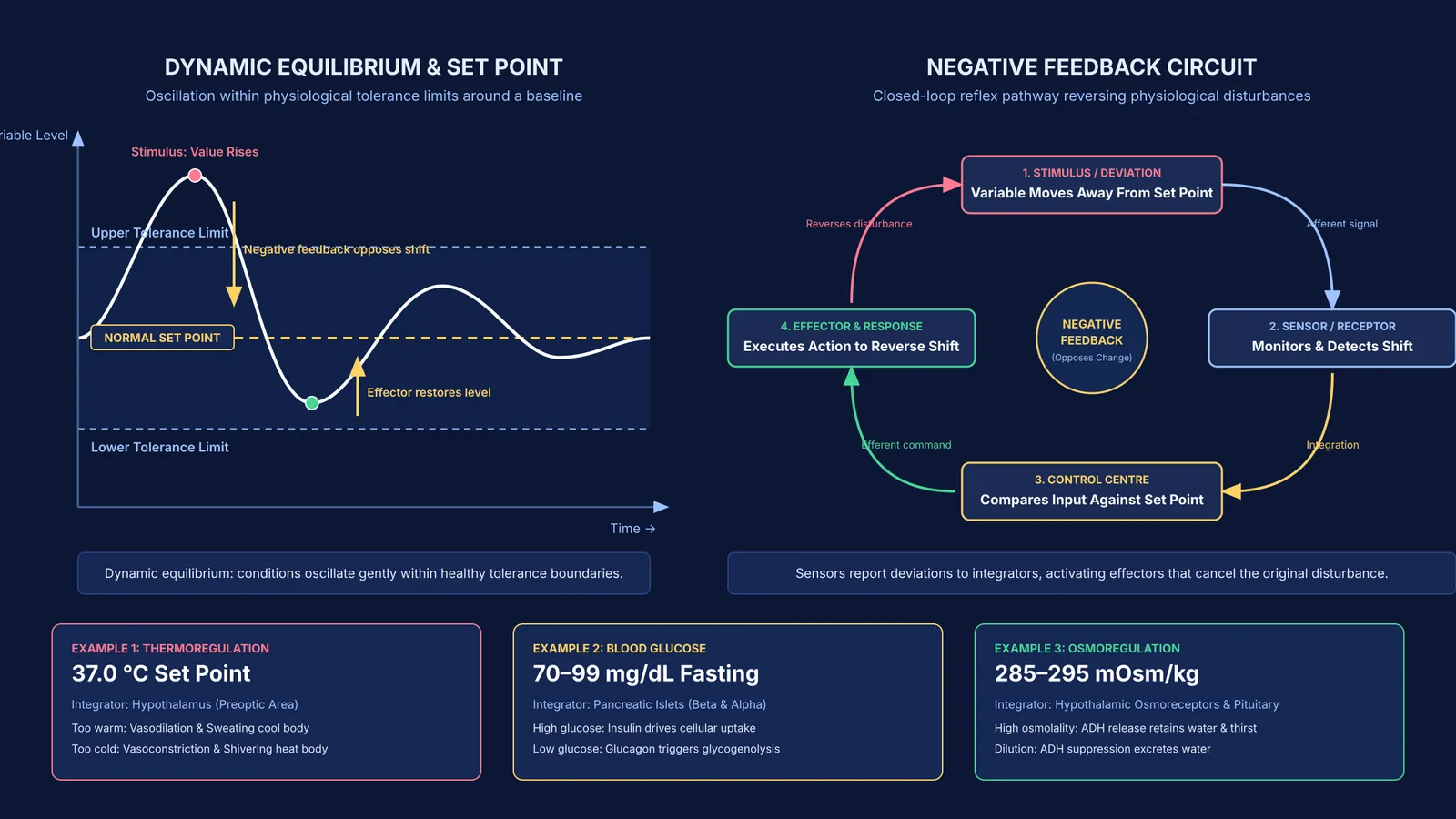
American physiologist Walter Cannon coined the term "homeostasis" in 1926 and detailed its mechanisms in *Physiological Reviews* (Cannon, 1929). Cannon selected the Greek prefix *homoios* ("similar") rather than *homo* ("identical") combined with *stasis* ("standing still") to show that physiological states are not rigid. Instead, internal conditions oscillate within a narrow, healthy tolerance band around an optimal set point. To see how acute stress interacts with these regulatory systems, read our article on Walter Cannon's work on emergency autonomic responses.
How does a negative feedback loop work?
The main driver of homeostasis is the negative feedback loop. In physiology, "negative" means the response opposes and reverses the initial shift away from the set point.
A standard negative feedback loop includes five distinct elements:
Regulated variable: The physical or chemical factor kept within bounds, such as core temperature or blood sugar.
Receptor: Sensory structures that monitor the variable and detect deviations from baseline.
Control centre: An integrator, such as hypothalamic nuclei or endocrine cells, that compares inputs against the set point.
Effector: An organ, gland, or muscle that carries out corrective commands.
Corrective response: The physiological action that counteracts the disturbance to restore baseline levels.
What are the three primary examples of human homeostasis?
Three body systems demonstrate how negative feedback loops maintain physiological stability:
Body temperature (thermoregulation): Human enzymes function optimally near a core body temperature of 37.0 °C. As reviewed by Morrison and Nakamura (2019), the preoptic area of the hypothalamus acts as the central thermostat. When core temperature rises during heat exposure or exercise, the hypothalamus promotes cutaneous vasodilation to radiate heat and activates eccrine sweat glands for evaporative cooling. When temperature falls, it triggers cutaneous vasoconstriction to preserve heat and stimulates involuntary shivering in skeletal muscles to generate warmth.
Blood glucose regulation (glycemia): Fasting plasma glucose is maintained between 70 and 99 mg/dL according to diagnostic standards from the American Diabetes Association (2024). After a meal, elevated glucose prompts beta cells in the pancreatic islets of Langerhans to secrete insulin, which drives cellular glucose uptake and stimulates hepatic glycogen synthesis. When fasting lowers blood glucose, pancreatic alpha cells secrete glucagon, stimulating glycogenolysis in the liver to release free glucose into the blood. Learn more in our guide on how hormones bind to cell receptors.
Water balance and osmolarity (osmoregulation): Human plasma osmolality is tightly held between 285 and 295 mOsm/kg, as synthesized by Bourque (2008). Osmoreceptor neurons in the anterior hypothalamus sense fluid concentration changes. If dehydration pushes osmolality above 285 mOsm/kg, the posterior pituitary releases antidiuretic hormone (ADH), directing renal collecting ducts to reabsorb water while the brain stimulates thirst. Dilution of plasma turns off osmoreceptor stimulation, suppressing ADH so excess water is excreted. Read further on regulating kidney function through ADH and RAAS.
How can you map any homeostatic reflex in five steps?
You can dissect any unfamiliar physiological reflex using this five-step sequence:
Identify the regulated variable and normal set point.
Locate the specific receptor detecting changes.
Identify the control centre evaluating incoming signals.
Trace the efferent pathway and target effectors.
Confirm the antagonistic response that reverses an opposite shift.
Consider arterial blood pressure. When pressure surges, baroreceptors in the carotid sinus and aortic arch fire rapid signals to the medulla oblongata. The medulla suppresses sympathetic tone and increases vagal parasympathetic activity, slowing heart rate and relaxing vascular smooth muscle to return blood pressure to its set point.
How do you master feedback loops for exams?
Exam questions on human physiology frequently test whether you can predict the outcome of a broken feedback link. Instead of memorizing isolated definitions, sketch paired antagonist pathways side by side, such as insulin against glucagon or vasodilation against vasoconstriction.
When revising physiological reflexes for competitive tests, mapping out how opposing hormones or neural pathways interact is often where students encounter concept gaps. The Fermi Concept Library covers every concept in physics, chemistry, biology, mathematics and computing, each with its own lesson and its place in the map.
If you are stuck distinguishing between afferent sensory inputs and efferent effector responses on exam questions, Fermi's AI tutor works out what you already know, builds a plan for the session, and notices where you get stuck, drawing out the pathway to test your understanding as you go.


