

On this page
You have just drawn the Lewis structure of NH4+ with an arrow for one of the bonds, and a fair question follows: is that fourth bond weaker, longer, or different in some way? It is not. The arrow tells you where the electrons came from. It does not describe a different bond in the finished ion.
How does the dative bond in NH4+ form?
Start with ammonia. According to the NCERT Class 11 chemistry chapter on chemical bonding, nitrogen in NH3 is sp3 hybridised. Three hybrid orbitals form N–H bonds and the fourth holds a lone pair, which repels the bonds more strongly than they repel each other, so the H–N–H angle shrinks to 107°.
When ammonia meets an acid such as hydrogen chloride, the lone pair picks up a proton. LibreTexts' page on coordinate (dative covalent) bonding/Chemical_Bonding/Fundamentals_of_Chemical_Bonding/Coordinate_(Dative_Covalent)_Bonding) puts it this way: only the hydrogen's nucleus moves from the chlorine to the nitrogen, and its electron stays behind on the chlorine as a chloride ion.
A dative (coordinate) bond is a covalent bond in which both shared electrons come from the same atom. Here, both electrons come from nitrogen's lone pair.
Are all four N–H bonds in ammonium ion identical?
Yes. The LibreTexts coordinate bonding page/Chemical_Bonding/Fundamentals_of_Chemical_Bonding/Coordinate_(Dative_Covalent)_Bonding) says it directly: "Once the ammonium ion has been formed it is impossible to tell any difference between the dative covalent and the ordinary covalent bonds." Three reasons:
Electrons carry no labels. A bond is a shared pair of electrons, and an electron from nitrogen's lone pair is the same as any other, so the finished bond keeps no record of its origin.
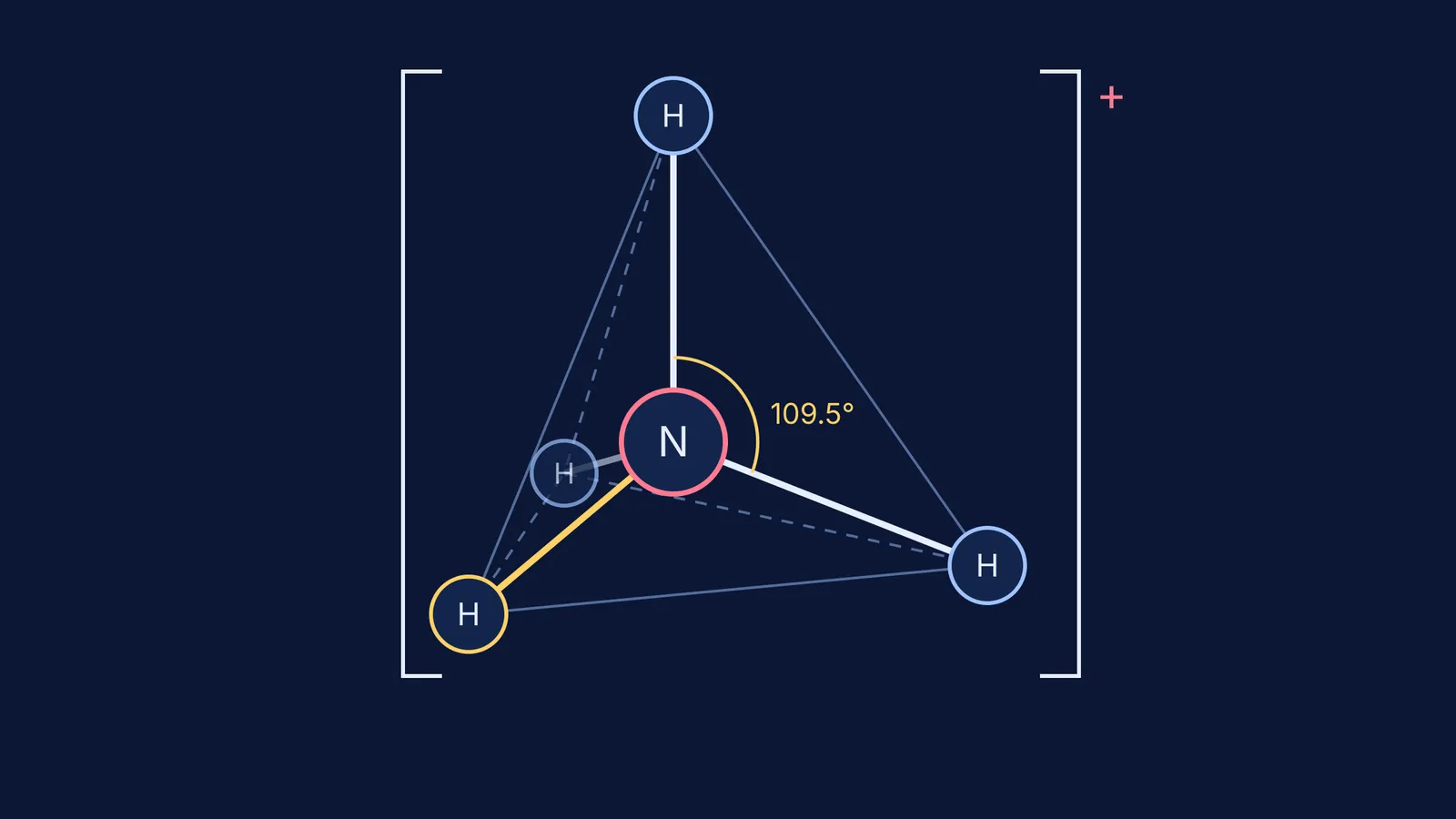
The electron pairs are now all the same kind. Nitrogen has gone from three bond pairs and one lone pair to four bond pairs and no lone pair. Four equal pairs push each other apart equally, so they point to the corners of a regular tetrahedron. NCERT's Table 4.6 lists NH4+ next to CH4 as tetrahedral with a bond angle of 109.5° (NCERT).
Symmetry settles it. NIST's Computational Chemistry Comparison and Benchmark Database lists the ammonium cation in point group Td, which is the full symmetry of a regular tetrahedron. In a Td shape, a rotation or reflection can move any hydrogen into the place of any other, so no N–H bond can be longer, shorter or weaker than the rest.
Why does the angle open from 107° to 109.5°?
In ammonia, the lone pair takes up more room and squeezes the three bonds together. Once it becomes the fourth bond, the angle opens to the tetrahedral value. NCERT gives 107° for NH3 and 109.5° for the tetrahedral case (NCERT).
The hybridisation stays sp3 in both species, but now all four hybrid orbitals do the same job. To picture these shapes, see our post on 3D shapes and bond angles in sp, sp2 and sp3 hybridisation.
Compare this with PCl5, where the bonds come in two kinds because the two axial positions are not equivalent to the three equatorial ones. Our explainer on why axial bonds in PCl5 are longer than equatorial bonds covers that case. The test is always the same: if symmetry can swap two bonds, they are identical.
How do you write this answer in an exam?
A four-step answer for a two or three mark question:
NH3 has three bond pairs and one lone pair on sp3 nitrogen, so it is pyramidal with an angle of about 107°.
The lone pair is donated to H+, forming a fourth N–H bond. This bond is a coordinate (dative) bond.
NH4+ now has four bond pairs and no lone pair, so by VSEPR theory it is a regular tetrahedron with 109.5° angles.
Once formed, the dative bond cannot be told apart from the other three. All four N–H bonds have equal length and strength.
If asked about charge, add nitrogen's formal charge. NCERT's rule (valence electrons, minus lone pair electrons, minus half the bonding electrons) gives 5 − 0 − ½(8) = +1. NCERT also warns that formal charges do not indicate real charge separation, and says a polyatomic ion's net charge belongs to the ion as a whole (NCERT). That is why the ion is written in brackets with the + outside.
Common traps:
"The coordinate bond is longer or weaker." It is not, once the ion has formed.
"NH4+ is pyramidal like NH3." It is not. The lone pair is gone, so the shape is tetrahedral.
"The positive charge sits on the fourth hydrogen." The charge belongs to the ion as a whole. The formal charge is assigned to nitrogen.
"Hybridisation changes on protonation." It is sp3 before and after.
If VSEPR or hybridisation still feels shaky, the Fermi Concept Library gives each concept in chemistry its own lesson and shows where it sits in the map. To practise, the Fermi Problem Library has worked problems with a step-by-step solver that explains the reasoning rather than printing an answer.
Next, try the symmetry test on CH4 and H2O to check that the idea has stuck.


