

On this page
In phosphorus pentachloride (PCl₅), the five phosphorus-chlorine bonds are not identical. Even though all five bonds involve the same two elements, their lengths differ depending on where they sit in the molecule.
What is the trigonal bipyramidal shape?
PCl₅ has an sp³d hybridised central phosphorus atom, giving it a trigonal bipyramidal geometry (Wikipedia).
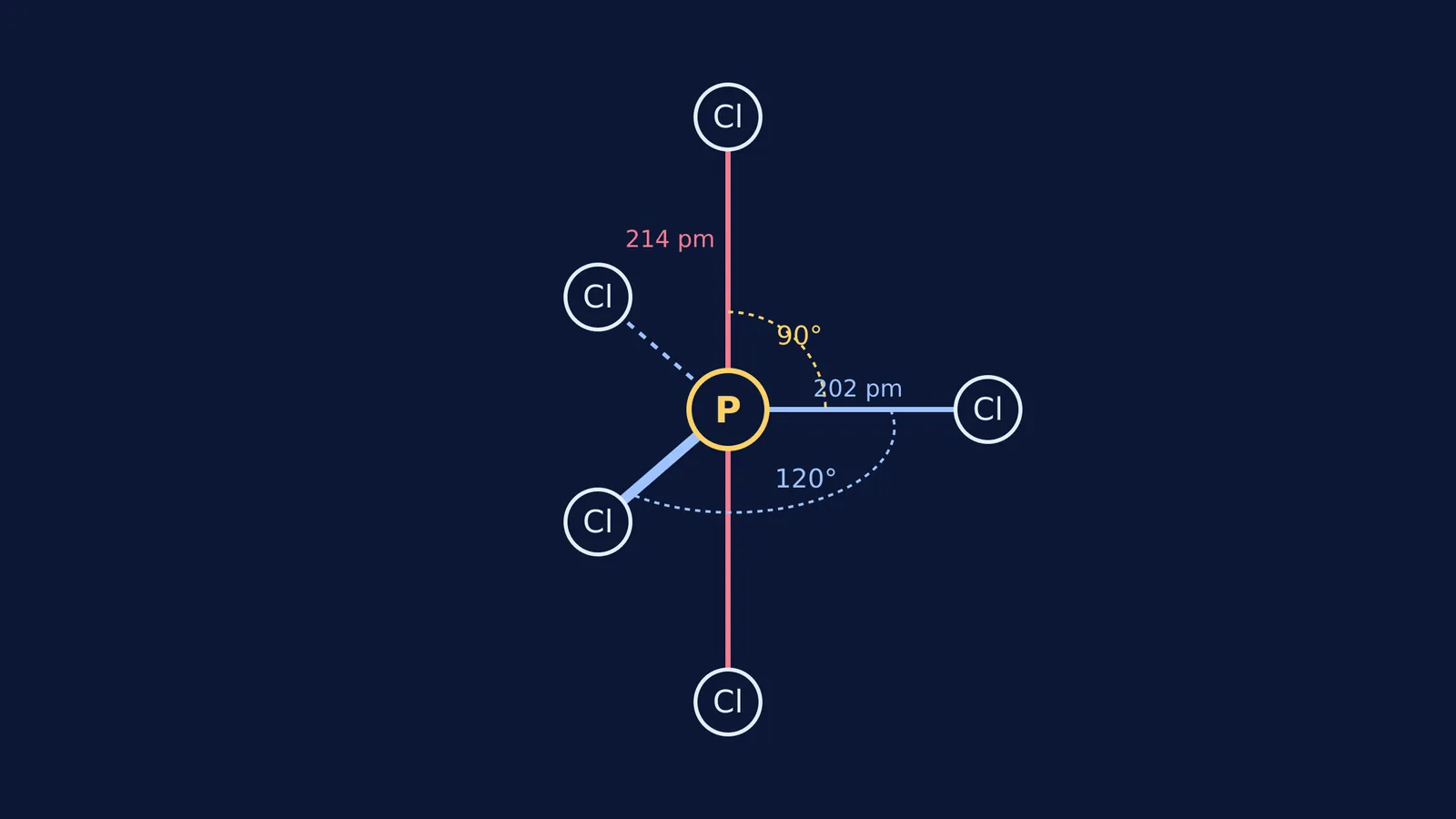
The two axial bonds have a length of 214 pm, while the three equatorial bonds are shorter at 202 pm. This difference comes down to the shape of the molecule and how the electron pairs repel each other.
Imagine a flat triangle with the phosphorus atom in the middle and three chlorine atoms at the corners. These are the equatorial bonds, and they sit at an angle of 120° to one another.
The remaining two chlorine atoms sit directly above and below this central triangle. These are the axial bonds, and they sit at exactly 90° to the equatorial plane.
Why are axial bonds in PCl5 longer than equatorial bonds?
The bonds in a molecule are made of electron pairs, and because electrons are negatively charged, they repel each other. According to Valence Shell Electron Pair Repulsion (VSEPR) theory, a molecule will arrange its bonds to minimise this repulsion.
The repulsion between two bond pairs is strongest when they are close together, specifically at a 90° angle (Wikipedia).
An axial bond pair sits at 90° to three equatorial bond pairs.
An equatorial bond pair sits at 90° to only two axial bond pairs (the other equatorial bonds are a safer 120° away).
Because the axial bonds suffer from more 90° repulsions (three instead of two), they experience a stronger repulsive force pushing them away from the central atom. To minimise this stress, the axial bonds stretch. This is why the axial bonds reach 214 pm, while the equatorial bonds stay tighter at 202 pm.
Why is PCl5 highly reactive?
A longer bond is generally a weaker bond. Because the axial P–Cl bonds are stretched by repulsion, they require less energy to break than the equatorial bonds.
This makes PCl₅ a highly reactive molecule, especially when heated. If you gently heat PCl₅ gas, it readily breaks its two weaker axial bonds and decomposes into phosphorus trichloride (PCl₃) and chlorine gas (Cl₂). The remaining PCl₃ molecule keeps the three shorter, stronger equatorial bonds, which rearrange into a stable trigonal pyramidal shape.
If you are reviewing inorganic chemistry, mastering this shape is as important as understanding diborane's three-centre banana bonds. And if you are struggling to picture 3D molecular geometries or need help deciding which bonds will break first in a reaction, the Fermi Concept Library holds lessons on chemical bonding that break down VSEPR theory visually, letting you build the intuition before you memorise the rules.
What happens to PCl5 in the solid state?
The trigonal bipyramidal shape and its uneven bond lengths only exist when phosphorus pentachloride is in a gas or liquid state. In the solid phase, the molecule undergoes a dramatic structural change.
Instead of remaining as individual PCl₅ molecules, solid phosphorus pentachloride auto-ionises into two distinct complex ions (Wikipedia). It forms a lattice of positively charged [PCl₄]⁺ cations and negatively charged [PCl₆]⁻ anions.
Because the number of bonds changes, the shapes and bond lengths change too:
The [PCl₄]⁺ cation has four bond pairs and zero lone pairs. This gives it a perfectly symmetrical tetrahedral shape, meaning all four of its bonds are identical in length.
The [PCl₆]⁻ anion has six bond pairs and zero lone pairs. This creates an octahedral geometry, where all six bonds are equal and sit at 90° to each other.
This transformation happens because the highly reactive axial bonds in the gas phase make the molecule unstable. By exchanging a chlorine atom to form [PCl₄]⁺ and [PCl₆]⁻, the solid achieves a lower, more stable energy state without the uneven VSEPR repulsions.
How do you solve VSEPR exam questions?
When you see a question about PCl₅ or need to predict the formula of an oxide or chloride, you can apply a quick checklist to predict its structure and reactivity:
Count the electron domains: Five bond pairs mean a trigonal bipyramidal shape.
Locate the 90° angles: Identify which positions suffer the most 90° repulsions (Wikipedia). These will always be the axial positions.
Predict the bond lengths: The bonds with more 90° repulsions stretch and become longer.
Identify the weak points: If the molecule reacts or decomposes, the longest bonds will break first.
This same logic applies to other molecules with five electron domains. For example, in sulfur tetrafluoride (SF₄), one position is taken by a lone pair instead of an atom. Because lone pairs repel more strongly than bond pairs, the lone pair will always occupy an equatorial position to minimise its 90° interactions with the rest of the molecule.


