

On this page
The periodic table is not just a list of elements; it is a cheat sheet for chemical bonding. By looking at an element's position, you can easily predict how it will react with common non-metals like oxygen and chlorine. Whether you are preparing for a board exam or tackling competitive chemistry, mastering this pattern is a foundational skill.
The relationship between an element's IUPAC group number and its valency (combining capacity) applies primarily to the main-group elements, which are groups 1, 2, and 13 to 17. The group number predicts the formula of oxides) because it tells you the element's highest oxidation state. By knowing this, you can immediately write down the correct chemical formula without memorising every single compound.
How do you find valency from the group number?
For main-group elements, valency is determined by the number of valence electrons in the outermost shell.
For Groups 1 and 2: The valency is simply the group number. Group 1 alkali metals (like sodium and potassium) have 1 valence electron and a valency of 1. Group 2 alkaline earth metals (like magnesium and calcium) have 2 valence electrons and a valency of 2.
For Groups 13 to 17: The number of valence electrons is the group number minus 10. For example, Group 13 elements (like aluminium) have 3 valence electrons, and Group 14 elements (like carbon and silicon) have 4.
Once you know the number of valence electrons, the element's valency is typically either the number of valence electrons (if 4 or fewer) or 8 minus the number of valence electrons (to complete the octet). For instance, Group 15 elements like nitrogen and phosphorus typically show a valency of 3, while Group 17 halogens like fluorine and chlorine have a valency of 1.
How do you predict formulas with the cross-over method?
Once you know the valencies of the constituent elements, you can predict the chemical formula using the cross-over method. Oxygen almost always has a valency of 2), and chlorine has a valency of 1.
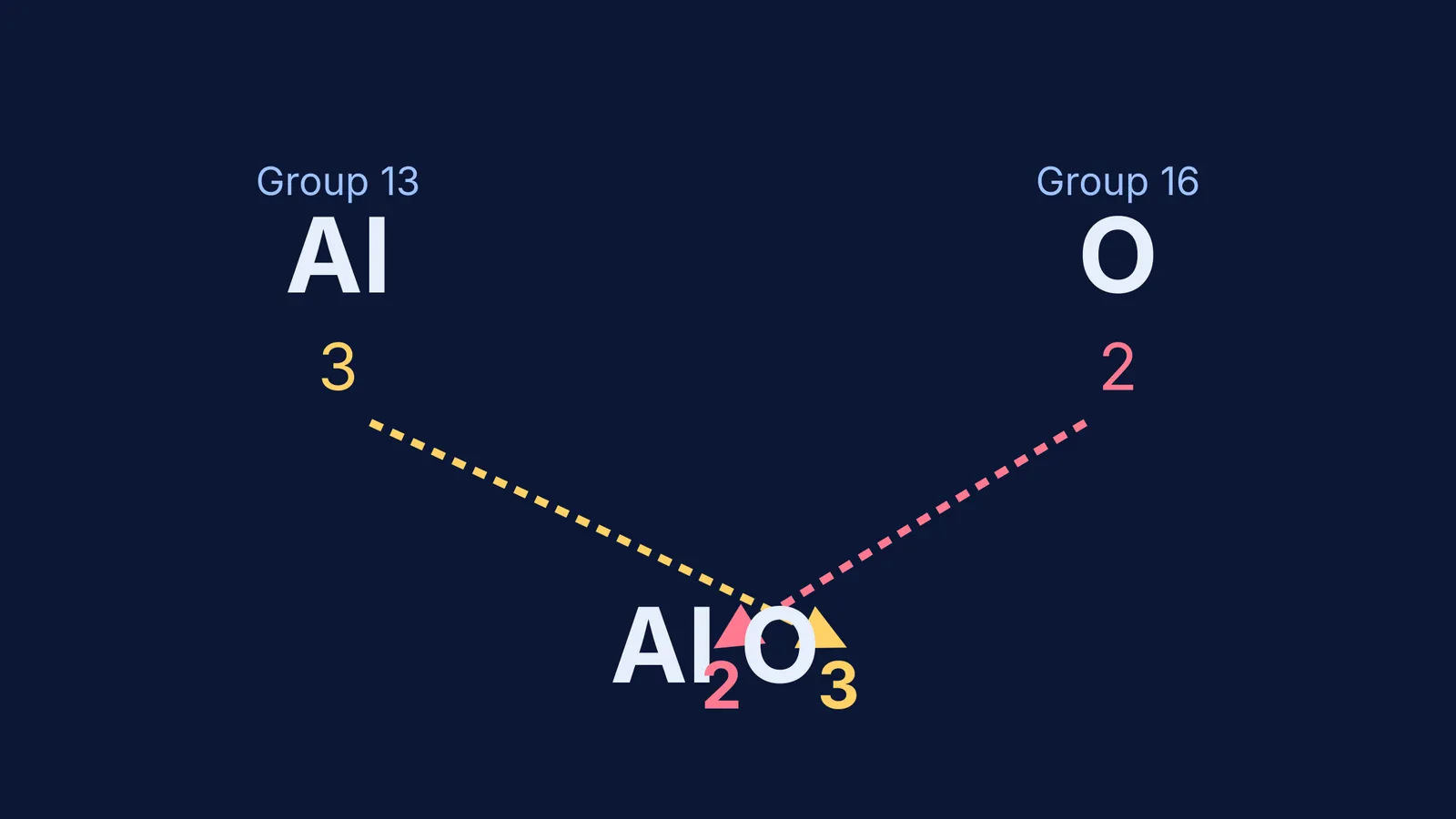
To predict the formula of a Group 13 oxide (like aluminium oxide):
Write the symbols and their valencies: Al (3) and O (2).
Cross over the valency numbers to become the subscripts of the other element.
The resulting formula is Al₂O₃.
If we apply this to a Group 14 chloride (like silicon tetrachloride):
Write the symbols and valencies: Si (4) and Cl (1).
Cross them over.
The formula is SiCl₄.
Sometimes, the cross-over method gives numbers that can be mathematically simplified to their lowest common ratio. For a Group 14 oxide like carbon, crossing over C (4) and O (2) gives C₂O₄. This simplifies to the familiar carbon dioxide, CO₂.
We can also try a Group 2 chloride. Magnesium has a valency of 2, and chlorine has a valency of 1. Crossing them over gives MgCl₂. If you want to practice building these molecules or seeing how they connect, the Fermi Concept Library maps out every concept in chemistry with its own lesson and its place in the map.
When does the group number rule break?
While these valency rules work perfectly for the first few rows (the lighter elements) of the periodic table, heavier elements often exhibit variable valency, breaking the standard predictable pattern.
Transition metals (Groups 3 to 12) do not follow the simple group number rules because they can use electrons from their inner d-subshells for chemical bonding. Because the energy difference between the outermost s-electrons and the inner d-electrons is very small, transition metals can lose varying numbers of electrons. Iron (Group 8), for example, can have a valency of 2 or 3, forming both FeCl₂ (iron(II) chloride) and FeCl₃ (iron(III) chloride). Copper similarly forms both CuCl and CuCl₂.
Even in the main groups (the p-block), heavier elements at the very bottom of the table behave unexpectedly due to the inert pair effect. In Group 14, the +4 oxidation state becomes less stable as you move down from carbon to lead, while the +2 state becomes significantly more stable.
This happens because the innermost pair of s-electrons in these heavy elements is poorly shielded by the filled inner d and f orbitals, causing the massive nucleus to pull them in very tightly. These two s-electrons become "inert" and refuse to participate in chemical bonding. As a result, while carbon easily forms the stable tetrachloride CCl₄ using all four valence electrons, lead strongly prefers to hold onto its s-electrons and form PbCl₂.
This inert pair effect is also seen in Group 13, where thallium prefers a +1 state over +3, and in Group 15, where bismuth prefers +3 over +5. (For more examples of variable oxidation states in lighter p-block elements and how they bond, read about oxides of nitrogen structures).
If you keep dropping marks on p-block exceptions, tricky oxidation states, or electron dot structures, Fermi's AI tutor can work out what you already know and build a plan for the session, teaching through the reasoning step by step.


