On this page
If you are preparing for JEE Main or Class 12 boards, you have met the line "PbCl4 exists but PbI4 does not". The inert pair effect is half the answer. The other half is redox: lead(IV) wants electrons, iodide gives them up easily, and the two cannot share a crystal. Together they make a check you can run on any doubtful halide.
What is the inert pair effect?
The inert-pair effect is "the tendency of the two electrons in the outermost atomic s-orbital to remain unshared in compounds of post-transition metals" (Wikipedia: Inert-pair effect). The same article notes that the term was first proposed by Nevil Sidgwick in 1927.
Lead's outer configuration is 6s2 6p2. Using only the two 6p electrons gives Pb(II); pulling the 6s pair into bonding as well gives Pb(IV). Down group 14 the +2 state becomes more stable than +4, and the group 14 trends page on LibreTexts states the consequence plainly: "PbO2 is an oxidizing agent, whereas SnO2, GeO2, and SiO2 are not" (LibreTexts: Carbon group trends). The same page says PbI4 does not exist.
Why does PbI4 not exist but PbCl4 does?
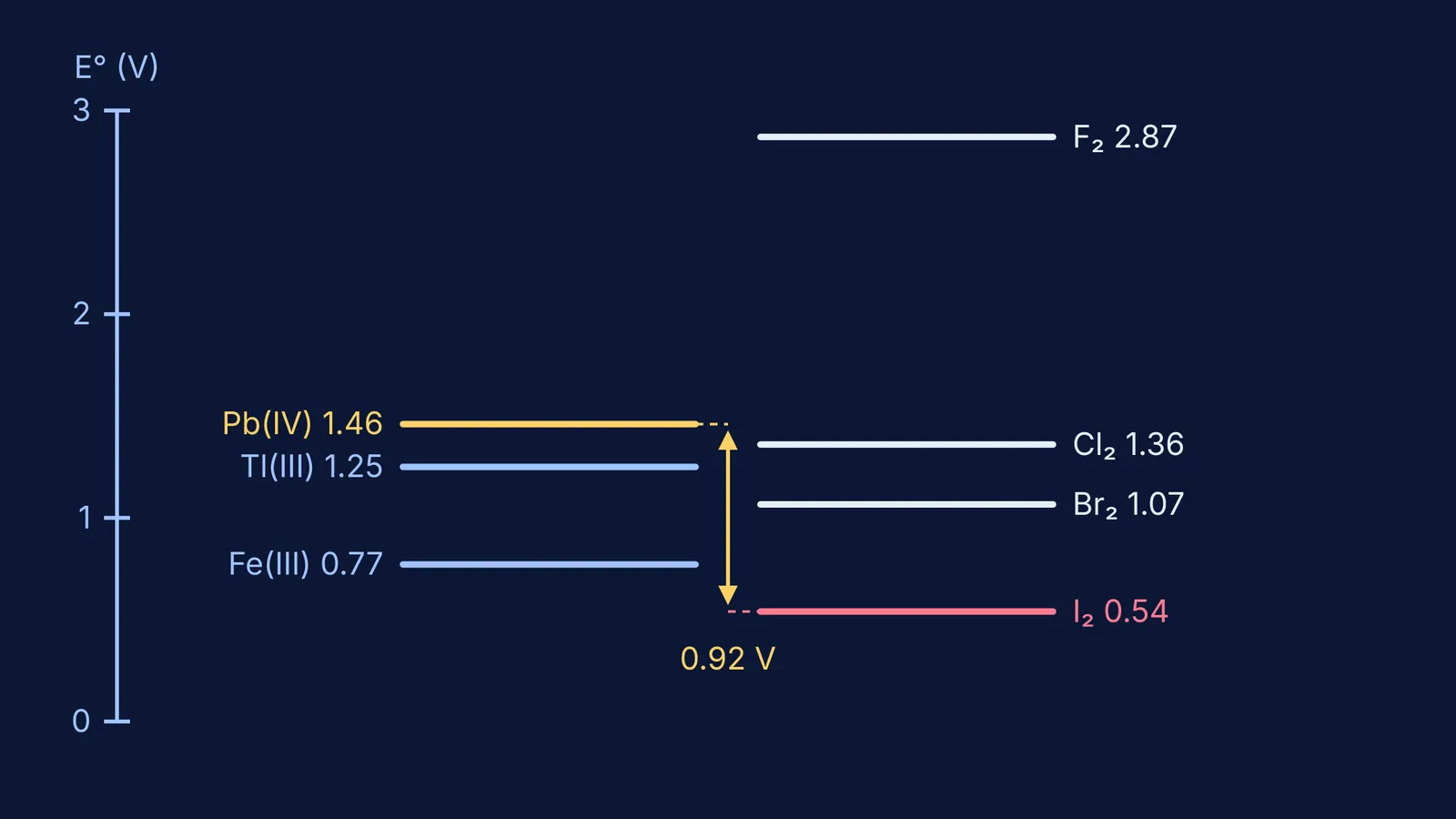
Standard electrode potentials put numbers on this (standard electrode potential data table):
PbO2 + 4H+ + 2e− → Pb2+ + 2H2O: E° = +1.46 V
Cl2 + 2e− → 2Cl−: E° = +1.36 V
Br2 + 2e− → 2Br−: E° = +1.07 V
I2 + 2e− → 2I−: E° = +0.54 V
The PbO2 couple stands in for Pb(IV); the table's bare Pb4+/Pb2+ value, +1.69 V, is higher still. Read these as a ladder: a species higher up takes electrons from one lower down. Pb(IV) sits 0.92 V above iodine, so any attempt to make PbI4 ends with lead pulling electrons off iodide: Pb4+ + 2I− → Pb2+ + I2. What you actually get is PbI2 and iodine.
Chloride is a much poorer electron donor. Pb(IV) sits only 0.10 V above chlorine, close enough that PbCl4 can be made, but only just. It is "stable below 0 °C", decomposes on warming into lead dichloride and chlorine gas, and "this reaction can proceed explosively" (Wikipedia: Lead(IV) chloride). Bromide sits in between, 0.39 V below Pb(IV), so the check predicts PbBr4 is even less stable than PbCl4.
At the other end, fluorine sits at +2.87 V, far above Pb(IV) (same data table), so fluoride cannot reduce the lead. PbF4 is "the only room-temperature stable tetrahalide of lead" and melts at 600 °C (Wikipedia: Lead(IV) fluoride).
How do you use the same check on other halides?
The check has three steps:
Write the metal's higher oxidation state and the couple that takes it to the lower one (for lead, Pb(IV) to Pb(II)).
Look up its E° and compare it with the X2/X− couple for the halide.
Metal couple well above the halogen couple: the halide falls apart. Below it: the compound is safe.
Here it is on three compounds, using the same electrode potential table:
TlI3. Tl3+ to Tl+ is +1.25 V, well above iodine's +0.54 V, so Tl(III) cannot survive next to iodide. TlI3 "is actually a thallium(I) salt" of the triiodide ion (Wikipedia: Thallium triiodide). We work through it in why TlI3 is Tl+ and I3−, not thallium(III) iodide.
FeI3. Fe3+ to Fe2+ is +0.77 V, still above iodine. "Iron(III) and iodide tend to undergo a redox reaction in which Fe3+ is reduced to Fe2+ and I− is oxidised to I2" (Wikipedia: Iron(III) iodide). The same article describes making it by a light-driven route at −20 °C, away from water.
SnI4. Sn4+ to Sn2+ is only +0.15 V, below iodine, so iodide cannot reduce tin(IV). SnI4 is a stable red-orange solid that melts at 143 °C, made by heating tin with iodine (Wikipedia: Tin(IV) iodide). Same group as lead, opposite result: the inert pair effect in one comparison.
How should you write this in an exam?
For a two-mark "give reason" question, this is enough:
"Due to the inert pair effect, Pb(IV) is unstable and acts as a strong oxidising agent. I− is a strong reducing agent, so Pb4+ would oxidise I− to I2 and be reduced to Pb2+. Hence PbI4 does not exist. Cl− is a much weaker reducing agent, so PbCl4 can form."
Some books give the reason as bond energy: the Pb–I bond does not release enough energy to unpair the 6s2 electrons. In assertion-reason questions treat that as the same idea, not a rival. The "who gives electrons to whom" habit also explains why H3PO2 is a strong reducing agent.
If you slip when a question twists the idea, the Fermi Problem Library has worked problems with a step-by-step solver that explains the reasoning rather than printing an answer. To revisit the inert pair effect or electrode potentials on their own, the Fermi Concept Library gives each concept its own lesson.
Next time an odd halide turns up, find the two potentials before you reach for a memorised list.