On this page
Hypophosphorous acid, H3PO2, is the phosphorus oxoacid that NCERT's redox exercises use to reduce silver nitrate to silver. The reason is in its structure, and the same reasoning predicts H3PO3 and H3PO4.
What makes H3PO2 a strong reducing agent?
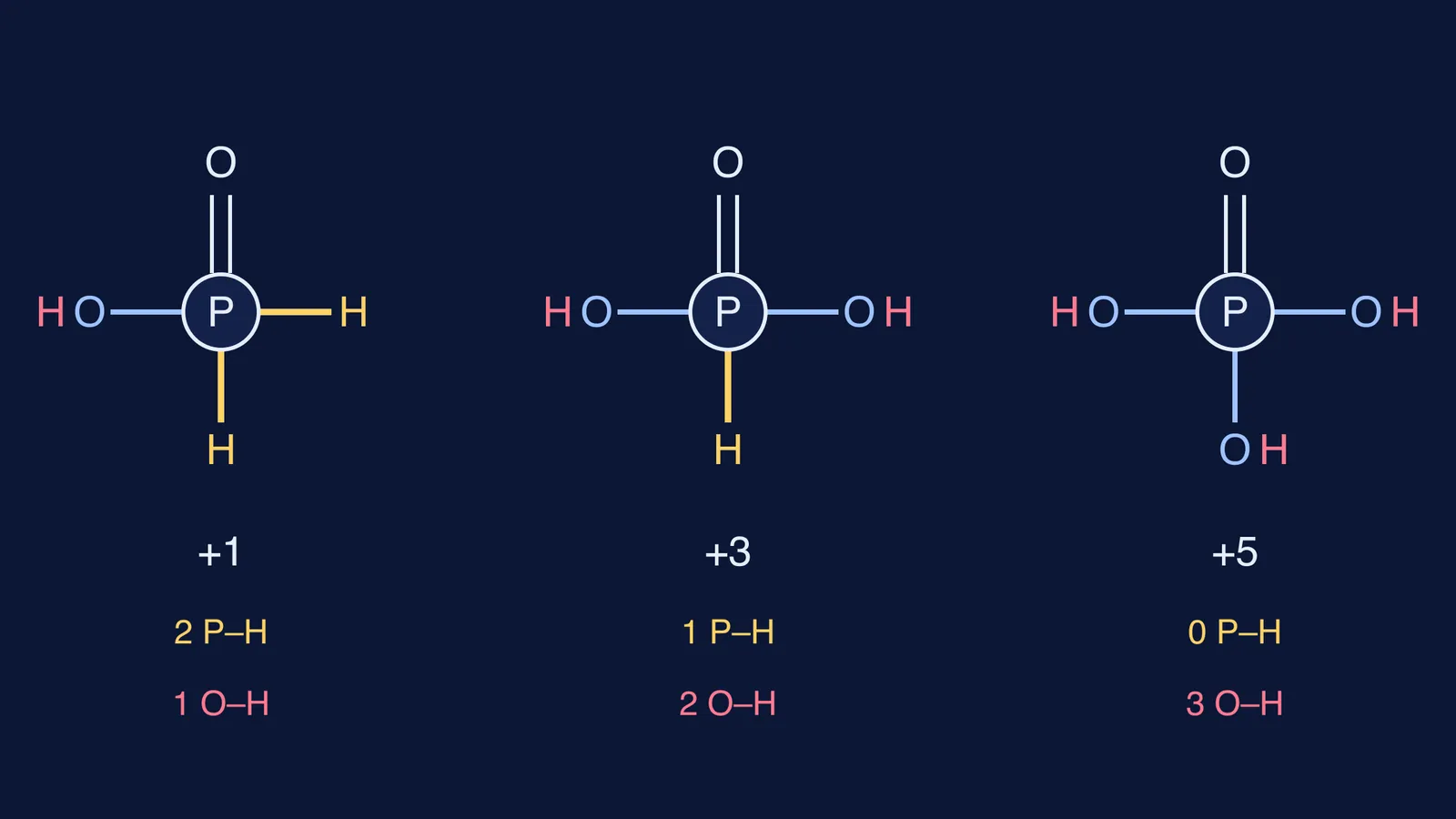
Hypophosphorous acid (also called phosphinic acid) is a phosphorus oxoacid and a powerful reducing agent, and its formula is better written HOP(O)H2, as Wikipedia's hypophosphorous acid entry explains. Phosphorus carries one double-bonded oxygen, one OH group and two hydrogens bonded directly to phosphorus.
Those P–H bonds do the reducing. When H3PO2 is oxidised, each P–H becomes a P–OH, and the product is phosphoric acid, H3PO4, which has no P–H bonds left. Phosphorus goes from the +1 oxidation state to +5, so each molecule gives up four electrons.
You can check this one bond at a time. Score phosphorus like this:
each P–H bond counts −1
each P–OH bond counts +1
the P=O double bond counts +2
For H3PO2, that gives −2 + 1 + 2 = +1. For H3PO4, it gives 3 + 2 = +5. So every P–H swapped for a P–OH releases two electrons. Two P–H bonds means four electrons.
Why is H3PO2 monobasic if it has three hydrogens?
Basicity counts the hydrogens an acid can release as H+ ions, and in H3PO2 only the hydrogen on oxygen does that. The hypophosphorous acid entry calls the acid monoprotic and gives its pKa as 0.89. The two hydrogens on phosphorus come off only when the molecule is oxidised.
The same logic works across the family. Phosphorous acid, HP(O)(OH)2, is diprotic, with pKa values of 1.3 and 6.7, and is a good reducing agent, according to Wikipedia's phosphorous acid entry. Phosphoric acid is triprotic in water, with pKa values of 2.14, 7.20 and 12.37, according to the phosphoric acid entry.
H3PO2: 2 P–H, 1 O–H, phosphorus at +1. Monobasic, and the strongest reducer of the three.
H3PO3: 1 P–H, 2 O–H, phosphorus at +3. Dibasic, and still a reducer.
H3PO4: 0 P–H, 3 O–H, phosphorus at +5. Tribasic, and not a reducer, because phosphorus has no P–H bond left to give up.
For the structures of the other phosphorus and sulphur oxoacids, see our explainer on oxoacids of phosphorus and sulphur: structures and basicity.
How does H3PO2 reduce AgNO3 to silver?
NCERT's Class 11 Chemistry Part II (Unit 7, Redox Reactions, Exercise 7.17) gives the balanced equation H3PO2 + 4AgNO3 + 2H2O → H3PO4 + 4Ag + 4HNO3; you can read it in the NCERT Redox Reactions chapter. The same exercise has H3PO2 reducing copper sulphate. Balanced, that is H3PO2 + 2CuSO4 + 2H2O → H3PO4 + 2Cu + 2H2SO4; the textbook prints a single H2SO4, which does not balance.
Why does one H3PO2 reduce exactly four silver ions?
Find phosphorus in H3PO2: 3(+1) + x + 2(−2) = 0, so x = +1.
Find phosphorus in H3PO4: 3(+1) + x + 4(−2) = 0, so x = +5.
Electrons lost per H3PO2: 5 − 1 = 4.
Each Ag+ takes one electron to become Ag, so one H3PO2 reduces four Ag+.
Check with copper: each Cu2+ takes two electrons, so one H3PO2 reduces two Cu2+. This matches the 2Cu in NCERT's second equation.
Balance oxygen with 2H2O on the left. The four H+ released pair with nitrate to give 4HNO3.
If a question asks how many moles of AgNO3 one mole of H3PO2 reduces, the answer is 4. By the same count, H3PO3, with one P–H bond, gives two electrons. For more practice with half-reactions, try our guide to balancing redox reactions with oxidation numbers and half-reactions.
Where else does H3PO2's reducing power show up?
Hypophosphorous acid can reduce ions of cobalt, copper, silver, manganese and platinum, and it is most often used to reduce nickel, according to Wikipedia's hypophosphorous acid entry. In organic chemistry, the same acid replaces a diazonium group with hydrogen; our post on how to replace an amino group by hydrogen in benzene walks through that step.
What mistakes do students make with H3PO2?
Calling it tribasic because the formula has three hydrogens. Count O–H bonds, not hydrogens.
Treating the low oxidation state and the P–H bonds as two separate reasons. They are the same fact seen two ways. When a question asks for the structural reason, name the two P–H bonds.
Dropping the water in the AgNO3 equation. Without 2H2O, the oxygen does not balance.
If a problem like this goes wrong at step 1 or step 3, the Fermi Problem Library has worked problems with a step-by-step solver that explains the reasoning instead of just printing an answer. If the gap comes earlier, in oxidation numbers or oxoacid structures, the Fermi Concept Library gives every chemistry concept its own lesson.
Next time you meet a phosphorus oxoacid, draw it and count the P–H and O–H bonds.