

On this page
Sometimes the shortest route to a benzene compound goes through a group the final product does not have. The amino group (–NH2) is the classic example. You add it to steer incoming groups to the right positions, then you remove it and leave a plain hydrogen behind.
How do you replace an amino group by hydrogen?
It takes two steps, and you cannot skip the first.
Diazotise. Dissolve the aromatic amine in acid, cool it to 0–5 °C and add sodium nitrite, as described in this LibreTexts chapter on arenediazonium salts/17:_Other_Reactions_of_Aromatics/17.03:_Reactions_involving_arenediazonium_salts). The –NH2 becomes –N2+, a diazonium group.
Reduce. Treat the diazonium salt with a mild reducing agent, hypophosphorous acid (H3PO2) or ethanol. Nitrogen gas leaves and a hydrogen takes its place.
With ethanol, the alcohol is oxidised to ethanal: C6H5N2Cl + C2H5OH → C6H6 + CH3CHO + N2 + HCl, as written in this worked NCERT exercise. With H3PO2, the Organic Syntheses procedure by Nathan Kornblum notes that “immediate evolution of nitrogen occurs” as soon as the cold diazonium solution is poured into the ice-cold acid.
The 0–5 °C matters because diazonium salts are unstable. Aromatic ones last long enough to use partly because the ring spreads out the charge; our post on why aromatic diazonium salts are more stable than aliphatic ones explains this.
Why add an NH2 group only to remove it?
Because –NH2 is a strong activating, ortho/para-directing group, it sends incoming electrophiles to the positions ortho and para to itself. Bromine is also an ortho/para director, so brominating benzene directly will not give three bromines all meta to each other. The LibreTexts chapter puts it plainly: “it is necessary to introduce a powerful ortho/para-directing prior to bromination, and then remove it following the tribromination. An amino group is ideal for this purpose.”
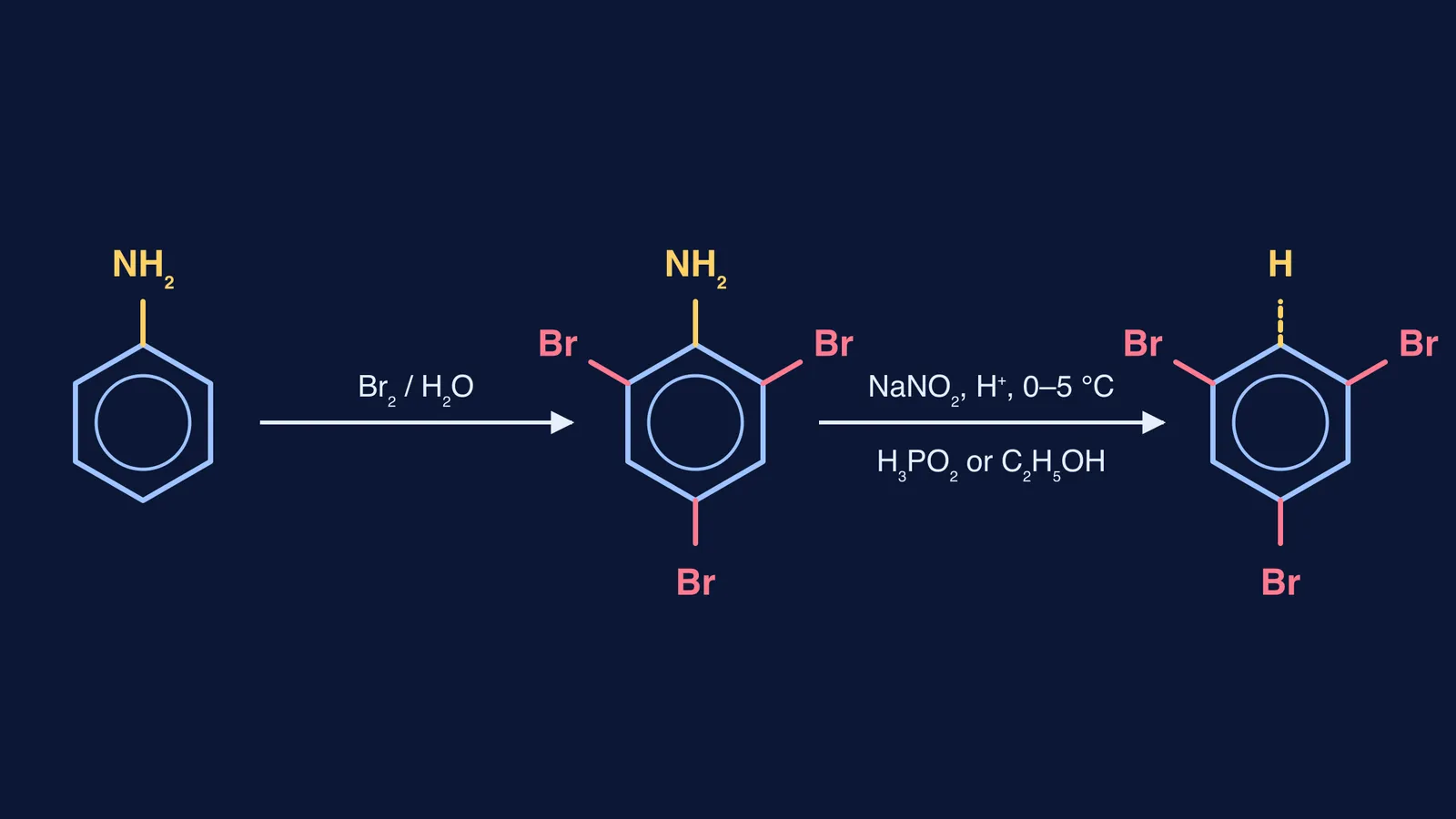
Look at aniline. Its ortho and para positions are carbons 2, 4 and 6, and those three sit meta to one another. Brominate there, delete the NH2, and you have 1,3,5-tribromobenzene. The order of steps decides the answer, which is the same lesson as in our guide to choosing the order of steps for a disubstituted benzene.
Worked example: aniline to 1,3,5-tribromobenzene
The Organic Syntheses procedure for sym-tribromobenzene, published in 1933 by G. H. Coleman and William F. Talbot, follows exactly this route.
Brominate. Air saturated with bromine vapour is drawn through aniline in dilute hydrochloric acid for about three to four hours. The 2,4,6-tribromoaniline that forms is filtered off.
Diazotise. The moist tribromoaniline is dissolved in hot 95 per cent alcohol and benzene, then concentrated sulfuric acid and powdered sodium nitrite are added. Note that this lab procedure works hot, not at 0–5 °C.
Reduce. The solution is boiled for as long as gas comes off. Here the ethanol serves as both the solvent and the reducing agent.
The crude yield is 74–77 per cent of the theoretical amount, counted from the starting aniline, and the recrystallised product melts at 121.5–122.5 °C, according to the same Organic Syntheses procedure.
If you want to take the diazonium salt somewhere other than hydrogen, our walk-through of aniline to tribromofluorobenzene uses the same tribromo intermediate.
H3PO2 or ethanol: which reducing agent should you choose?
Both appear in textbook equations. In his Organic Syntheses procedure, Kornblum wrote that he used H3PO2 in preference to ethanol because “this procedure is much simpler, the yields are higher, and the products are of better quality.” His deamination of o-tolidine with 30% hypophosphorous acid gave 3,3′-dimethylbiphenyl in 76–82% yield.
Kornblum’s review in Organic Reactions lists the wider set of reducing agents, including alcohols, hypophosphorous acid, alkaline formaldehyde and sodium stannite. For exams, H3PO2 and ethanol are the two to know.
These are procedures for trained chemists. The tribromobenzene write-up adds the nitrite “as rapidly as the violence of the reaction will permit”, and Kornblum notes that diazonium salts from aniline derivatives are less thermally stable than the biphenyl salts in his procedure. Learn this one on paper, not at home.
How do you spot when a question needs this trick?
Run these three checks on the target molecule:
Are two or three groups meta to each other, even though each one is an ortho/para director?
Would an NH2 at one free position point electrophiles to exactly those spots?
Is that free position a plain hydrogen in the target?
If all three answers are yes, plan it as: get an NH2 on the ring (nitrate, then reduce), substitute, diazotise, then reduce with H3PO2. Try it on 3,5-dibromotoluene. Start from p-toluidine (4-methylaniline): the NH2 sends both bromines to its ortho positions, which are meta to the methyl, and deamination leaves 3,5-dibromotoluene.
For more conversion chains like this, the Fermi Problem Library has worked problems with a step-by-step solver that explains the reasoning rather than printing an answer. If directing effects themselves still feel shaky, the Fermi Concept Library gives each concept in chemistry its own lesson.


