

On this page
When planning the synthesis of a disubstituted benzene, you cannot just throw both reagents into the flask in any order. The first group you attach to the benzene ring takes charge. It determines exactly where the second group will go.
This "directing effect" is a classic trap in organic chemistry synthesis. If you get the order wrong, you will synthesise the wrong isomer and lose marks in your JEE or NEET paper.
Why does the order of steps matter?
The first substituent on a benzene ring alters the electron density of the remaining carbon atoms. According to the principles of electrophilic aromatic substitution, these groups fall into two broad categories:
Ortho/para-directing groups: These push electron density into the ring (often via resonance) and direct the next incoming group to the positions next to them (ortho, positions 2 and 6) or exactly opposite (para, position 4). Examples include −OH, −NH₂, −CH₃, and halogens like −Cl and −Br.
Meta-directing groups: These withdraw electron density from the ring, making the ortho and para positions strongly positive, which leaves the meta position (positions 3 and 5) as the most reactive target for the incoming electrophile. Examples include −NO₂, −CN, −COOH, and −CHO. They are also deactivating; for instance, a highly deactivated meta-substituted ring can react much more slowly than benzene, according to data on electrophilic aromatic substitution.
If your target molecule has two groups meta to each other, you must attach the meta-director first. If they are para or ortho to each other, the ortho/para-director must go on first. If you struggle to remember which group does what, the Fermi Concept Library maps out every concept in chemistry, each with its own lesson.
Order of reactions to make m-nitrochlorobenzene from benzene?
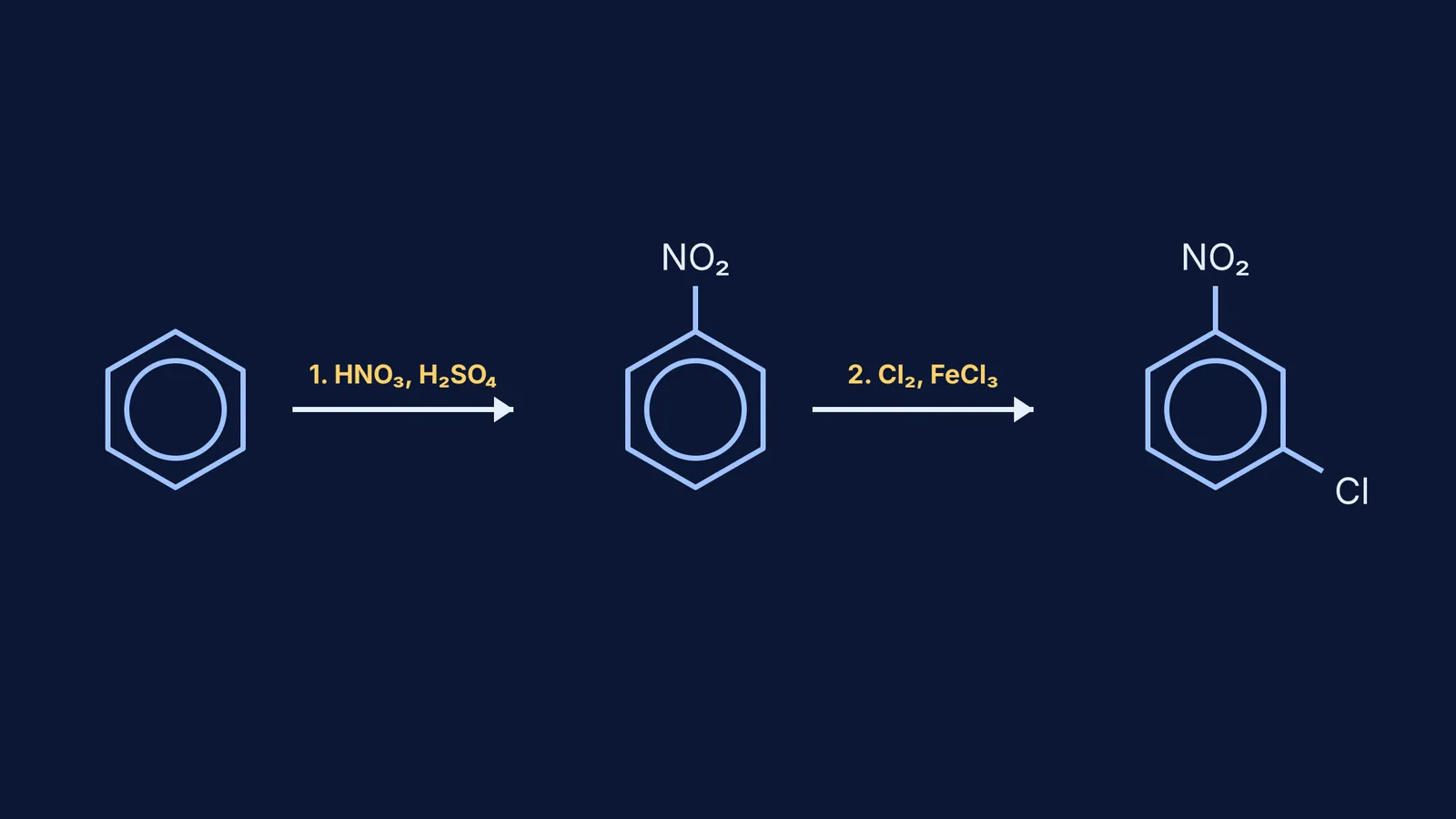
The target molecule is 1-chloro-3-nitrobenzene (m-nitrochlorobenzene). It has a chlorine atom and a nitro group meta to each other.
To make it, we must add the meta-directing group first.
Nitration: React benzene with a mixture of concentrated nitric acid (HNO₃) and concentrated sulphuric acid (H₂SO₄). This produces nitrobenzene. The reaction proceeds via the attack of a nitronium ion (NO₂⁺) electrophile on the aromatic ring, forming a positively charged arenium ion intermediate before restoring aromaticity. The newly formed nitrobenzene is strongly deactivated. In fact, due to the electron-withdrawing nature of the nitro group, the reaction rate for subsequent substitutions on this ring drops to a relative reaction rate of 6×10⁻⁸ compared to benzene, according to the electrophilic aromatic substitution principles.
Chlorination: React the nitrobenzene with chlorine gas (Cl₂) and a Lewis acid catalyst like anhydrous FeCl₃. Because the −NO₂ group is a meta-director, it forces the chlorine to attach at the meta position, yielding the desired m-nitrochlorobenzene. The Lewis acid catalyst is strictly required to generate the reactive electrophilic species from the otherwise stable chlorine molecule.
What happens if you reverse the order? If you chlorinate first, you produce chlorobenzene. Halogens are an exception to the activator/deactivator rule: they are deactivating by induction but ortho/para-directing by resonance. Subsequent nitration would yield a mixture of o-nitrochlorobenzene and p-nitrochlorobenzene, completely missing the meta target and failing the synthesis.
How to make p-bromonitrobenzene from benzene?
Here, the bromine atom and nitro group are opposite each other (para). This means we must put the ortho/para-director onto the ring first to ensure correct positioning.
Bromination: React benzene with bromine (Br₂) and a catalyst like FeBr₃. This forms bromobenzene. The bromine atom acts as an ortho/para-director. The Lewis acid catalyst generates the reactive electrophilic species from bromine, which attacks the ring to form a delocalised arenium ion intermediate.
Nitration: Treat the bromobenzene with concentrated HNO₃ and H₂SO₄. The bromine atom directs the incoming nitro group to the ortho and para positions. The para isomer (p-bromonitrobenzene) is usually the major product because the bulky bromine atom physically blocks the ortho positions, making them significantly less accessible.
If you were to nitrate first, you would get nitrobenzene. Subsequent bromination would yield m-bromonitrobenzene instead. You can see similar directing logic at play when planning the bromination of phenol or preparing an amine via nitrobenzene reduction.
A quick checklist for synthesis planning
Before you write out a reaction scheme on your exam paper, pause and ask yourself these three critical questions:
What is the spatial relationship in the final target? Are the two groups ortho (1,2), meta (1,3), or para (1,4)?
What are the directing effects of each individual group? Classify both groups as either ortho/para-directors or meta-directors based on resonance and inductive effects.
Which one must go first? If the target is meta, add the meta-director first. If the target is ortho or para, add the ortho/para-director first to ensure correct geometry.
If you are unsure whether your proposed synthesis pathway will work, try working it out in the Fermi Problem Library. Its step-by-step solver explains the reasoning behind each directing group rather than printing an answer.
Mastering this order of operations transforms organic synthesis from a pure memorisation exercise into a logical, predictable puzzle. Once you know the directing rules, you can accurately build almost any disubstituted aromatic ring.


