

On this page
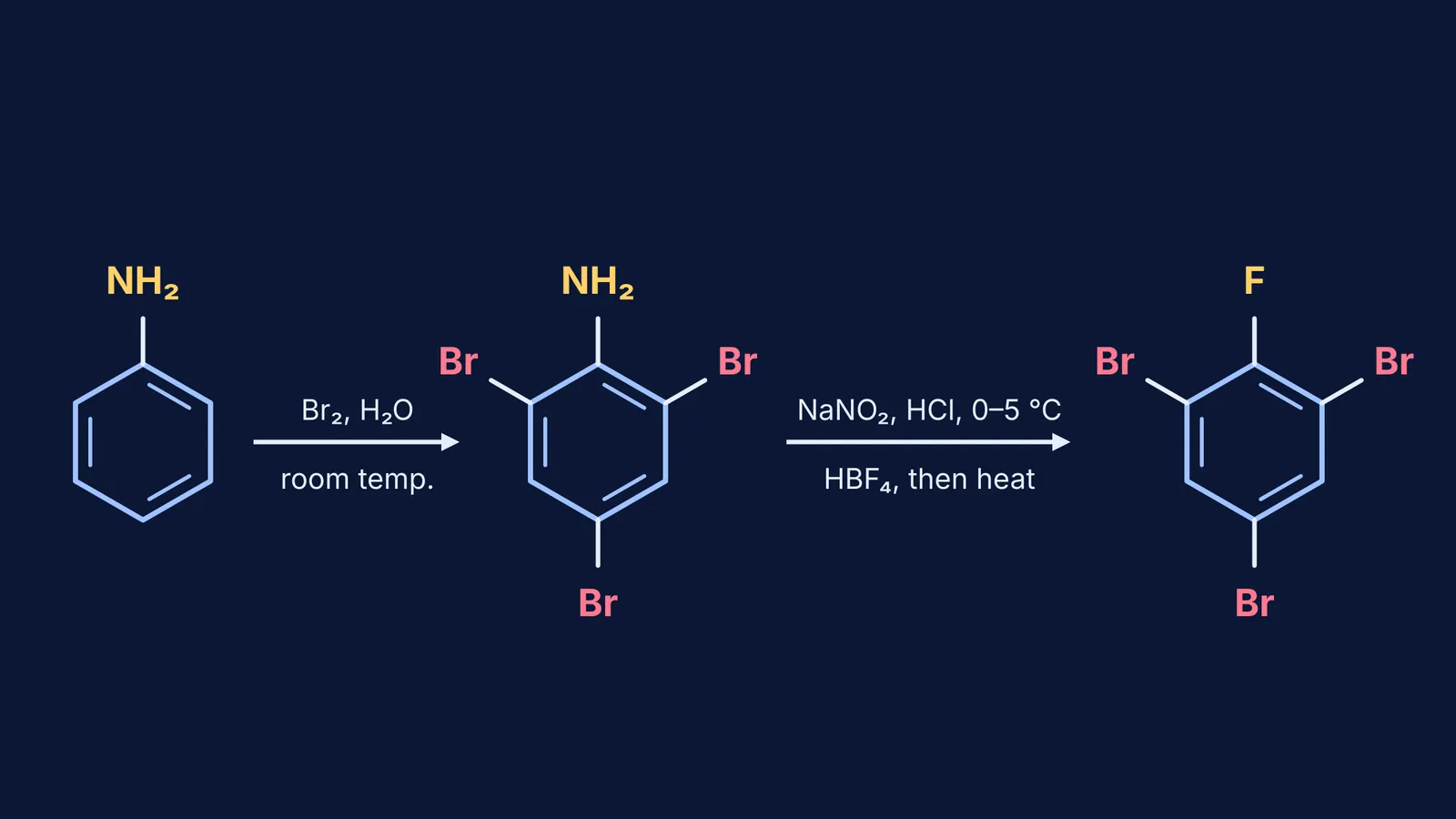
This conversion is Exercise 9.8(iv) in the NCERT Class 12 Chemistry chapter on Amines. It looks like a three-reagent memory test. Really it tests one idea: the amino group puts the bromines in place, then gets swapped for fluorine.
If you write the steps in the wrong order, the answer falls apart. Here is the order, the reason for it, and how to set it out for full marks.
What are the three steps from aniline to 2,4,6-tribromofluorobenzene?
Every reagent and condition below comes from the NCERT Amines chapter.
Bromination. Aniline reacts with bromine water at room temperature to give a white precipitate of 2,4,6-tribromoaniline: C6H5NH2 + 3Br2 → 2,4,6-Br3C6H2NH2 + 3HBr.
Diazotisation. The tribromoaniline reacts with nitrous acid, made in the flask from NaNO2 and HCl, at 273–278 K: ArNH2 + NaNO2 + 2HCl → ArN2+Cl− + NaCl + 2H2O. This gives 2,4,6-tribromobenzenediazonium chloride.
Fluoroborate, then heat. Adding fluoroboric acid precipitates the diazonium fluoroborate, ArN2+BF4−. Heating it gives off nitrogen and boron trifluoride and leaves the aryl fluoride: ArN2+BF4− → ArF + BF3 + N2.
The product is 1-fluoro-2,4,6-tribromobenzene, usually written 2,4,6-tribromofluorobenzene. The bromines sit at the same three positions they had in tribromoaniline. Fluorine simply takes carbon 1, where the nitrogen was. If the numbering trips you up, our guide to naming benzene derivatives with ortho, meta and para walks through it.
Why brominate before removing the amino group?
The NCERT chapter explains that the –NH2 group is ortho and para directing and a powerful activating group, because it pushes electron density into those ring positions (NCERT, Amines). That is why bromine water alone, with no catalyst, substitutes all three of them at once. The 2, 4 and 6 positions in the target are exactly the two ortho positions and the para position of the old amino group.
The amino group is also the only way in for fluorine. NCERT states that aryl fluorides and iodides cannot be prepared by direct halogenation (NCERT, section 9.10). So fluorine has to arrive through a diazonium salt, and you need the –NH2 group still in place to make one. Bromine goes on first, and the group that placed it leaves last.
Why must diazotisation be done at 0–5 °C?
NCERT says arenediazonium salts are stable only for a short time in solution, at low temperatures of 273–278 K (NCERT, Amines). If the temperature is allowed to rise to 283 K, the salt is hydrolysed to a phenol. In this problem that would give you 2,4,6-tribromophenol instead of the fluoride. Our explainer on why diazotisation is done at 0–5 degrees covers the stability argument in more depth.
The fluoroborate behaves differently. NCERT notes that benzenediazonium fluoroborate is insoluble in water and stable at room temperature. So once it precipitates, it can be filtered off and then heated on purpose.
What is the Balz–Schiemann reaction?
The Balz–Schiemann reaction is the conversion of an aryl diazonium salt into an aryl fluoride by forming and heating its tetrafluoroborate. Günther Balz and Günther Schiemann reported it in 1927 in Berichte der deutschen chemischen Gesellschaft (Balz and Schiemann, 1927). NCERT describes the reaction under "replacement by fluoride ion" without using the name, so expect either wording in a question. For the plain case, benzene diazonium chloride to fluorobenzene, see our Balz–Schiemann fluorobenzene walkthrough.
How do you write this conversion for full marks?
Use this checklist before you move on to the next question:
Three arrows, in this order: Br2/H2O; NaNO2 + HCl at 273–278 K; HBF4, then heat.
Name every intermediate: 2,4,6-tribromoaniline, 2,4,6-tribromobenzenediazonium chloride, 2,4,6-tribromobenzenediazonium fluoroborate.
Write the temperature on the diazotisation arrow, as NCERT does in every diazotisation equation.
Show the by-products of the last step: N2 and BF3.
Draw fluorine on the carbon that held –NH2, with bromines ortho, ortho and para to it.
The mistakes that cost the most marks:
Using Br2 with FeBr3. Aniline is reactive enough without a Lewis acid.
Trying a Sandmeyer reaction for fluorine. In NCERT, Cu(I) salts bring in Cl, Br and CN; fluorine comes in through HBF4.
Removing –NH2 before brominating. Without it you lose the 2,4,6 pattern and any way to add fluorine.
If you can recite the reagents but still mix up the order under time pressure, try the conversion in the Fermi Problem Library. It has worked problems with a step-by-step solver that explains the reasoning rather than printing an answer. If the gap is the directing-group idea itself, the Fermi Concept Library gives each concept in chemistry its own lesson.
Next, try NCERT Intext Question 9.9(ii), aniline into 1,3,5-tribromobenzene. It uses the same first two steps, but the diazo group is replaced by hydrogen instead of fluorine.


