

On this page
Benzene nomenclature feels straightforward until two substituents compete for numbering priority. Textbooks often mix traditional prefixes like *ortho-*, *meta-*, and *para-* with numerical locants, leaving students uncertain which convention to follow. Once you grasp how IUPAC prioritises systematic clarity, retained parent hydrides, and alphabetical order, naming any disubstituted ring becomes completely predictable.
Why does IUPAC prefer numerical locants over ortho, meta, and para?
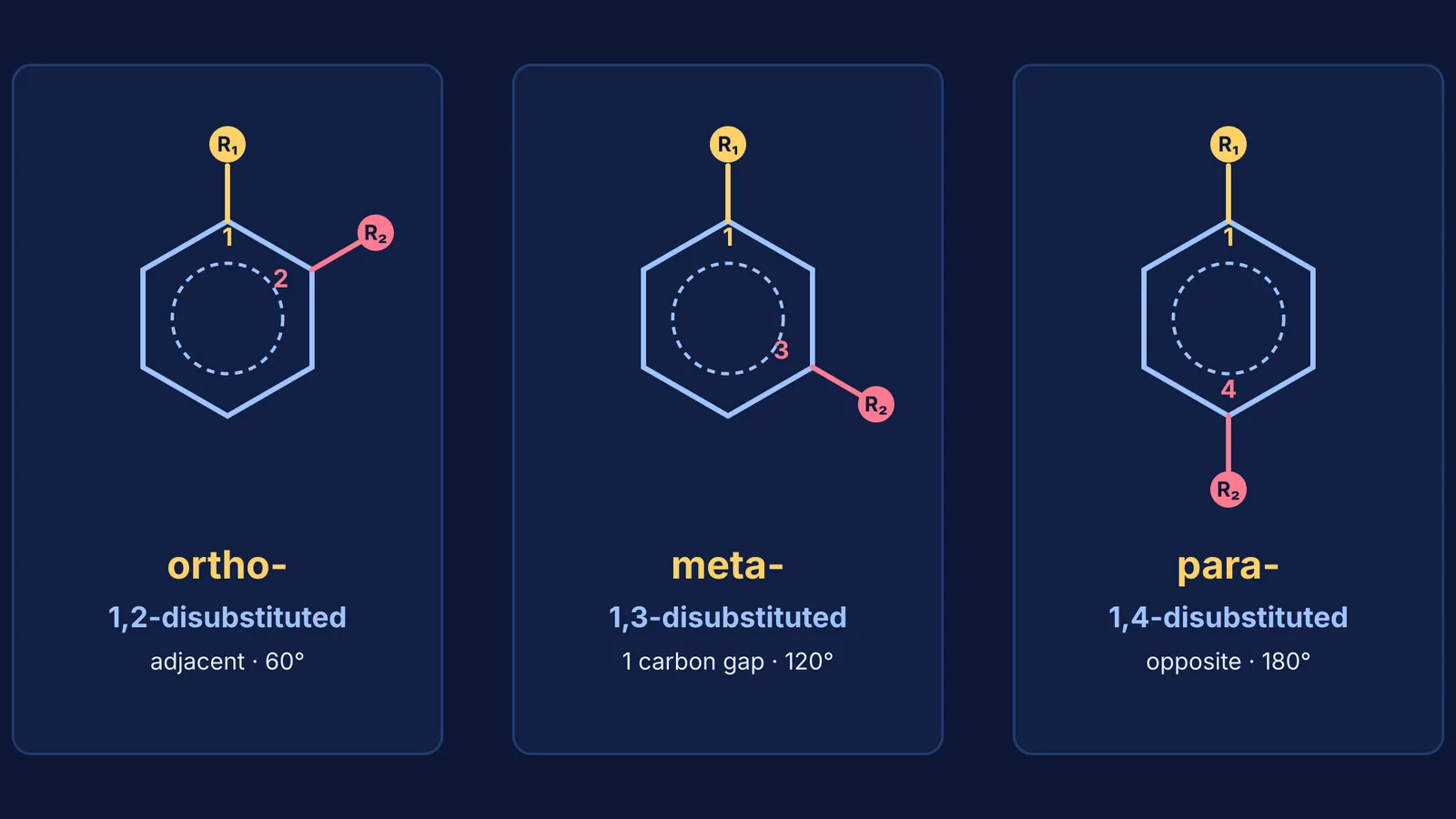
The classical descriptors *ortho* (Greek for upright), *meta* (after), and *para* (across) arose in nineteenth-century chemistry to denote positional relationships on a benzene ring. Under traditional usage, *ortho-* (*o-*) describes adjacent ring carbons, *meta-* (*m-*) denotes substituents separated by one carbon, and *para-* (*p-*) indicates groups directly opposite each other.
However, the IUPAC Blue Book recommendations explicitly state that traditional prefixes *o-*, *m-*, and *p-* are no longer recommended for Preferred IUPAC Names (PINs). Systematic naming requires numerical locants: 1,2- for ortho, 1,3- for meta, and 1,4- for para. As set out in IUPAC rule P-14.3, numbers prevent confusion when rings carry three or more substituents, where classical prefixes fail completely. For example, 1,2-dichlorobenzene is the systematic name for *o*-dichlorobenzene. Classical prefixes remain acceptable only in general nomenclature for a few traditional hydrocarbon names like *o*-xylene, *m*-xylene, and *p*-xylene.
When students review structural isomers across organic chemistry, the Fermi Concept Library includes every concept in chemistry, each with its own lesson and its place in the map.
When do you retain parent names like toluene, phenol, and aniline?
A central rule in aromatic nomenclature is the retention of common parent names. Under the IUPAC Blue Book recommendations, several monosubstituted benzenes have historical names retained as preferred parents (PINs):
Phenol for hydroxybenzene (–OH)
Aniline for aminobenzene (–NH₂)
Benzoic acid for benzenecarboxylic acid (–COOH)
Benzaldehyde for formylbenzene (–CHO)
Other traditional names like toluene (methylbenzene) and anisole (methoxybenzene) are retained in general nomenclature and widely used in introductory organic chemistry, though strict Preferred IUPAC Names often name their substituted derivatives systematically as benzenes (such as 1-chloro-4-methylbenzene).
When one substituent defines a retained parent, that ring carbon is automatically assigned position 1 (C1). Numbering then proceeds around the ring in whichever direction yields the lowest possible locant for the second group.
For example, attaching a chlorine atom adjacent to the hydroxyl group on phenol produces 2-chlorophenol, not 1-chloro-2-hydroxybenzene. Similarly, placing a nitro group opposite the amino group on aniline forms 4-nitroaniline, an aromatic amine synthesized when reducing nitrobenzene to aniline. Recognizing these exact locants is essential for predicting properties; for instance, 2-nitrophenol displays intramolecular hydrogen bonding, making it far more steam-volatile than 4-nitrophenol.
How do you break locant ties and order substituents alphabetically?
When neither substituent defines a special parent name—such as two halogens, or an alkyl group and a halogen—the root name is simply "benzene." Naming follows two straightforward conventions explained in Chemistry LibreTexts organic guidelines/15%3A_Benzene_and_Aromaticity/15.01%3A_Naming_Aromatic_Compounds):
Lowest locant rule: Number the ring to give the substituents the lowest possible numbers at the first point of difference, yielding {1,2}, {1,3}, or {1,4}.
Alphabetical priority: If numbering from either substituent gives the exact same numerical set, assign carbon-1 to the group that comes first in alphabetical order.
In 1-bromo-2-chlorobenzene, numbering from bromine gives {1, 2}, and numbering from chlorine also gives {1, 2}. Because "bromo" precedes "chloro" alphabetically, bromine claims carbon-1. Naming the molecule 2-bromo-1-chlorobenzene is incorrect because it violates the alphabetical tie-breaker. Multiplicative prefixes like di- or tri- are ignored during alphabetical sorting.
When practice problems present competing functional groups or subtle locant ties, the Fermi Problem Library provides worked problems with a step-by-step solver that explains the reasoning rather than printing an answer.
What is the 4-step checklist for naming disubstituted benzenes?
Whenever you name a disubstituted benzene, apply this four-step sequence:
Identify the parent: Does either group create a retained parent name such as phenol, aniline, or benzoic acid? If yes, that substituent defines the root and occupies C1. If neither does, the parent is benzene.
Assign the numbering: If a retained parent is present, number toward the second group (yielding locants 2, 3, or 4). Otherwise, number to produce the lowest numerical pair ({1,2}, {1,3}, or {1,4}), breaking any tie by alphabetical preference.
Assemble the name alphabetically: List substituent prefixes alphabetically before the root, separating numbers from letters with hyphens and numbers from each other with commas (e.g. 1-bromo-3-chlorobenzene).
Distinguish formal and laboratory contexts: Use numerical locants for formal IUPAC answers, while keeping traditional descriptors in mind for reaction chemistry, such as predicting directing effects during the bromination of phenol.
For students untangling tricky nomenclature rules or aromatic mechanisms, Fermi's AI tutor can work out what you already know and build a plan for the session, stepping through each numbering convention on a shared digital board.


