On this page
Work out the oxidation state of thallium in TlI3 the quick way and you get +3. That answer is wrong. TlI3 is thallium(I) triiodide: a Tl+ cation next to a triiodide anion, I3−, the same ion that forms when iodine dissolves in potassium iodide solution (Wikipedia: Thallium triiodide). Two ideas from your Class 11 and 12 chemistry explain it: electrode potentials and the inert pair effect.
Why is TlI3 not thallium(III) iodide?
Because Tl3+ is a strong oxidising agent and iodide is an easy reducing agent, so the two react.
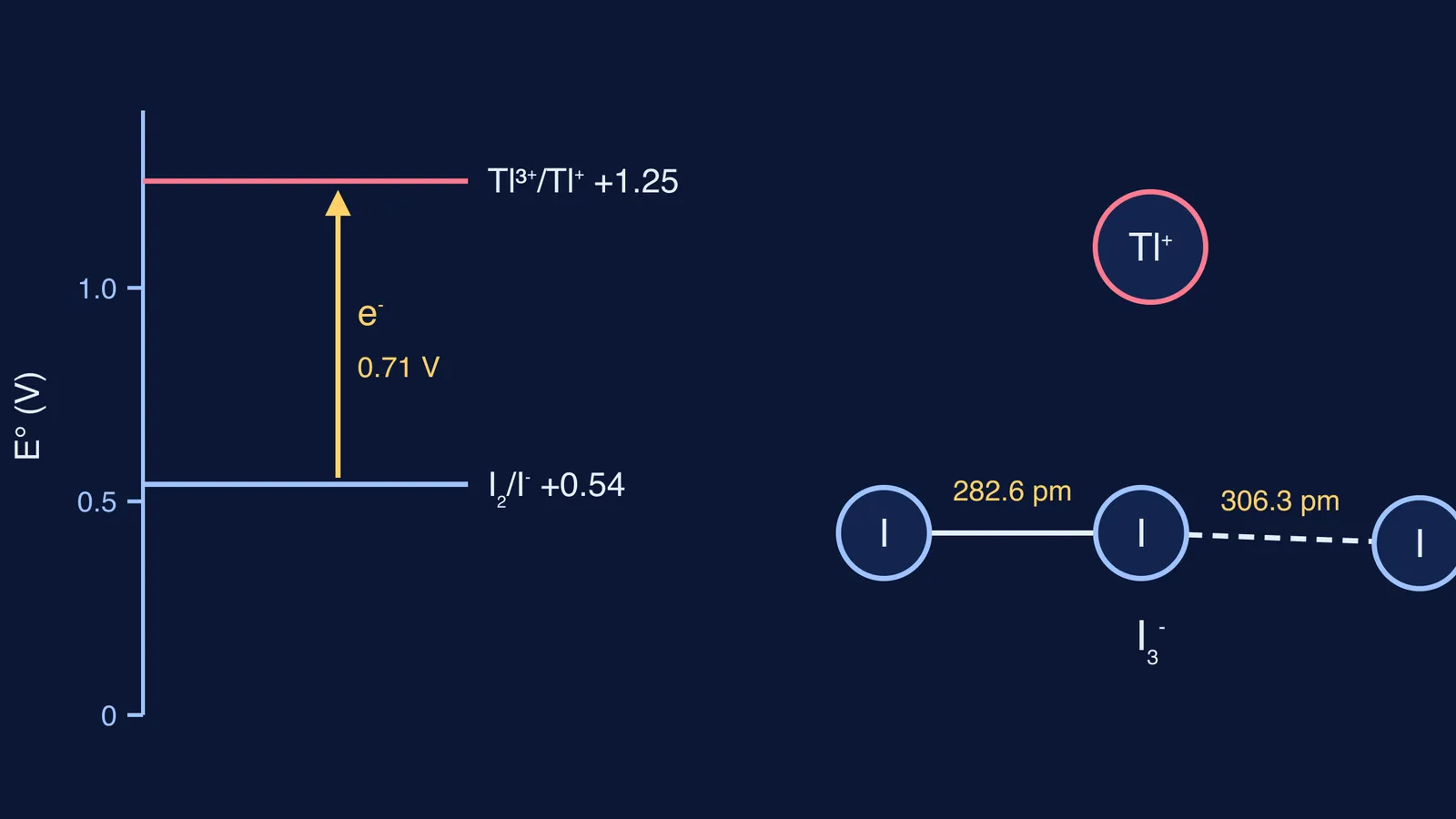
The standard reduction potential for Tl3+ + 2e− → Tl+ is +1.25 V, and for I2 + 2e− → 2I− it is +0.54 V (table of standard electrode potentials)).
Put the two half-reactions together:
Reduction: Tl3+ + 2e− → Tl+, E° = +1.25 V
Oxidation: 2I− → I2 + 2e−, which is the I2/I− couple (E° = +0.54 V) run backwards
E°cell = E°(reduced couple) − E°(oxidised couple) = 1.25 − 0.54 = +0.71 V
A positive E°cell makes ΔG° = −nFE° negative, so Tl3+ + 2I− → Tl+ + I2 goes forward
So if you tried to make "Tl3+ with three I−", two iodides would hand their electrons to thallium, leaving Tl+, one I− and one I2. The I− and I2 join as I3−, giving Tl+ I3−. If the sign in step 3 trips you up, our explainer on why reduction and oxidation potentials differ only in sign walks through it.
What does the inert pair effect have to do with it?
The electrode potential tells you Tl3+ is eager to gain two electrons. The inert pair effect is the name for why. Down group 13 the +1 state becomes more stable and the +3 state less so, and for thallium, Tl3+(aq) is less stable than Tl+(aq) (LibreTexts: heavier elements of group 13 and the inert pair effect/08%3A_Chemistry_of_the_Main_Group_Elements/8.06%3A_Group_13_(and_a_note_on_the_post-transition_metals)/8.6.02%3A_Heavier_Elements_of_Group_13_and_the_Inert_Pair_Effect)).
The school answer says the 6s2 pair is reluctant to take part in bonding. The same LibreTexts page gives a more precise reason: bond energies fall as bonds get longer down the group, so forming two extra bonds no longer pays for removing two more electrons. Either way, thallium is comfortable as Tl+. For the full trend across groups 13 to 15, read our post on the inert pair effect in heavy p-block elements.
How do we know TlI3 really contains I3−?
From its crystal structure. K. F. Tebbe and U. Georgy reported the X-ray crystal structures of rubidium triiodide and thallium triiodide in Acta Crystallographica Section C in 1986 (doi:10.1107/S0108270186090972).
TlI3 has a structure similar to CsI3, RbI3 and NH4I3, salts whose cations can only be +1 (Wikipedia: Thallium triiodide). The I3− unit in TlI3 is nearly straight, with a bond angle of 177.9°, and slightly lopsided, with I–I distances of 282.6 pm and 306.3 pm (same source). That linear shape is the one you meet when explaining why iodine dissolves in KI as the linear I3− ion.
What is the oxidation-state trap?
The trap is treating every iodine as I− by default. Do the bookkeeping on the real ions instead:
Thallium is +1.
I3− carries a total charge of −1, so the average oxidation state of iodine is −1/3.
Check: +1 + 3(−1/3) = 0.
For a heavy p-block metal paired with an easily oxidised anion, run three checks:
Does the metal prefer its lower state because of the inert pair effect (thallium, lead, bismuth)?
Is E° for the metal's higher state above E° for the anion's couple? If yes, the pair reacts.
Can the anion form a known polyatomic ion, such as I3−?
One caution from the same Wikipedia article: standard potentials should be used with care beyond neutral aqueous solution. With excess iodide in alcoholic base, TlI3 does give thallium(III), as the complex ion [TlI4]− (Wikipedia: Thallium triiodide). Complex formation shifts the balance; the simple E° argument explains only the plain compound.
If you keep landing on +3 in questions like this, the Fermi Problem Library has worked problems with a step-by-step solver that explains the reasoning rather than printing an answer.
Practice question: can you spot the same trap?
Use E°(Tl3+/Tl+) = +1.25 V and E°(Cl2/Cl−) = +1.36 V, both from the table of standard electrode potentials).
Question. (a) Give the oxidation state of thallium and the average oxidation state of iodine in TlI3. (b) Predict whether Tl3+ oxidises chloride ion under standard conditions. (c) Which anion can Tl3+ sit beside without being reduced: Cl− or I−?
Answer. (a) Thallium is +1; iodine averages −1/3. (b) For Tl3+ + 2Cl− → Tl+ + Cl2, E°cell = 1.25 − 1.36 = −0.11 V. It is negative, so Tl3+ cannot oxidise chloride under standard conditions. (c) Cl−. Iodide (E° = +0.54 V) sits well below Tl3+/Tl+ and reduces it, which is why TlI3 is Tl+ I3−.
If the inert pair effect still feels like a rule to memorise, the Fermi Concept Library gives each chemistry concept its own lesson and its place in the map.