On this page
Add sodium cobaltinitrite to a solution containing K⁺ and a yellow precipitate appears. For years this was only a qualitative test. In 1900, Richard Haliburton Adie and Thomas Barlow Wood, writing from Cambridge, showed that the precipitate has a fixed formula and turned the test into a way to measure potassium. Their paper, "A new method of estimating potassium", is in the Journal of the Chemical Society, Transactions, volume 77, pages 1076 to 1080 (scan on the Internet Archive). Its volumetric finish is a neat n-factor problem: one formula unit is worth 12 electrons to permanganate.
What is the yellow precipitate?
Adie and Wood analysed several samples and found them to be dipotassium sodium cobaltinitrite, K₂NaCo(NO₂)₆·H₂O. "So far as the authors have been able to ascertain," they wrote, this salt "has not been previously described."
Their analysis (mean found, with their calculated value in brackets):
K: 17.2% (17.2)
Na: 4.9% (5.1)
Co: 13.1% (13.0)
NO₂: 61.2% (60.8)
H₂O: 4.1% (3.9)
With modern atomic masses the formula mass is 454.16 g/mol, and the calculated values become K 17.22%, Na 5.06%, Co 12.98%, NO₂ 60.78% and H₂O 3.97%. Their mixed KCl and NaCl after ignition came to 45.5% (found and calculated); modern masses give about 45.7%.
In today's notation the salt is K₂Na[Co(NO₂)₆]·H₂O. The oxidation state of cobalt follows from 2(+1) + (+1) + x + 6(−1) = 0, so x = +3. Co³⁺ is d⁶, and the complex ion is [Co(NO₂)₆]³⁻.
How did they weigh potassium?
They precipitated 10 mL of 1% potassium chloride solution with 10 mL of the reagent and 1 mL of strong acetic acid, left it overnight, filtered, washed with 10% acetic acid and dried at 125 °C. The water of crystallisation stays put at that temperature; they found it "was not readily given off, even at 130°".
Three runs gave 0.103, 0.101 and 0.096 g of KCl, against 0.1 g taken.
Two practical points from the paper:
Concentration matters. Work between 0.5% and 1% K₂O. At 0.2% the precipitate came out 6% low, and at 0.1% only two-thirds could be collected. They blamed a fine precipitate that sticks to glass and runs through the filter, not solubility.
Solubility is tiny. Their measurement put it at "rather less than 1 part of the salt in 20,000" of 10% acetic acid. From their titre (0.6 mL of N/10 permanganate for 50 mL), the figure works out to about 0.045 g/L, or 1 part in 22,000.
Why titrate the nitrite with permanganate?
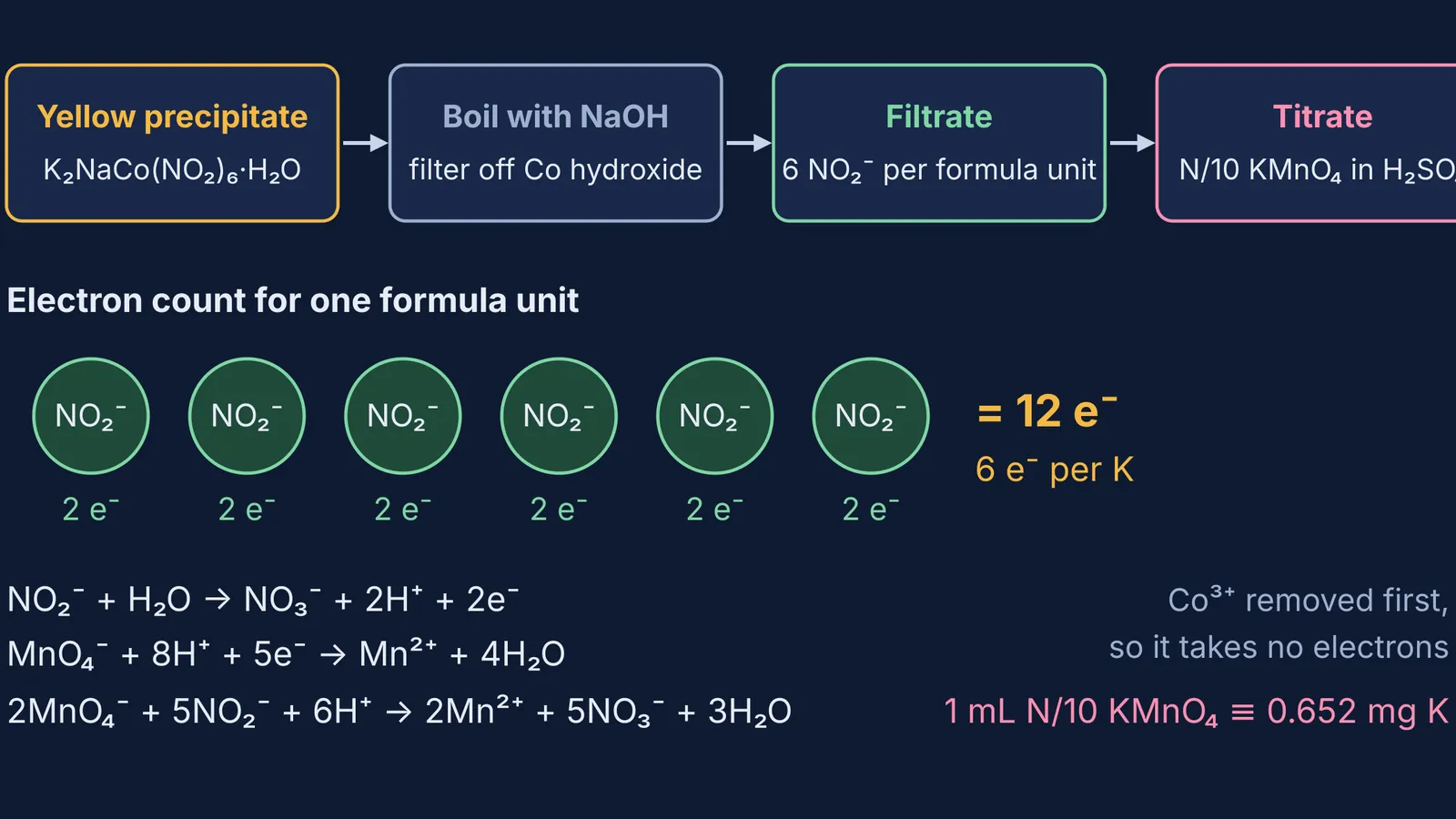
For the volumetric finish, they boiled the precipitate with dilute sodium hydroxide, filtered off the cobalt as hydroxide, and made the filtrate, which holds all six nitrites, up to 100 mL. They used asbestos in a Gooch filter, because paper interferes with permanganate. Then they titrated 20 mL portions with N/10 KMnO₄ in sulphuric acid. For why sulphuric and not hydrochloric acid, see why dilute H₂SO₄ is used in KMnO₄ titrations.
The half-equations:
MnO₄⁻ + 8H⁺ + 5e⁻ → Mn²⁺ + 4H₂O
NO₂⁻ + H₂O → NO₃⁻ + 2H⁺ + 2e⁻
Overall: 2MnO₄⁻ + 5NO₂⁻ + 6H⁺ → 2Mn²⁺ + 5NO₃⁻ + 3H₂O. Atoms and charge balance (−1 on each side).
There was a catch. Nitrous acid loses oxides of nitrogen once the solution is acidified. Their fix was clever: do a quick rough titration, then add that whole volume of permanganate to a fresh portion before acidifying, and finish dropwise. In their example, 20 mL took 16.3 mL on the rough run, and the careful run needed 16.3 + 0.1 mL.
How do you get potassium from the burette reading?
Here is the electron bookkeeping, using their 16.4 mL figure. The paper gives it only to illustrate the titration and does not say what sample it came from, so we treat it as if it came from 0.100 g of KCl, the amount in their weighing test.
Electrons per formula unit. Each NO₂⁻ gives 2 e⁻. There are 6 nitrites, so one K₂NaCo(NO₂)₆·H₂O is worth 12 e⁻. The cobalt was filtered off, so it does not count.
Electrons per potassium. 2 K per formula unit, so 6 e⁻ per K.
Total equivalents. 16.4 mL per 20 mL portion means 16.4 × 5 = 82.0 mL for all 100 mL. 82.0 mL × 0.1 N = 8.20 meq.
Moles of salt. 8.20 ÷ 12 = 0.683 mmol of K₂NaCo(NO₂)₆·H₂O.
Potassium. 2 × 0.683 = 1.367 mmol K, which is 1.367 × 74.55 = 0.102 g of KCl.
Check against theory. Exactly 0.100 g of KCl is 1.341 mmol K, which gives 0.671 mmol of salt (0.305 g). That needs 0.671 × 12 = 8.05 meq, or 16.1 mL per 20 mL portion. So 16.4 mL is within about 2%.
A handy factor: 1 mL of N/10 KMnO₄ corresponds to 0.1 meq, so it is equivalent to 0.1 ÷ 6 = 0.0167 mmol K, or 0.652 mg of K (0.785 mg of K₂O). For weighing, the gravimetric factor KCl/precipitate is 2 × 74.55 ÷ 454.16 = 0.3283.
The general method is in n-factor and the equivalent concept in redox titrations.
What about the cobalt(III)?
Co³⁺ is an oxidising agent, and Co²⁺ is the stable state of cobalt in acid. If the whole precipitate were dissolved in acid with the cobalt still present, Co³⁺ → Co²⁺ would take electrons from the nitrite that would otherwise go to permanganate. Electron bookkeeping says one electron per formula unit, so permanganate would see fewer than 12.
Adie and Wood avoided the question by boiling with alkali and filtering the cobalt off first, so their count is a clean 12. Later procedures for this precipitate may handle the cobalt differently, and we have not checked the factor they use. Always take the n-factor from the procedure in front of you.
Did it work outside the lab?
They tried it on fertilisers and a soil, against the platinic chloride method then in use (K₂O per cent):
Muriate of potash: 49.67 by cobaltinitrite, 49.64 by platinic chloride.
Sulphate of potash: 50.05 and 50.82, against 50.80.
Kainite: 12.22, 11.94 and 12.70, against 11.98, 12.07 and 12.53.
A peaty soil: mean 1.10, against 1.08.
Their verdict was that the method "is nearly as accurate as the methods hitherto available for estimating potassium by means of platinum, whilst it is much easier to work".
Where does this meet your syllabus?
Class 11 Redox: n-factors of NO₂⁻ (2) and MnO₄⁻ in acid (5), and balancing by half-equations.
Class 12 Coordination compounds: working out the oxidation state of Co in [Co(NO₂)₆]³⁻ and its d⁶ configuration. The nitrite ligand can bind through N or O; see ambident nucleophiles such as nitrite.
Practical chemistry: gravimetric factors and back-checking a titre against theory.
If n-factor questions are your weak spot before the exam, Fermi Test Prep is JEE Main and Advanced preparation with an AI tutor. For more worked titration problems, the Fermi Problem Library has a step-by-step solver that explains the reasoning.
Quick checklist
Precipitate: K₂NaCo(NO₂)₆·H₂O, M = 454.16 g/mol, 17.22% K.
Co is +3; check it before you count electrons.
Cobalt filtered off: n = 12 per formula unit, 6 per K.
1 mL N/10 KMnO₄ ≡ 0.652 mg K.
Add the rough titre before acidifying, so nitrous acid is not lost.