On this page
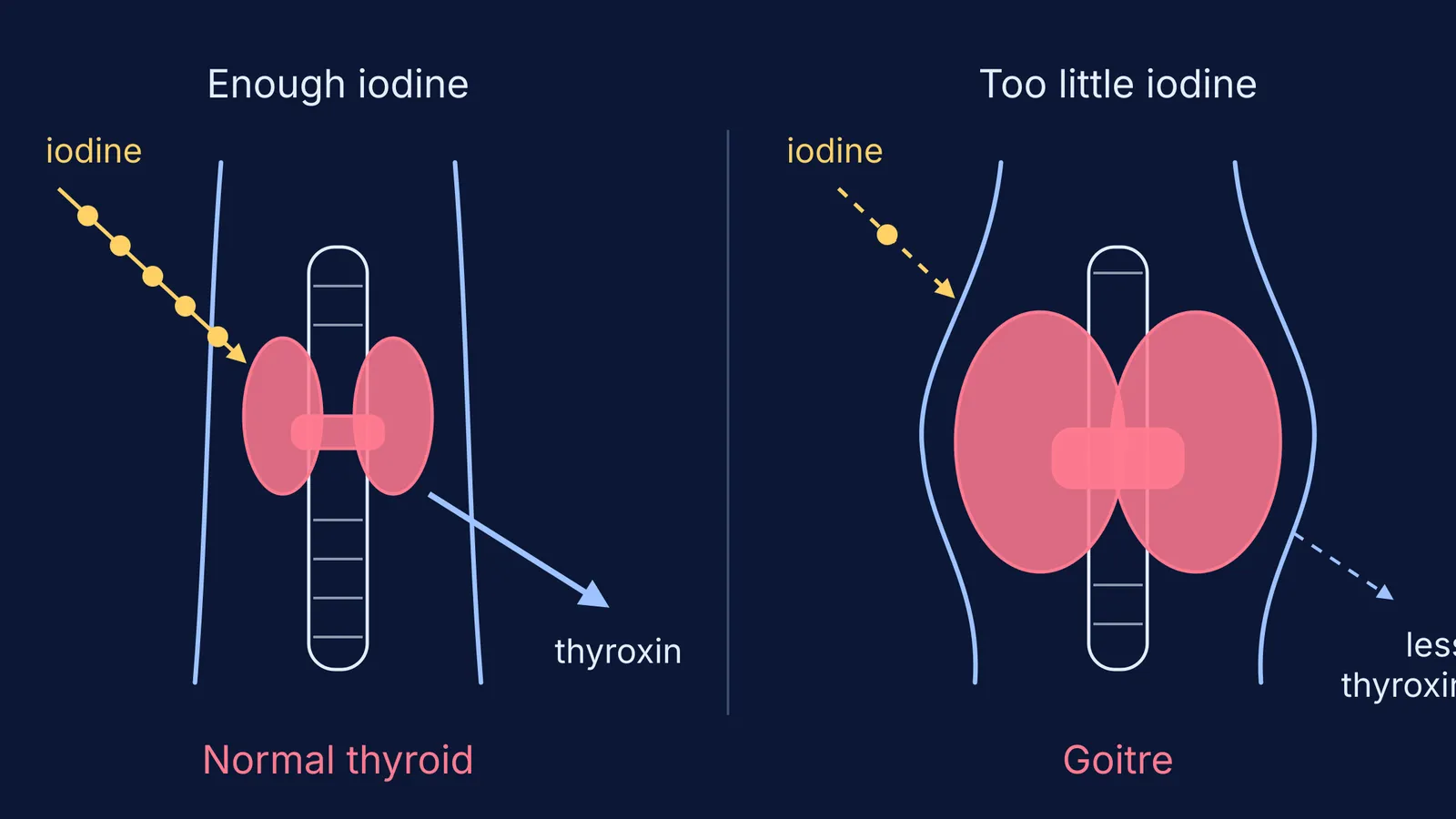
"Why is the use of iodised salt advisable?" comes straight from the NCERT Class 10 Science textbook. The answer is short once you see the chain: salt carries iodine, the thyroid uses iodine to make a hormone, and without enough iodine the gland swells into a goitre. Here is that chain, the textbook wording, and a two-mark answer.
What does NCERT say about iodised salt?
The passage sits in Chapter 6, Control and Coordination, under section 6.3, Hormones in animals, of the NCERT Class 10 Science textbook (Chapter 6 PDF). NCERT states: "Iodine is necessary for the thyroid gland to make thyroxin hormone." It adds that thyroxin "regulates carbohydrate, protein and fat metabolism in the body so as to provide the best balance for growth", and that if iodine is deficient in our diet, "there is a possibility that we might suffer from goitre". One symptom, the book says, is a swollen neck.
The chapter then asks this exact question in its in-text questions. NCERT spells the hormone "thyroxin"; many other books write "thyroxine". Both name the same hormone.
How does the thyroid use iodine to make thyroxin?
Think of it as four links in a chain:
You take in iodine through food, such as iodised salt.
The thyroid gland, which sits in the front of your neck (Figure 6.7 in the chapter shows where), takes up that iodine.
The thyroid builds iodine into the hormone thyroxin and releases it into the blood.
Thyroxin reaches cells across the body and regulates how they use carbohydrates, proteins and fats.
That is why the topic sits in a chapter on coordination: thyroxin is a chemical messenger, made in one place and acting somewhere else. A 2023 review in Nutrients by Giuseppe Lisco and colleagues states the dependency plainly: the thyroid gland "requires iodine to synthesize thyroid hormones", and iodine deficiency results in inadequate production of thyroxine.
Revising all the glands? Our explainer on why the pituitary is called the master gland shows how they are linked. If they still blur together, the Fermi Concept Library gives each biology concept its own lesson and its place in the map.
What is goitre, and why does the neck swell?
A simple goitre is an enlargement of the thyroid gland, according to MedlinePlus, from the US National Library of Medicine. MedlinePlus explains that when the diet lacks iodine, "the thyroid gets larger to try and capture all the iodine it can" to make enough hormone. That is the swollen neck NCERT describes.
So the exam logic runs: too little iodine, too little thyroxin, an enlarged gland, goitre. Not every goitre has this cause; our post on simple goitre vs exophthalmic goitre sets out the difference.
Why is iodine added to salt in India?
Nearly every kitchen uses salt every day in small, steady amounts, which makes it a practical carrier for a nutrient needed only in tiny quantities. The Directorate General of Health Services says the National Goitre Control Programme was renamed the National Iodine Deficiency Disorders Control Programme in August 1992. Its goals are to reduce the prevalence of iodine deficiency disorders to below 5% and to ensure that every household uses adequately iodised salt, which the page defines as 15 parts per million (ppm) of iodine. The same page reports that 94.3% of households were using adequately iodised salt in the National Family Health Survey of 2020-21.
How do you write the two-mark answer?
Q. Why is the use of iodised salt advisable?
Iodine is necessary for the thyroid gland to make the hormone thyroxin. Thyroxin regulates carbohydrate, protein and fat metabolism in the body to provide the best balance for growth. If our diet lacks iodine, we may suffer from goitre, in which the thyroid gland enlarges and the neck swells. Iodised salt is an easy way to get iodine every day, so its use is advisable.
Check your answer against four points:
Does it name the gland (thyroid), not just "the body"?
Does it name the hormone (thyroxin)?
Does it say what thyroxin does (regulates metabolism for growth)?
Does it name the disease (goitre) and its sign (swollen neck)?
Common slips to avoid:
Calling iodine a hormone. Iodine is the raw material; thyroxin is the hormone.
Naming the wrong gland. Goitre is a swelling of the thyroid, not the pituitary or pancreas.
Writing "iodised salt is healthy" and stopping. The question asks why, so give the gland, hormone and disease chain.
For a three-mark version, add where the thyroid sits (in the neck, Figure 6.7) and sketch the four-link chain. For other minerals asked about this way, see our guide to iron, iodine and calcium: functions, deficiencies and foods.
Not sure where to start with Chapter 6? Fermi's AI tutor can work out what you already know and build a plan for the session.