On this page
Both conditions make the thyroid swell at the front of the neck, and that is why students mix them up in a difference question. The way to keep them apart is to ask one thing: is the gland making too little hormone, or too much?
What does NCERT say about each goitre?
The Class 11 chapter Chemical Coordination and Integration (NCERT, Chapter 19) covers both in the section on the thyroid gland. The follicular cells make two hormones, thyroxine (T4) and triiodothyronine (T3), and NCERT says iodine is essential for the normal rate of hormone synthesis.
For simple goitre, NCERT says that a lack of iodine in the diet causes hypothyroidism and an enlarged thyroid gland, commonly called goitre. It adds that hypothyroidism during pregnancy can cause cretinism in the baby (stunted growth, mental retardation, low IQ, abnormal skin, deaf-mutism), and in adult women it can make the menstrual cycle irregular.
For exophthalmic goitre, the textbook's definition fits in one sentence: it is a form of hyperthyroidism, marked by an enlarged thyroid, bulging eyeballs, a higher basal metabolic rate and weight loss, and is also called Graves' disease (NCERT, Chapter 19).
What is the difference between simple goitre and exophthalmic goitre?
Write each point as a matching pair, the way examiners mark difference questions.
Also called: NCERT calls simple goitre just goitre; exophthalmic goitre is also called Graves' disease.
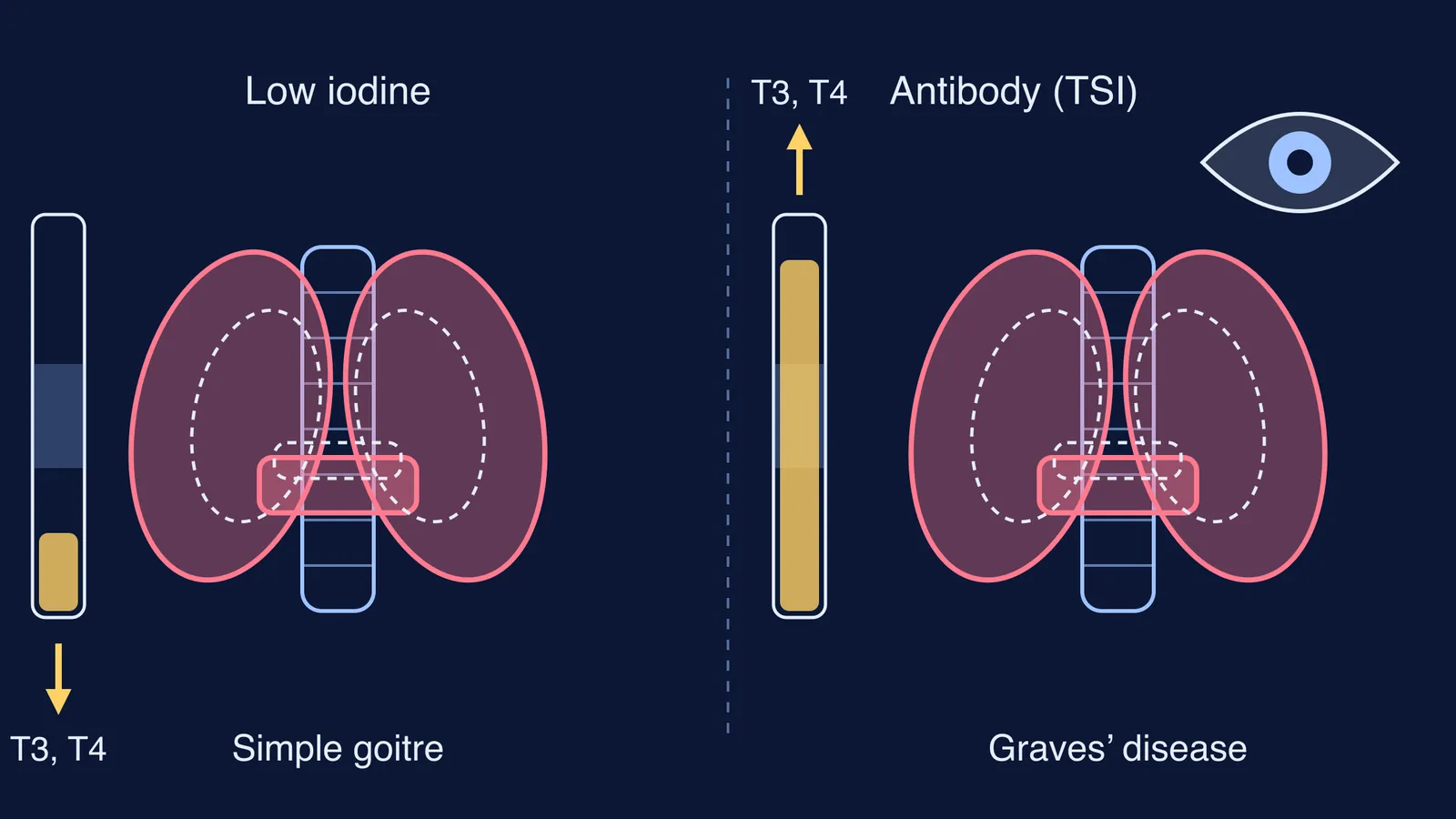
Cause: simple goitre comes from too little iodine in the diet; exophthalmic goitre is an immune problem that pushes the thyroid to make too much hormone (explained below).
Hormone level: NCERT links simple goitre to hypothyroidism (low T3 and T4), though MedlinePlus notes levels can stay normal at first; they are high in exophthalmic goitre (hyperthyroidism).
Basal metabolic rate: low in simple goitre; high in exophthalmic goitre.
Eyes: normal in simple goitre; bulging (exophthalmos) in exophthalmic goitre.
Body weight: weight loss is a sign of exophthalmic goitre in NCERT; the textbook names no weight change for simple goitre.
Prevention: India fights iodine-deficiency goitre with iodised salt (see below); exophthalmic goitre does not come from an iodine shortage, so iodised salt is not the remedy for it.
The low-BMR row follows from what NCERT says: thyroid hormones regulate the basal metabolic rate, so too little hormone means a lower rate.
Why does the thyroid swell in both cases?
In simple goitre, the gland grows to make up for a shortage. MedlinePlus, from the US National Library of Medicine, explains that without enough iodine in the diet the thyroid gets larger to try to capture all the iodine it can (MedlinePlus: Simple goiter). The same page says iodine deficiency is the most common cause of a goitre, and that the gland grows so it can still make the right amount of hormone. Over time it may fall short, which is the hypothyroidism NCERT describes.
In Graves' disease, the gland is being pushed. The US National Institute of Diabetes and Digestive and Kidney Diseases says the immune system makes an antibody called thyroid-stimulating immunoglobulin (TSI) that attaches to thyroid cells and drives them to make too much hormone (NIDDK: Graves' disease). NIDDK says Graves' disease causes about 4 out of 5 cases of hyperthyroidism in the United States, and more than 1 in 3 people with it develop the eye disease that makes the eyes bulge. NCERT does not explain this antibody, so for a board answer, stick to the textbook lines above.
The pituitary's thyroid-stimulating hormone (TSH) sits in the middle of all this, which is why it helps to revise the thyroid hormone negative feedback loop alongside this topic.
How does India prevent iodine-deficiency goitre?
Iodised salt. India's Directorate General of Health Services says the National Goitre Control Programme was renamed the National Iodine Deficiency Disorders Control Programme in August 1992, and it aims for every household to use adequately iodised salt, which it sets at 15 ppm of iodine (DGHS: NIDDCP).
A 3-mark answer you can copy the shape of
Name both: simple goitre is an enlarged thyroid caused by iodine deficiency; exophthalmic goitre (Graves' disease) is a form of hyperthyroidism.
Hormone level: simple goitre goes with hypothyroidism (low T3 and T4); exophthalmic goitre is hyperthyroidism (high T3 and T4).
Signs: exophthalmic goitre shows bulging eyeballs, higher BMR and weight loss; simple goitre shows a swollen neck with low-hormone effects, such as cretinism in babies if it happens during pregnancy.
Watch for the classic trap: an MCQ that pairs "exophthalmic goitre" with "iodine deficiency" is wrong. Our guide to writing difference tables in CBSE biology shows how to turn these pairs into full marks, and the table of hormone deficiency and excess disorders puts goitre next to cretinism, acromegaly and Addison's disease.
If the hypothyroidism and hyperthyroidism labels keep swapping in your head, the Fermi Concept Library gives every biology concept its own lesson and its place in the map, so you can see how the thyroid topics connect. To test yourself on exam-style questions, the Fermi Problem Library has worked problems with a step-by-step solver that explains the reasoning.
This guide is for exams, not diagnosis. A swelling in the neck, bulging eyes or unexplained weight loss needs a doctor, not a textbook.