

On this page
Endocrine disorders are easy NEET-UG and board marks, and easy to lose, because so many names sound alike. The way through: almost every disorder answers two questions. Which gland, and is the hormone too low or too high? NCERT's Class 11 chapter Chemical Coordination and Integration names most of them; we have added a few from official medical references to complete the pattern.
Which disorders come from too little or too much of a hormone?
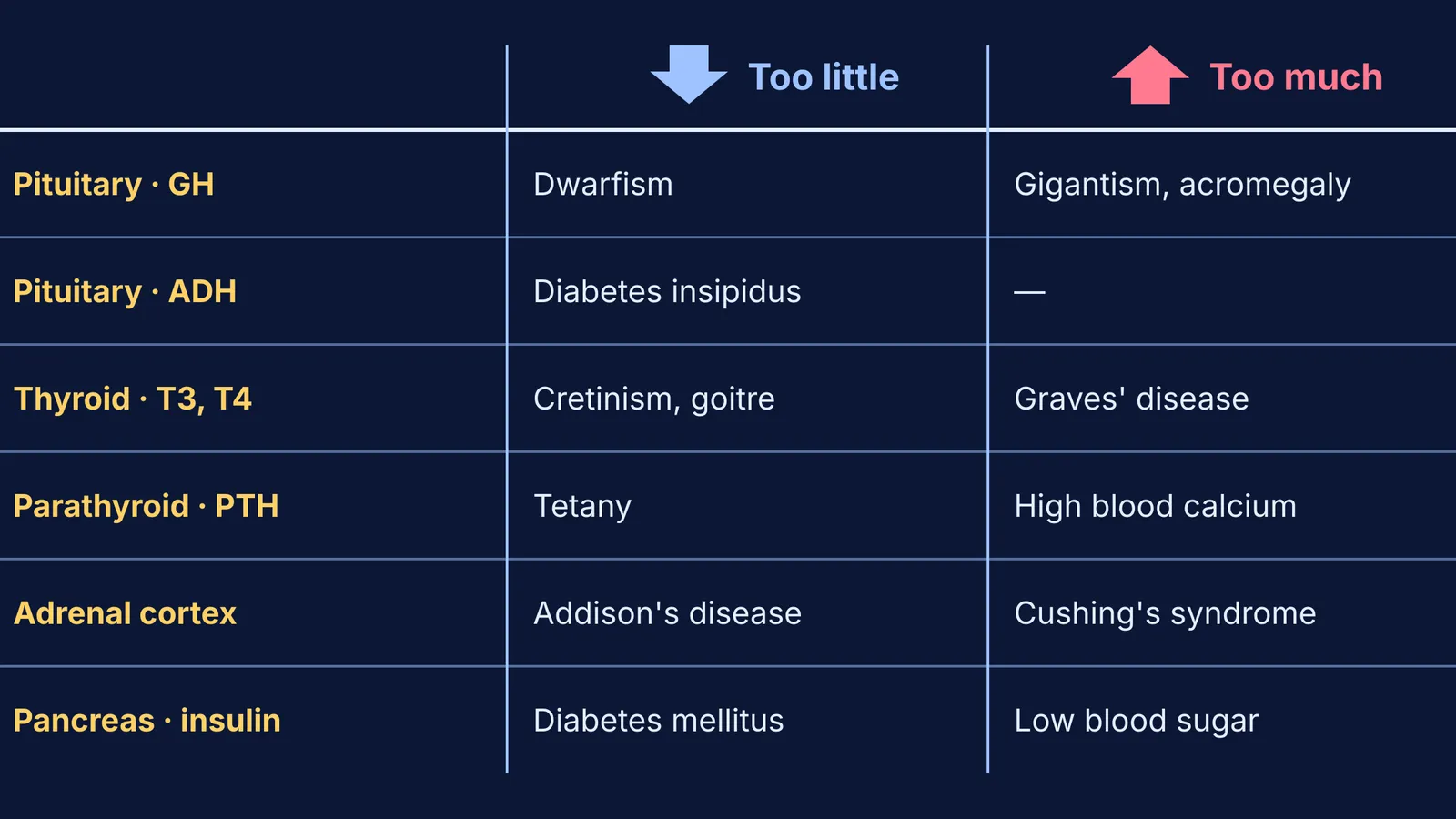
Pituitary, growth hormone (GH): low secretion causes pituitary dwarfism and over-secretion causes gigantism; excess GH in adults, especially in middle age, causes acromegaly, a disfigurement mainly of the face (NCERT Class 11, Chapter 19).
Posterior pituitary, ADH (vasopressin): when its synthesis or release is impaired, the kidney cannot conserve water, and the result is diabetes insipidus (NCERT, same chapter).
Thyroid, thyroxine (T4) and T3: iodine deficiency causes hypothyroidism and goitre, an enlarged thyroid; hypothyroidism in pregnancy causes cretinism in the baby; too much hormone is hyperthyroidism, and exophthalmic goitre, also called Graves' disease, is one form of it (NCERT).
Parathyroid, PTH: hypoparathyroidism means too little PTH, which lowers blood calcium and can cause the muscle spasms called tetany (MedlinePlus on hypoparathyroidism); too much PTH raises blood calcium (MedlinePlus on hyperparathyroidism).
Adrenal cortex, corticoids: underproduction causes Addison's disease, with acute weakness and fatigue (NCERT), and the hormones that run short include cortisol and aldosterone (MedlinePlus on Addison disease). A high level of cortisol causes Cushing syndrome (MedlinePlus on Cushing syndrome).
Pancreas, insulin: prolonged hyperglycemia leads to diabetes mellitus, with glucose lost in urine and ketone bodies formed; insulin itself lowers blood glucose (NCERT), and too much insulin in the bloodstream is one cause of low blood sugar, or hypoglycemia (MedlinePlus on low blood sugar).
To see where each gland sits and what every hormone normally does, start with our guide to endocrine glands, hormones and their actions.
How do you tell dwarfism, gigantism and acromegaly apart?
All three come from one hormone, GH, so the difference is direction and timing. Too little gives dwarfism. Too much gives gigantism. Too much in an adult gives acromegaly, which NCERT notes is hard to diagnose early and can go unnoticed for years until the face and features change (NCERT). If a question says "adult" or "middle age", the answer is acromegaly, not gigantism.
Why does goitre appear on both sides of the list?
Goitre simply means an enlarged thyroid. NCERT uses the word twice: goitre from iodine deficiency, where hormone is too low, and exophthalmic goitre, or Graves' disease, where hormone is too high, with protruding eyeballs and a raised basal metabolic rate (NCERT). So "goitre" alone does not tell you the direction; the eyes and the metabolic rate do.
The second pair to watch is the two kinds of diabetes. Diabetes mellitus is about insulin and blood sugar; diabetes insipidus is about ADH and water. The names look alike, which makes them easy to swap under time pressure.
Diabetes mellitus is also the one you will meet outside the exam hall. WHO defines diabetes as a chronic disease that occurs when the pancreas does not produce enough insulin or the body cannot effectively use the insulin it produces, and counts 830 million people living with it in 2022 (WHO diabetes fact sheet). In India, the ICMR-INDIAB survey of 113,043 people found a weighted diabetes prevalence of 11.4% and a prediabetes prevalence of 15.3% (Anjana and colleagues, The Lancet Diabetes and Endocrinology, 2023).
How should you memorise endocrine disorders for NEET?
Learn them as a grid, not as loose facts: six glands down the side, two columns, too little and too much. Then drill it.
Draw the empty grid from memory.
Fill every cell without looking. Leave a blank rather than guess.
Check against the NCERT chapter and circle each wrong or blank cell.
Next day, redo the circled cells, then the whole grid once.
Ask each cell both ways: "Excess GH in an adult causes what?" and "Acromegaly is caused by what?"
Worked example: "A middle-aged adult's facial features have slowly coarsened over years. Which hormone is likely in excess?" Gland: pituitary. Hormone: GH. Direction: too much. Timing: adult. Answer: excess GH, acromegaly. Statement-based and match-the-list questions can test the same chain in pieces.
The grid makes more sense once you see how the body holds hormone levels steady; read our posts on hormonal feedback loops and how hormones act through membrane and intracellular receptors.
If a cell keeps coming up blank, the Fermi Concept Library has a lesson for every concept in biology, each with its place in the map, so you can rebuild the gap from the gland up.
Draw the empty grid tonight and check it against NCERT tomorrow.


