On this page
In transcription, a cell copies only a segment of DNA into RNA, and only one of that segment's two strands. Replication is different: there, the whole DNA gets copied. Exam questions often ask why, then hand you a template strand and ask for the mRNA. Here are NCERT's two reasons, plus a worked example that shows each one with real bases.
Why are both DNA strands not transcribed?
The answer you should learn is in section 5.5 of NCERT Class 12 Biology, Chapter 5, Molecular Basis of Inheritance. The textbook defines transcription as “the process of copying genetic information from one strand of the DNA into RNA”. It then gives two reasons why both strands are not copied.
Two different proteins. The two strands are complementary, and NCERT reminds you that “complementarity does not mean identical”. If both strands were templates, they would give RNAs with different sequences. If both RNAs coded for proteins, one segment of DNA would code for two different proteins, and NCERT says this “would complicate the genetic information transfer machinery”.
The RNAs would stick together. Two RNAs made at the same time from the two strands would be complementary to each other. They would pair up into double-stranded RNA, which cannot be translated into protein. In NCERT's words, transcription “would become a futile one”.
Which DNA strand is the template strand?
NCERT's rule comes from the enzyme. DNA-dependent RNA polymerase builds RNA in only one direction, 5′ to 3′. So the strand with 3′→5′ polarity acts as the template strand (NCERT Chapter 5, section 5.5.1).
The other strand has 5′→3′ polarity. Its sequence matches the RNA, except that it has thymine where the RNA has uracil. NCERT calls it the coding strand, even though it “does not code for anything”. By convention, a transcription unit is always described using the coding strand.
What decides which strand gets read? The promoter. NCERT notes that the promoter defines the template and coding strands, and that swapping the positions of the promoter and terminator would reverse which strand is which. Our post on the promoter, structural gene and terminator covers the transcription unit in detail. If 5′ and 3′ still feel like labels you memorise rather than understand, start with what antiparallel means in DNA.
How do you find the mRNA from a template strand?
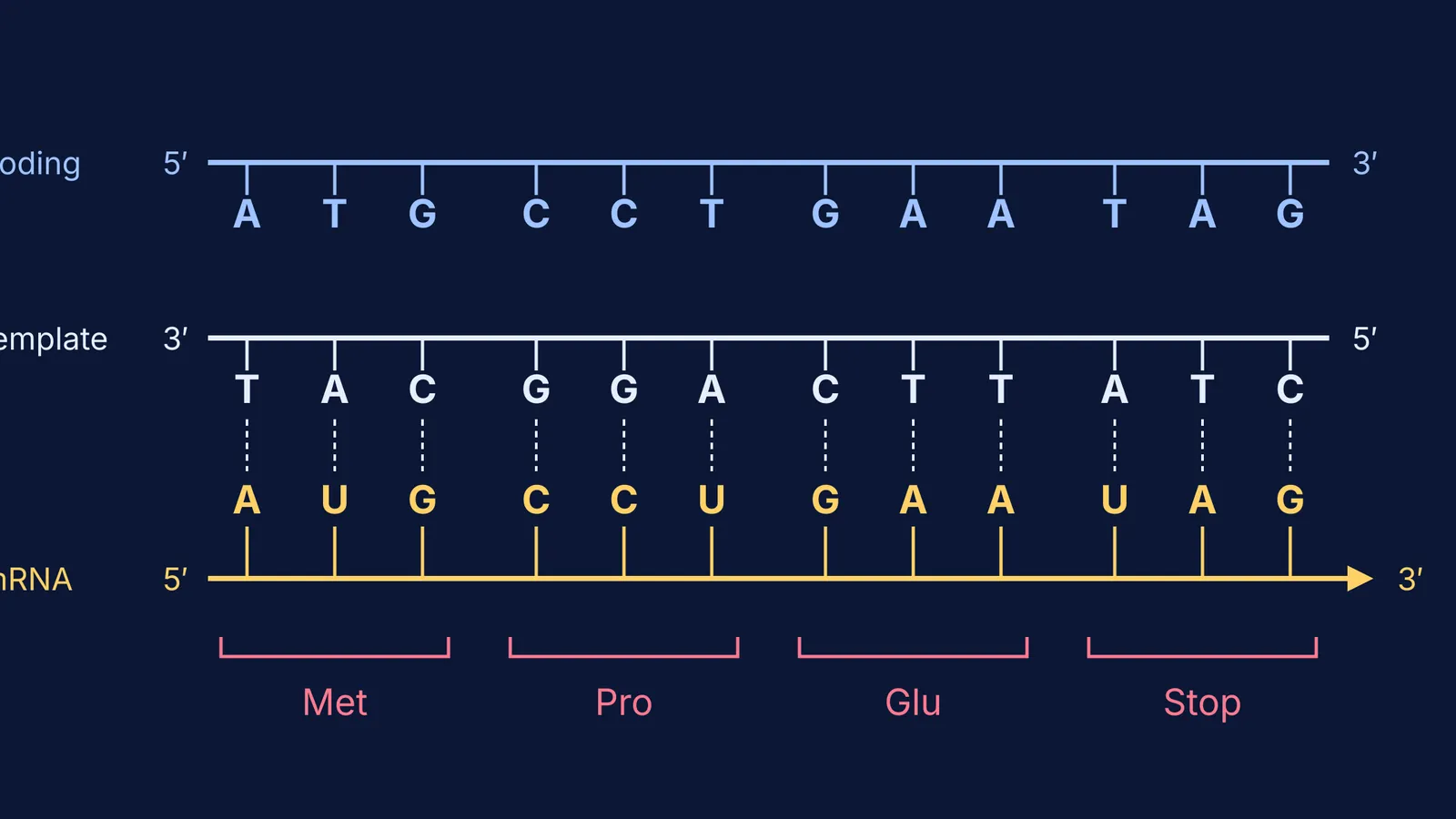
Take this template strand, split into triplets so you can read it:
Template: 3′-TAC GGA CTT ATC-5′
Check the ends first. It is written 3′ to 5′ from left to right, so you can pair the bases from left to right.
Pair each base, with U in place of T. A pairs with U, T with A, G with C and C with G.
Write the mRNA with its own ends. mRNA: 5′-AUG CCU GAA UAG-3′. It is antiparallel to the template.
Check it against the coding strand. The coding strand is 5′-ATG CCT GAA TAG-3′. It matches the mRNA exactly once you swap T for U.
Read the codons. In NCERT's codon table (Table 5.1 in the same chapter), AUG is methionine, CCU is proline, GAA is glutamate and UAG is a stop codon. The peptide is Met-Pro-Glu.
Now use the same DNA to test both of NCERT's reasons. If the coding strand were also used as a template, its RNA would be 5′-CUA UUC AGG CAU-3′. Read in triplets with the same table, that gives Leu-Phe-Arg-His, a completely different peptide. That is reason one. The two RNAs, 5′-AUGCCUGAAUAG-3′ and 5′-CUAUUCAGGCAU-3′, are also complementary along their full length when you line them up antiparallel. They would zip together into double-stranded RNA, which is reason two.
For practice, try NCERT's own question. Its template strand is 3′-ATGCATGCATGCATGCATGCATGC-5′ (NCERT Chapter 5, section 5.5.1). The RNA you should get is 5′-UACGUACGUACGUACGUACGUACG-3′, which is the textbook's coding strand with every T changed to U. We go through more cases, including questions that give only the coding strand, in how to find the mRNA sequence from a template strand.
What should you check before writing the answer?
Both ends of every strand are labelled 5′ or 3′.
The template strand runs 3′ to 5′, and the mRNA runs 5′ to 3′.
There is no T anywhere in your mRNA.
Your mRNA matches the coding strand, with U in place of T.
For “why only one strand”, you gave both reasons: two different proteins, and double-stranded RNA that cannot be translated.
If transcription keeps blurring into replication for you, the Fermi Concept Library has a lesson on every biology concept, and each one shows where it sits in the map. Fermi's AI tutor can draw both strands for you and check your understanding as you pair the bases yourself.