

On this page
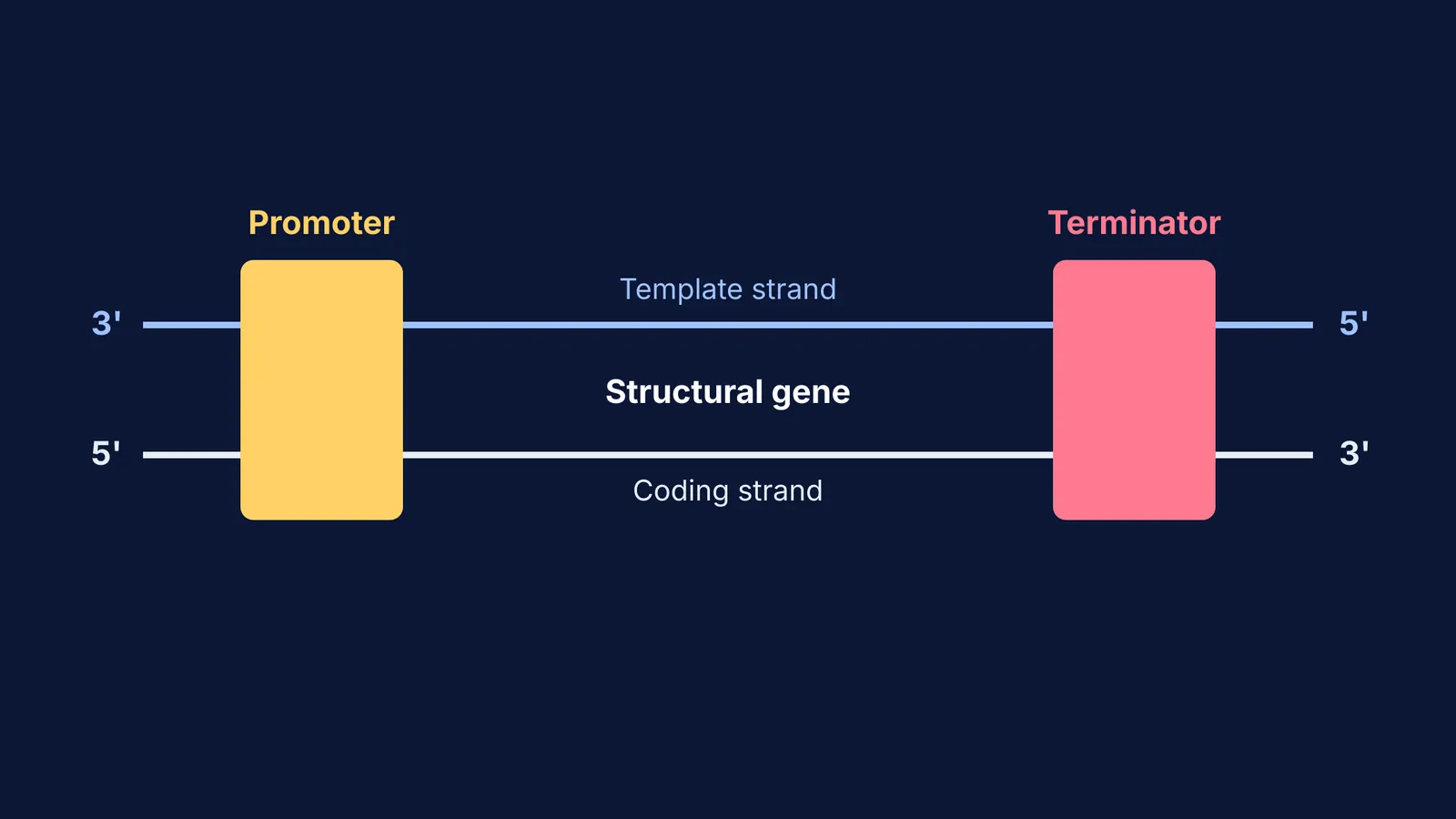
When you learn how DNA is copied into RNA for exams like NEET, you will need to draw and label a transcription unit. According to the NCERT Biology textbook, a transcription unit in DNA is defined by three primary regions: a promoter, a structural gene, and a terminator.
To label the diagram correctly, you first have to identify the two strands of DNA and the direction they run in.
Which is the template strand and which is the coding strand?
Transcription is carried out by an enzyme called DNA-dependent RNA polymerase. This enzyme only catalyses the polymerisation of RNA in one specific direction: 5' to 3'.
Because of this strict directional rule, the DNA strand that has the 3' to 5' polarity acts as the template for the RNA. It is logically called the template strand. The other DNA strand, which has the 5' to 3' polarity, is pushed out of the way during transcription. It is called the coding strand.
Paradoxically, the coding strand does not actually code for RNA. Its sequence is simply identical to the newly made RNA transcript (except that the base thymine in DNA is replaced by uracil in RNA). However, biologists use this non-transcribing coding strand as the master reference point for defining where everything else sits.
If you understand the convention of reading from the coding strand, you can solve most exam questions on this topic. If you struggle to hold these conventions in mind during an exam, the Fermi Concept Library maps every concept in biology, each with its own lesson.
Where is the promoter located?
The promoter is a specific DNA sequence that provides a binding site for RNA polymerase. It signals exactly where transcription should begin.
In a transcription unit, the promoter is located towards the 5' end of the structural gene. Remember that we measure everything with respect to the coding strand. So, the promoter sits at the 5' end (upstream) of the 5' to 3' coding strand.
It is the presence of the promoter that actually defines which strand will be the template and which will be the coding strand. If you were to artificially swap the positions of the promoter and terminator, the roles of the two strands would reverse completely.
What is the structural gene?
The structural gene is the stretch of DNA between the promoter and the terminator that actually gets transcribed into RNA.
In eukaryotes (like humans and plants), a structural gene is usually monocistronic, meaning one gene codes for one polypeptide. Eukaryotes also have multiple types of RNA polymerase to handle different jobs, which you can read about in our guide to Three RNA polymerases in eukaryotes: what each one makes. Before a eukaryotic RNA molecule can be used, it must undergo RNA processing in eukaryotes: capping, tailing and splicing to remove non-coding sections called introns.
In prokaryotes (like bacteria), the structural gene is often polycistronic, meaning a single stretch of DNA codes for several different proteins at once.
Where does the terminator sit?
The terminator is a DNA sequence that defines the end of the transcription process. When RNA polymerase reaches the terminator region, the newly formed RNA chain and the enzyme both fall off the DNA template.
The terminator is located towards the 3' end of the coding strand. Again, because the coding strand is our universal reference point, we say the terminator sits downstream at the 3' end.
A practical checklist for drawing the transcription unit
When you are asked to draw this in a board exam, follow this step-by-step plan:
Draw two parallel lines to represent the DNA strands.
Label the top line from 3' (left) to 5' (right). Label it "Template strand".
Label the bottom line from 5' (left) to 3' (right). Label it "Coding strand".
Draw a box on the left side covering both strands and label it "Promoter". It sits at the 5' end of the bottom coding strand.
Draw a box on the right side covering both strands and label it "Terminator". It sits at the 3' end of the bottom coding strand.
Label the space in the middle as the "Structural gene".
If you are practising past papers, you will often find questions testing this exact positioning. You can work through more genetics numericals, such as Chargaff's rule numericals: strand-by-strand DNA base sums, using the step-by-step solver in the Fermi Problem Library. It helps you see the logic behind strand polarity rather than just giving you the final answer.


