

On this page
If you have ever written the partner of a DNA strand, got every base right and still lost the mark, the problem was often direction. DNA strands have a front and a back, and the two strands of a double helix point opposite ways. That one idea, antiparallel polarity, explains why replication has a leading and a lagging strand and which way a gene's template strand is read during transcription.
What does antiparallel mean in DNA?
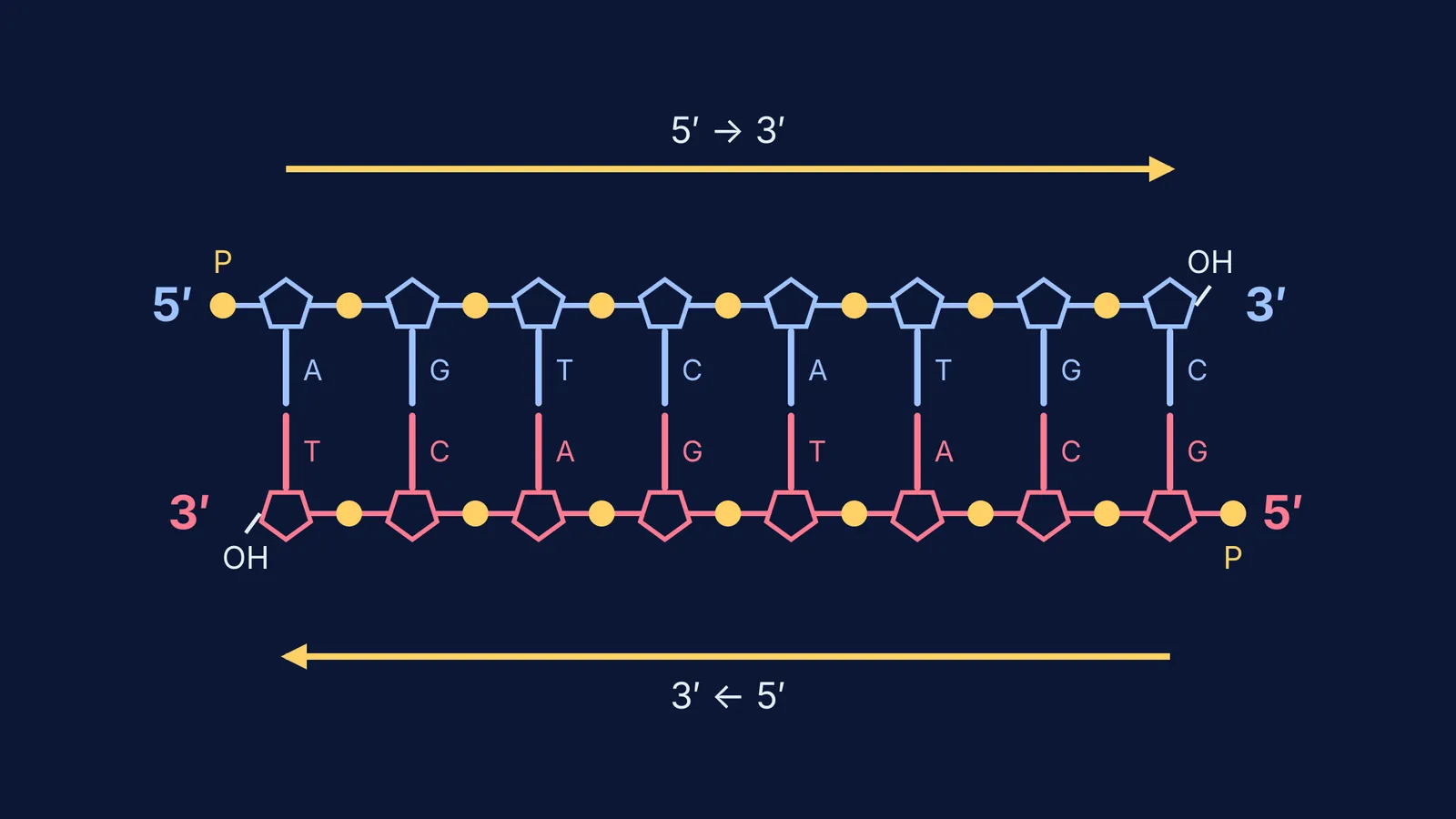
In DNA, antiparallel means the two strands run in opposite directions, so the 3' end of one strand faces the 5' end of the other (OpenStax Biology 2e, section 14.2).
James Watson and Francis Crick built this into their 1953 model. Their paper in Nature says: "Both chains follow right-handed helices, but owing to the dyad the sequences of the atoms in the two chains run in opposite directions" (Watson and Crick, Nature, 1953; full text).
The same OpenStax section gives the dimensions you are expected to know: the helix is 2 nm wide, neighbouring base pairs sit 0.34 nm apart, and one turn of 3.4 nm holds 10 base pairs. If you want to draw this neatly for a board exam, our guide to drawing the DNA double helix diagram walks through it.
What are the 5' and 3' ends of a DNA strand?
The numbers come from the carbon atoms of the sugar, deoxyribose, which are numbered 1' to 5' (OpenStax Biology 2e, section 14.2).
The phosphate group is attached to the 5' carbon of the sugar.
A hydroxyl (OH) group sits on the 3' carbon.
Nucleotides join when the phosphate on one sugar's 5' carbon bonds to the 3'-OH of the next sugar, making a 5'-3' phosphodiester bond.
So every strand ends with a free 5' phosphate at one end and a free 3'-OH at the other.
The bases in the middle pair up across the strands, A with T and G with C. Our post on counting hydrogen bonds in DNA covers that part. Polarity is about the backbone, not the bases.
Why does 5' to 3' direction matter in DNA replication?
DNA polymerase can add nucleotides only in the 5' to 3' direction, and it needs a free 3'-OH to add to (OpenStax Biology 2e, section 14.4). Now put that rule next to two antiparallel template strands at a replication fork.
The fork opens in one direction, exposing both templates at once.
The new strand copied from the 3' to 5' template can grow continuously towards the fork. This is the leading strand.
The other new strand would have to grow 3' to 5' to follow the fork, which polymerase cannot do. It is built away from the fork in short Okazaki fragments, each starting from its own primer. This is the lagging strand.
In the bacterium E. coli about 1,000 nucleotides are added per second (OpenStax Biology 2e, section 14.4), while in eukaryotes the rate is about 100 nucleotides per second (OpenStax Biology 2e, section 14.5). That eukaryote section also explains a later consequence: at the end of a linear chromosome, the primer at the 5' end of the lagging strand cannot be replaced, so the chromosome ends, called telomeres, may get progressively shorter as cells keep dividing. Where replication starts is a separate question, covered in our post on the origin of replication (ori).
How does strand polarity shape transcription?
Transcription follows the same rule. RNA is made in its 5' to 3' direction by RNA polymerase, always from one DNA strand per gene, called the template strand (OpenStax Biology 2e, section 15.2). The mRNA is complementary to the template and almost identical to the other strand, the coding strand, except that every T becomes U. In bacteria, elongation runs at about 40 nucleotides per second, according to the same section.
Because the mRNA grows 5' to 3' and must be antiparallel to its template, the template is read from its 3' end towards its 5' end.
Worked example: write the partner strand and the mRNA
Say a question gives you the coding strand: 5'-ATGCCTAGT-3'.
Write the complement directly underneath, base by base: 3'-TACGGATCA-5'. This is the template strand. Label the ends at once, opposite to the strand above.
Rewrite it in the standard 5' to 3' form if asked: reverse it to get 5'-ACTAGGCAT-3'. Writing 5'-TACGGATCA-3' is a common mistake: right bases, wrong direction.
Write the mRNA: it pairs with the template and runs antiparallel to it, so it reads 5'-AUGCCUAGU-3', the coding strand with U for T.
Check: the mRNA and the coding strand should match letter for letter (apart from U and T) and in direction.
If the labels still feel like guesswork, the Fermi Concept Library covers every concept in biology, each with its own lesson and its place in the map. When you want practice, the Fermi Problem Library has worked problems with a step-by-step solver that explains the reasoning rather than printing an answer.
Next time you see a strand, before you write any bases, label its ends first.


