

On this page
A typical exam question on this topic gives you one base percentage and a length, then asks for hydrogen bonds, turns or length in nanometres. All three answers come from four facts in one NCERT chapter. Here they are, with a method and four worked examples.
How many hydrogen bonds are in A–T and G–C pairs?
The NCERT Class 12 Biology chapter Molecular Basis of Inheritance gives the four facts you need:
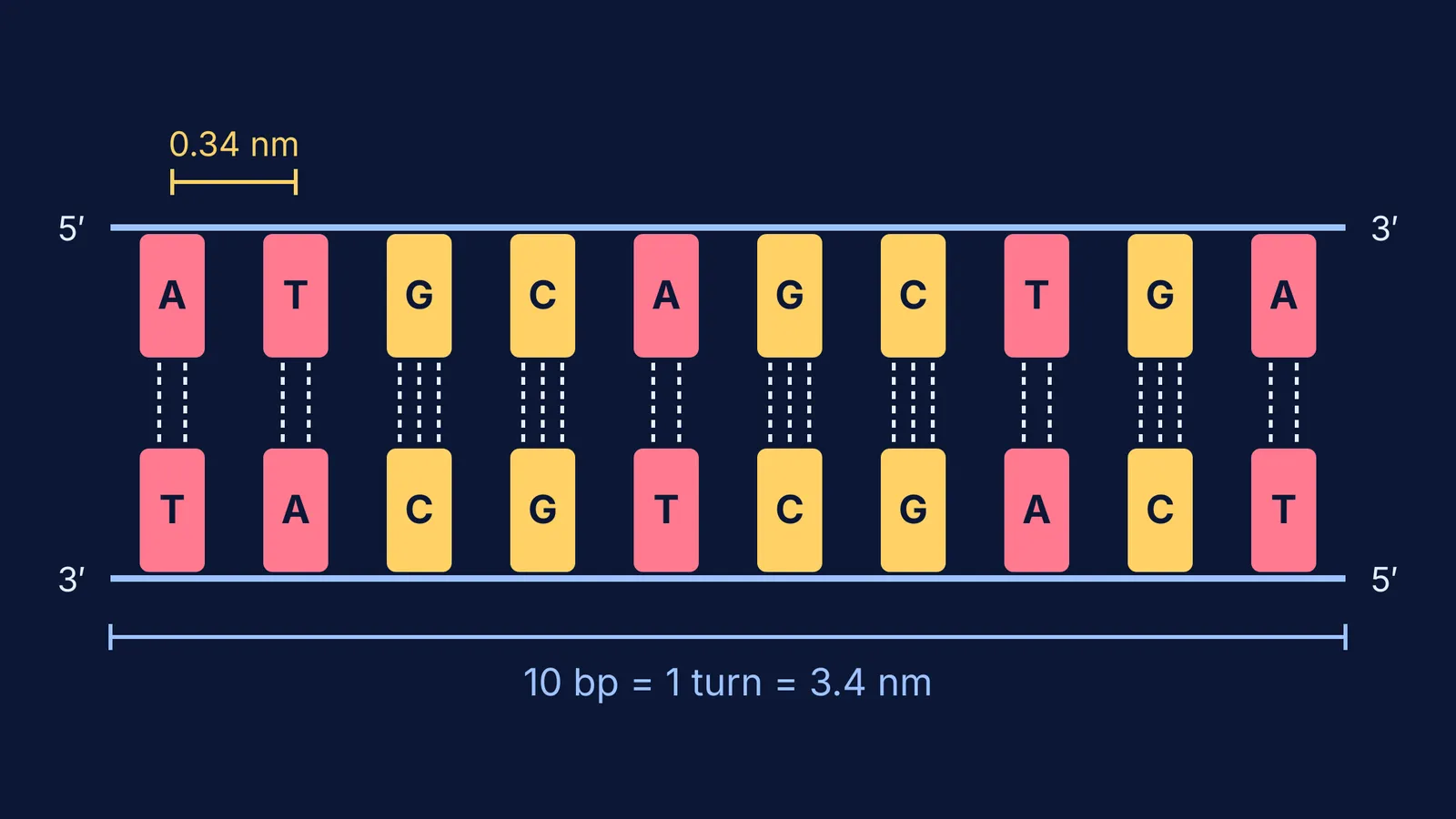
Adenine forms two hydrogen bonds with thymine, and guanine forms three with cytosine.
The pitch of the helix is 3.4 nm, with roughly 10 base pairs in each turn.
That makes the distance between adjacent base pairs about 0.34 nm.
Following Erwin Chargaff's observation, the ratios A/T and G/C in double-stranded DNA both equal one.
Those ratios were a clue in how Watson and Crick built the DNA double helix model.
The first fact gives a built-in check. A DNA with N base pairs has at least 2N hydrogen bonds (if every pair is A–T) and at most 3N (if every pair is G–C). If your answer falls outside that range, it is wrong.
How do you calculate hydrogen bonds from base percentages?
This method uses the base-pairing rules from the NCERT chapter:
Convert to base pairs. Halve a count of nucleotides in double-stranded DNA; divide a length by 0.34 nm.
Fill in all four percentages using Chargaff's rule. A = T, G = C, and the four add up to 100%. If A is 30%, then T is 30%, and G and C share the remaining 40% at 20% each.
Find the pairs. G–C pairs make up (G% + C%) of the base pairs, which is 40% in this example. The rest are A–T pairs.
Add: H-bonds = 2 × (A–T pairs) + 3 × (G–C pairs).
Shortcut for step 4: H-bonds = 2N + (number of G–C pairs). Every pair gives two bonds, and each G–C pair adds one more.
Worked examples: from percentages and length to the total
All four examples use the NCERT values from Molecular Basis of Inheritance: 2 and 3 hydrogen bonds, 10 bp per turn and 0.34 nm per bp.
Example 1: 100 base pairs, 30% adenine. A = T = 30%, so G = C = 20%. That gives 40% of 100 = 40 G–C pairs and 60 A–T pairs. H-bonds = 2 × 60 + 3 × 40 = 240. Shortcut: 200 + 40 = 240. Turns = 100 ÷ 10 = 10. Length = 100 × 0.34 nm = 34 nm.
Example 2: 680 nm long, 20% cytosine. Base pairs = 680 ÷ 0.34 = 2,000. G = C = 20%, so there are 40% of 2,000 = 800 G–C pairs and 1,200 A–T pairs. H-bonds = 2 × 1,200 + 3 × 800 = 4,800. Turns = 2,000 ÷ 10 = 200.
Example 3: 1,000 nucleotides, 300 of them guanine. The DNA is double-stranded, so it has 500 base pairs. Every G sits in its own G–C pair, so 300 guanines means 300 G–C pairs and 200 A–T pairs. H-bonds = 2 × 200 + 3 × 300 = 1,300. It lies between 2N = 1,000 and 3N = 1,500, as it must.
Example 4: bacteriophage lambda. NCERT gives the lambda genome as 48,502 bp. Its length is 48,502 × 0.34 nm ≈ 16,491 nm, about 16.5 µm, and it has about 4,850 turns. With no base composition given, you cannot find the exact number of hydrogen bonds, only that it lies between 97,004 and 145,506.
How many turns does a DNA molecule have, and how long is it?
Turns = base pairs ÷ 10. Length = base pairs × 0.34 nm, or turns × 3.4 nm, using the NCERT values. Keep an eye on units: 1 µm = 1,000 nm and 1 nm = 10 Å. For how such long DNA is packed, see chromatin vs chromosome vs chromatid.
The 10 bp per turn is the textbook figure. When J. C. Wang measured DNA in solution, he found a helical repeat of about 10.4 base pairs per turn under physiological conditions (PNAS, 1979). In NCERT-based exams, use 10 unless the question gives another figure.
A one-minute check before you mark the answer
Did I convert to base pairs, not bases?
Did I fill in all four percentages using A = T and G = C?
Did I take G–C pairs as (G% + C%) of the base pairs?
Is my total between 2N and 3N?
Are my units right: nm, µm or Å?
If you keep picking the wrong method, the Fermi Problem Library has worked problems with a step-by-step solver that explains the reasoning rather than printing an answer. If the structure itself is the shaky part, the Fermi Concept Library gives each biology concept its own lesson. To pair this with the diagram question, read how to draw the DNA double helix diagram for exams.


