

On this page
What is an origin of replication, and why is it necessary?
An origin of replication (*ori*) is a specific nucleotide sequence on a DNA molecule where replication begins. Because DNA polymerases cannot start synthesis from scratch without an unwound template and a primer, cells require dedicated initiator proteins that recognize the origin and open the double helix. The segment of DNA that replicates from a single origin as one continuous unit is called a replicon. You can see how this compares to other genetic processes in our guide on DNA replication and transcription compared.
The number of origins per genome reflects cellular architecture. As reviewed by Marcel Méchali in *Nature Reviews Molecular Cell Biology*, human cells activate roughly 30,000 to 50,000 replication origins during S phase to duplicate six billion base pairs across 46 chromosomes. With replication forks moving at roughly 50 base pairs per second, copying a human chromosome from one start site would take over 30 days. Eukaryotes solve this with multiple firing sites, whereas bacteria replicate their entire genome from a single origin.
How does E. coli initiate copying at its single oriC?
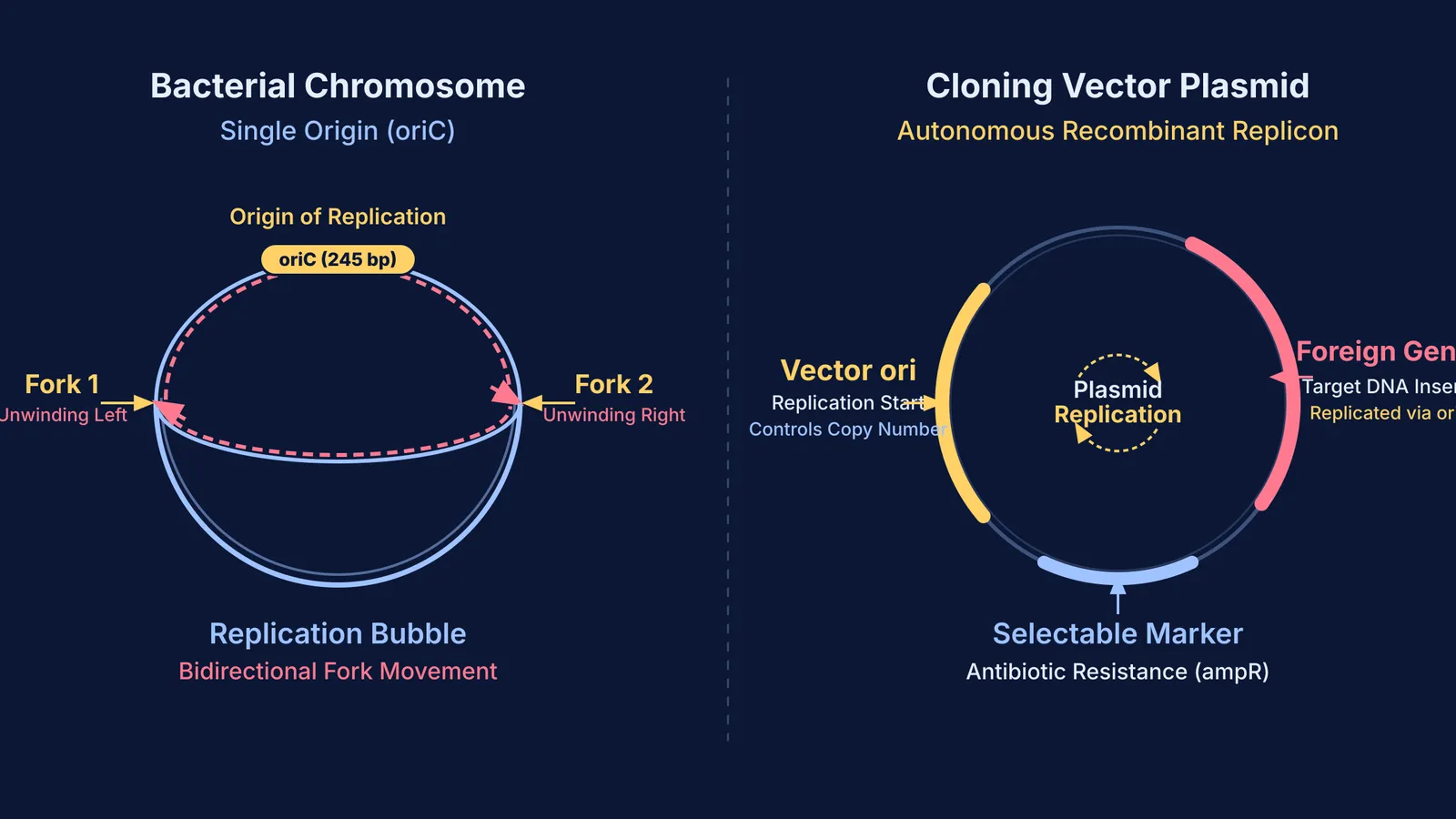
In *Escherichia coli*, the circular chromosome of 4.6 million base pairs forms a single replicon with one origin, *oriC*. Satoshi Tabata and colleagues showed in *Nucleic Acids Research* that the minimal functional *oriC* spans 245 base pairs. Deleting or mutating key bases within this sequence stops replication entirely.
As detailed by Tsutomu Katayama and colleagues in *Frontiers in Microbiology*, *oriC* contains an array of 9-mer DnaA-binding boxes (anchored by high-affinity sites R1, R2, and R4) and three tandem 13-mer repeats. Initiator DnaA proteins bind the 9-mer boxes and bend the DNA into a nucleoprotein filament. This oligomerisation exerts torsional stress that melts the adenine-thymine-rich 13-mer repeats. Because adenine and thymine form two hydrogen bonds rather than three, this unwinding zone melts easily at physiological temperatures. DnaB helicases then load onto both strands, creating two replication forks that travel bidirectionally until they meet at the opposite terminus.
When revising how molecular machinery controls reproduction, the Fermi Concept Library maps replication alongside cell division, giving each concept its own lesson and place in the map, complementing our review of the molecular basis of inheritance.
Why do gene cloning vectors require an ori sequence?
When you introduce a standalone piece of foreign DNA into a bacterium, host DNA polymerases ignore it. Without an origin, unlinked DNA fragments cannot recruit replication complexes and are degraded by nucleases or diluted out during cell division.
To replicate a target gene, biotechnologists ligate it into a cloning vector such as a plasmid. Francisco Bolivar and colleagues demonstrated this in *Gene*90000-2) when constructing plasmid pBR322 with an *ori*, selectable markers, and restriction sites. By inserting foreign DNA into the vector, the target gene becomes part of the plasmid replicon. The host cell replicates the insert every time it copies the plasmid, as discussed in our guide to biotechnology principles and cloning vectors.
How does ori control plasmid copy number in biotechnology?
An origin also dictates plasmid copy number: the average number of plasmid molecules maintained in each bacterial host. As Gloria del Solar and colleagues reviewed in *Microbiology and Molecular Biology Reviews*, plasmids range from stringent controls of 1 to 2 copies per cell to relaxed systems supporting dozens or hundreds.
ColE1-derived plasmids regulate initiation using two transcripts: pre-primer RNA II initiates DNA synthesis, while antisense RNA I binds RNA II to block initiation, aided by the plasmid *rop* protein. In pBR322, this circuit maintains 15 to 20 copies per cell. In high-copy vectors like pUC19, deleting *rop* and modifying RNA II weakens this brake, yielding 500 to 700 copies per cell.
When working through questions on vector design and copy yield, the Fermi Problem Library provides worked problems with a step-by-step solver that explains the reasoning rather than printing an answer.
How do you evaluate origin of replication questions in exams?
When evaluating origin and vector questions in exam problems, use this four-step diagnostic sequence:
Check for physical linkage: Alien DNA must be covalently ligated into a replicon containing an *ori* to replicate in the host.
Verify host compatibility: A bacterial origin functions in prokaryotes but cannot initiate replication in yeast or mammalian cells.
Match origin to copy yield: If high DNA yield is required, choose a high-copy vector (such as pUC19) rather than a low-copy plasmid.
Separate replication from selection: The *ori* enables copying; antibiotic markers allow selection of transformants.
When you get stuck diagnosing plasmid questions, Fermi's AI tutor works out what you already know, builds a plan for the session, and works through problems alongside you.


