

On this page
A DNA-to-mRNA question gives you one DNA strand and asks for the mRNA, the codons and sometimes the tRNA anticodons. Base pairing is easy. Marks go on using the wrong strand and writing the answer in the wrong direction. Here is one short gene, step by step.
What is the difference between the template and coding strand?
Transcription always copies the same strand of a gene, called the template strand (OpenStax Biology 2e).
The mRNA is complementary to the template strand and almost identical to the other strand, the coding (nontemplate) strand; the only difference is that every T becomes U (OpenStax Biology 2e).
RNA polymerase always builds RNA in the 5′ to 3′ direction (OpenStax Biology 2e). Because the mRNA pairs antiparallel with the template, the template runs 3′ to 5′ alongside it.
So the decision rule is short:
Given the template strand: pair every base, then make sure your answer reads 5′ to 3′.
Given the coding strand: keep the same direction and swap T for U. No pairing at all.
Given an unlabelled strand: look for a start signal. In textbook questions the coding strand usually shows ATG near its 5′ end, and the template shows TAC near its 3′ end.
How do you find the mRNA sequence from the template strand?
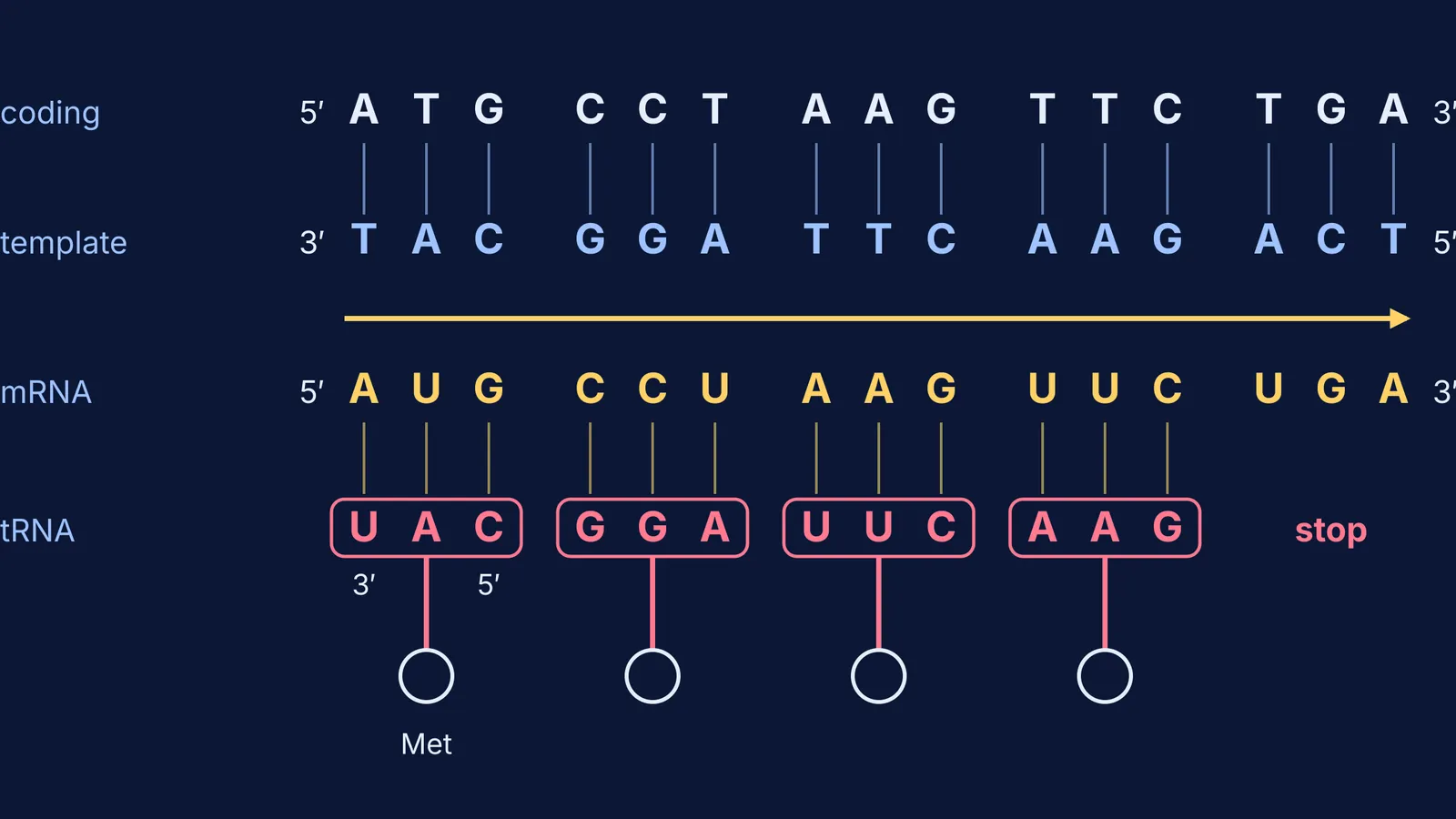
Worked example. The question gives the template strand:
3′-TAC GGA TTC AAG ACT-5′
Check the ends. This template is written 3′ on the left, the easy case.
Pair each base: T→A, A→U, G→C, C→G. RNA has no T, so A always pairs with U.
Write the new strand with opposite labels: 5′-AUG CCU AAG UUC UGA-3′.
Check against the coding strand, 5′-ATG CCT AAG TTC TGA-3′. Swap T for U and you get the same mRNA.
Read codons in threes from the 5′ end. The ribosome reads mRNA 5′ to 3′ and builds the protein from the N terminus to the C terminus (OpenStax Biology 2e).
AUG codes for methionine and is also the start codon (OpenStax Biology 2e). UGA is a stop codon, along with UAA and UAG (OpenStax Biology 2e). Three of the 64 possible codons are stop codons, leaving 61 that code for amino acids (OpenStax Biology 2e).
What if the template strand is written 5′ to 3′?
This is the trap. Suppose the same template is printed the other way round:
5′-TCA GAA CTT AGG CAT-3′
Pair from left to right and you get AGU CUU GAA UCC GUA. Every pair is correct, but the left end is 3′. Label it 5′, read codons from the left, and you get the wrong protein.
The fix: pair, then reverse. Read right to left, the pairs give 5′-AUG CCU AAG UUC UGA-3′, the same mRNA as before, as it should be for the same gene. Write the final answer with 5′ on the left, the standard way sequences are written.
How do you write the tRNA anticodons from the mRNA?
An anticodon is a three-base sequence at one end of a tRNA that is complementary to a codon on the mRNA (NHGRI glossary).
Codon and anticodon pair antiparallel, like the two DNA strands. The University of Arizona Biology Project gives the example of anticodon 5′-UAC pairing with codon 3′-AUG.
For our mRNA, line each anticodon up under its codon:
5′-AUG-3′ pairs with 3′-UAC-5′, written 5′-CAU-3′ the standard way.
5′-CCU-3′ pairs with 3′-GGA-5′, or 5′-AGG-3′.
5′-AAG-3′ pairs with 3′-UUC-5′, or 5′-CUU-3′.
5′-UUC-3′ pairs with 3′-AAG-5′, or 5′-GAA-3′.
5′-UGA-3′ is a stop codon, so translation ends there and no anticodon is listed.
Either way of writing an anticodon is correct if the ends are labelled. One tRNA can sometimes read more than one codon: Steven Carr of Memorial University explains that the 5′ base of the anticodon can "wobble" against the third base of the codon.
Which polarity mistakes cost marks?
Run this checklist before moving on:
Did you identify which strand you were given before pairing?
Did you use U, never T, in the mRNA?
Is your mRNA labelled 5′ on the left and 3′ on the right?
If the template was printed 5′ to 3′, did you reverse your answer?
Does your mRNA match the coding strand, with U for T?
Did you read codons from the 5′ end, starting at AUG?
Are your anticodons labelled, with none listed for the stop codon?
For the next step, read our guide to reading codons in the genetic code and translation, compare DNA replication and transcription point by point, or see what one wrong base does in point and frameshift mutations.
For practice, the Fermi Problem Library has worked problems with a step-by-step solver that explains the reasoning rather than printing an answer. If the idea itself is the gap, the Fermi Concept Library gives each biology concept its own lesson.


