On this page
The sky turns grey, the breeze drops, and you are sweating while sitting still. Across much of India, sticky spells like this often come before storms and the monsoon. The thermometer may read only 32°C, yet it can feel worse than a hotter, drier day in May. Here is the physics, and how to see it on a weather app.
Why does it feel so hot and humid before rain?
Your body cools itself mainly by sweating. When sweat evaporates it takes heat from your skin, because turning liquid water into vapour needs energy. Evaporating water takes about 600 calories for each gram, according to the NOAA Northwest River Forecast Center. That is roughly 2,500 joules per gram, close to the 2.501 × 10^6 J/kg value at 0°C given in a 2005 paper by atmospheric scientist Mark Lawrence.
That cooling only works if the sweat can evaporate. The US National Weather Service heat index page explains that when the moisture content of the air is high, the rate of evaporation from the body decreases. More sweat stays on your skin or drips off, and sweat that drips off carries away much less heat than sweat that evaporates.
The weather service puts numbers on it. At an air temperature of 100°F (about 38°C), 55% relative humidity gives a heat index of 124°F (about 51°C). At 15% humidity, the same temperature feels like 96°F (about 36°C). We cover the dry-versus-humid comparison in more detail in why humid heat feels far worse than dry heat.
Do clouds really release heat before it rains?
Yes, but mostly high above you. A cloud forms when rising air cools and its water vapour condenses into droplets. The National Weather Service's cloud development notes explain that condensation releases latent heat. That heat warms the rising air and makes it more buoyant, which helps it keep rising. Condensation gives back the same 600 calories per gram that evaporation took in (NOAA), and this energy helps a storm cloud grow taller.
That heat is released inside the cloud, not on your skin. Near the ground, the cloud deck matters in a different way: clouds tend to keep daytime temperatures lower and night-time temperatures higher, as an Iowa State University course on clouds and radiation explains. So a cloudy, humid evening tends not to cool off as much as a clear night would, and your sweat still evaporates slowly.
If evaporation and condensation still feel like two separate chapters, the Fermi Concept Library gives every concept in physics and chemistry its own lesson and its place in the map, so you can see how latent heat links the two.
What is dew point, and why is it better than humidity?
The dew point is the temperature the air would have to be cooled to, at constant pressure, to reach 100% relative humidity (National Weather Service, La Crosse). Relative humidity is the actual water vapour pressure divided by the saturation vapour pressure at that temperature, times 100 (Lawrence, 2005).
Relative humidity depends on temperature, so it shifts through the day even when the amount of water in the air stays the same. Dew point tracks the water itself. The same National Weather Service page gives this comfort guide for summer:
Dew point 55°F (about 13°C) or lower: dry and comfortable.
55 to 65°F (about 13 to 18°C): becoming sticky, with muggy evenings.
65°F (about 18°C) or higher: lots of moisture in the air, becoming oppressive.
For the basics of the humidity figure on its own, see what 80 percent humidity means on a weather app.
How do you read dew point and humidity on a weather app?
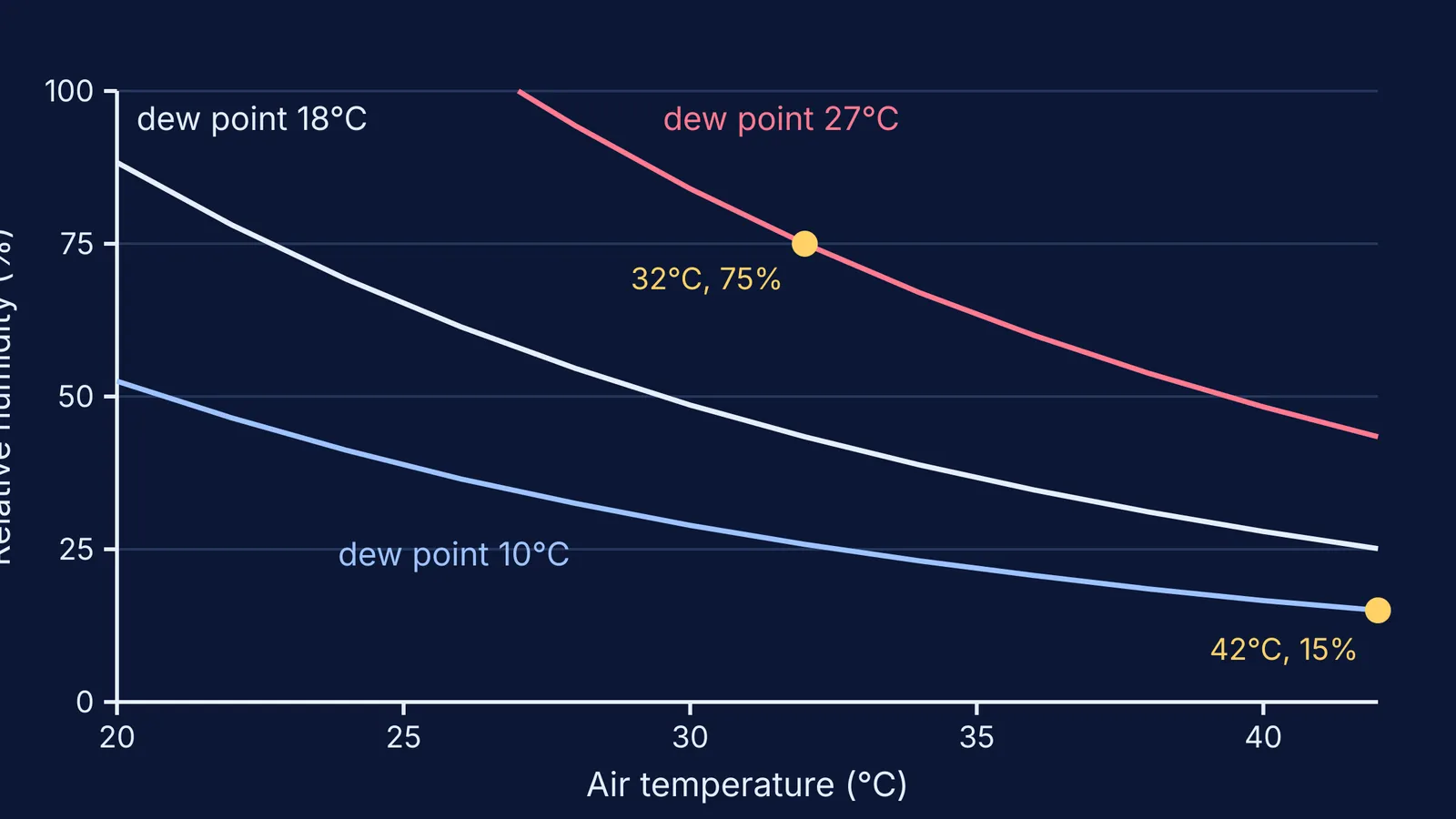
Many weather apps list the dew point next to humidity, sometimes in a details view. Here are three readings, converted with the Magnus formula and the coefficients (17.625 and 243.04°C) given in Lawrence's 2005 paper.
A pre-monsoon afternoon: 32°C, 75% humidity. Dew point works out to about 27°C, far above the 18°C oppressive line.
A dry May afternoon: 42°C, 15% humidity. Dew point is about 10°C. It is still dangerously hot, but sweat evaporates fast.
One humid day, dew point steady at 24°C. At 25°C at dawn the app shows about 94% humidity. At 33°C in the afternoon it shows about 59%. The humidity fell, but the air did not get any drier.
Use this checklist when the sky starts to build:
Look at the dew point first, not the humidity percentage.
If the dew point is near or above 18°C, expect sweat to cool you less than usual. Shade, loose clothing and moving air all help what sweat you have evaporate.
Watch whether the dew point climbs over a day or two. A rising dew point usually means moister air is moving in.
If someone feels unwell in the heat, get medical help.
For practice with calculations like these, the Fermi Problem Library has worked problems with a step-by-step solver that explains the reasoning. For the full chapter on humidity, clouds and rainfall, read our guide to water in the atmosphere for Class 11.