

On this page
Why does sweating cool the human body?
When your internal temperature rises during summer or heavy physical exertion, your autonomic nervous system activates eccrine sweat glands across your skin. Liquid water sitting on the skin does not cool you down. Cooling occurs exclusively through a thermodynamic phase change known as the latent heat of vaporization.
According to thermophysical data compiled in the NIST Chemistry WebBook, water at human skin temperature (around 34 °C) has an enthalpy of vaporization of approximately 2,420 joules per gram. As sweat absorbs thermal energy from cutaneous blood vessels, water molecules break intermolecular hydrogen bonds and enter the air as vapor. This mechanism, explored in evaporation and latent heat in Class 9 science, carries away 2,420 joules of heat for every gram evaporated.
How does humidity stop sweat from evaporating?
Evaporation is driven by partial pressure differences rather than temperature alone. Liquid sweat on the skin saturates the boundary layer of air directly above it. At a normal skin temperature of 34 °C, water has a saturation vapor pressure of approximately 5.33 kilopascals (kPa), as listed in the NIST Chemistry WebBook.
The evaporation rate depends on the vapor pressure gradient: the difference between saturation vapor pressure at the skin and ambient vapor pressure. In dry air, this gradient is steep, vaporizing moisture rapidly. In humid air, the atmosphere already holds substantial water vapor. As ambient vapor pressure nears 5.33 kPa, net evaporation slows toward zero.
How much cooling power does high humidity erase?
To see why humid air feels suffocating, consider how the driving vapor pressure gradient changes at an air temperature of 35 °C, where pure water's saturation vapor pressure is 5.63 kPa according to thermophysical tables in the NIST Chemistry WebBook:
In dry conditions at 20% relative humidity, ambient vapor pressure is only 1.13 kPa. The driving difference between skin (5.33 kPa) and air is 4.20 kPa. Sweat vaporizes quickly, keeping skin cool.
In humid conditions at 80% relative humidity, ambient vapor pressure reaches 4.50 kPa. The driving difference plummets to 0.83 kPa.
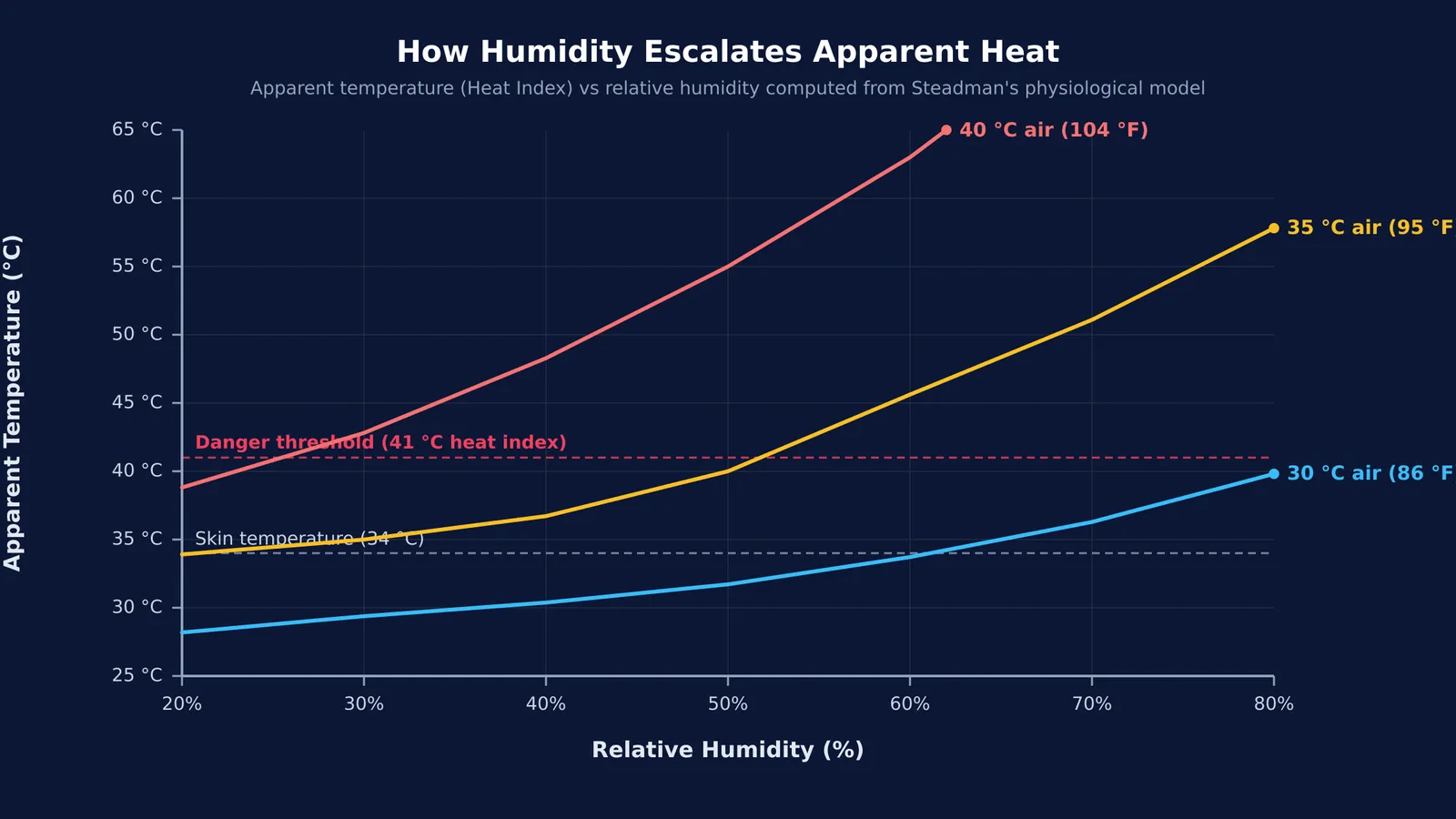
This represents an 80% drop in evaporative driving force. Under physiological models developed by Steadman (1979)018<0861:TAOSPI>2.0.CO;2), apparent temperature tracks this loss of cooling. The National Weather Service calculates that 35 °C (95 °F) at 20% humidity feels like 34 °C (93 °F), but at 60% humidity, that same temperature feels like nearly 46 °C (114 °F).
Grasping how vapor pressure shifts across phase boundaries is easier with interactive models. The Fermi Simulation Lab provides interactive simulations for the ideas that are easier to see than to read, helping you explore how temperature and vapor pressure drive molecular transfer rates directly.
Why does dripping sweat fail to cool you?
When humidity blocks evaporation, sweat does not stop. The hypothalamus detects rising core heat and signals sweat glands to produce more fluid. Sweat pools on the skin and drips off.
Dripping sweat provides no cooling because water never undergoes a phase change on your body. You lose fluid and electrolytes without dumping heat. This distinction is central to temperature-time graphs of latent heat of transformation, which show how phase changes absorb thermal energy without temperature rising, rooted in Joseph Black's discovery of latent heat.
What is the critical threshold where humid heat becomes dangerous?
Humans must keep a core body temperature near 37 °C to preserve cellular function. When ambient air is hot and humidity prevents sweat from evaporating, uncompensable heat stress causes core temperature to climb toward heat exhaustion. While theoretical models long assumed a wet-bulb survivability limit of 35 °C, empirical testing by Vecellio et al. (2022) in the Journal of Applied Physiology found that healthy young adults experience uncompensable heat stress at humid wet-bulb thresholds of just 30 °C to 31 °C.
Understanding the physics of heat dissipation highlights how environmental factors alter thermal stress:
Air movement from fans thins the saturated boundary layer of air directly above the skin, steepening the local vapor pressure gradient and restoring evaporation.
Breathable, loose fabrics reduce humidity trapping near the body surface, allowing water molecules to enter ambient air rather than pooling.
Early morning hours offer lower ambient temperatures and lower vapor pressure, providing the steepest driving gradient for evaporative cooling.
To explore how thermodynamic principles apply across living systems, the Fermi Concept Library covers every concept in physics, chemistry, biology, mathematics and computing, each with its own lesson and its place in the map.


