

On this page
Most Indian homes make chai by boiling the leaves, and most of us have tasted a pan forgotten on the stove: dark, harsh and drying. That taste is chemistry you can test in your own kitchen.
Why does tea taste bitter when boiled too long?
Two groups of molecules do most of the work. A study in the Journal of Agricultural and Food Chemistry rebuilt black tea's taste from pure compounds and narrowed it to 12 key ones, including bitter caffeine, the astringent and bitter catechin EGCG, and nine flavonol glycosides with a velvety astringency (Scharbert and Hofmann, 2005). The same study found that those flavonol glycosides make caffeine taste more bitter than it would on its own.
Catechins and their relatives are polyphenols, the family usually called tea tannins. They cause astringency, the puckery, sandpaper feeling in your mouth. Gallate-type catechins are more astringent than non-gallate ones, and when brewing time is extended their share rises faster, so astringency climbs "exponentially, rather than proportionally" (Liu and Tzen, 2022). Longer in the pot means more of the harshest molecules, not just more of everything.
What comes out of the leaves, and when?
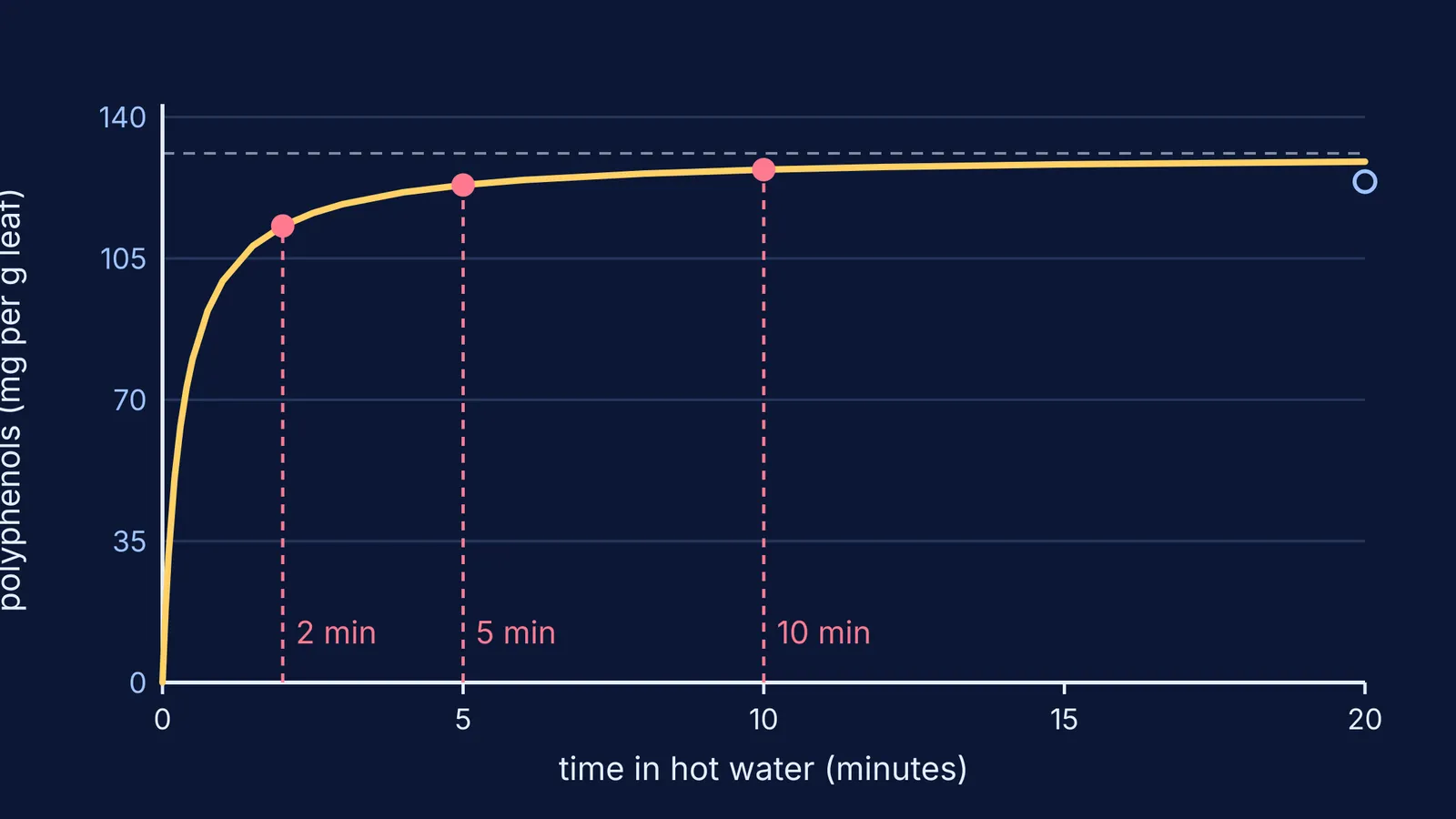
Researchers in Sri Lanka added 5 g of CTC black tea (the crush, tear, curl type that is common in chai) to 500 mL of just-boiled water and sampled it for 20 minutes (Fernando and Soysa, 2015). Gallic acid, caffeine and the catechins EC and EGCG came out within a very short time. Total polyphenols were released more slowly and reached their maximum at 6 to 8 minutes. By 20 minutes the brew held about 42 mg of caffeine per gram of leaf.
In that experiment the heat was switched off when the leaves went in, and the water cooled from 100 °C to 75 °C over the 20 minutes. A pan of chai left on the flame never cools, and temperature matters. In a 2026 study of Turkish black tea, water at 95 °C pulled out more caffeine (2.20% against 1.70%) and more total phenolics (5.30% against 4.10%) than water at 75 °C (Cho and colleagues, Scientific Reports).
So overboiled tea is bitter for three reasons: more time, more heat and less water. For the steeped-tea side of the story, see how tannins, heat and time make tea bitter.
How can you test it at home?
You need three small pans, one tea, a timer, a measuring cup and a helper. An adult should handle the boiling pans. You only need a few sips of each cup, and if you want to know how much tea is sensible on a study day, read what the evidence says about tea, coffee and studying.
Put 250 mL of water and one level teaspoon of the same tea leaves in each pan. Leave out milk and sugar, which hide bitterness.
Bring each pan to a gentle boil and start a timer. Take pan A off at 2 minutes, pan B at 5 and pan C at 10.
Strain each into the measuring cup and write down the volume left.
Pour half of C into a fourth cup, D, and top it up with hot water until it holds half of A's volume. D now has C's extraction at A's dilution. If D tastes milder than C, some bitterness was concentration.
Let all four cool to the same sipping warmth. Your helper labels the bottoms and serves them in a shuffled order, so you do not know which is which.
Sip each, rinse with water between cups, and score bitterness and dryness from 1 to 5.
Shuffling and hiding the labels is the trick behind Ronald Fisher's lady tasting tea experiment: it stops what you expect from deciding what you taste.
The chemistry suggests A will be lightest and C harshest. One caution: in the Turkish study, a trained panel did not find astringency changed significantly with brewing conditions, even when the chemistry did. Taste is noisy, which is why the blind step matters. Record your own scores rather than assume the answer.
How do you make chai that is strong but not bitter?
Boil the water (and milk, if you use it) first, then add the leaves for only the last few minutes.
For a stronger cup, add more leaf rather than more minutes.
Turn the flame off and cover the pan to let it rest, instead of keeping it at a rolling boil.
Do not reheat yesterday's tea on the stove for long; it keeps losing water.
The shape of the curve, fast at first and then slowing as the leaf runs out, is the same one you meet in rates of reaction. If that feels abstract, the Fermi Concept Library covers every concept in chemistry, each with its own lesson and its place in the map. And for ideas that are easier to see than to read, the Fermi Simulation Lab has interactive simulations.
Run the test this weekend and see whether your tongue agrees with the chemistry.