

On this page
The thin white line a plane draws across the sky is not smoke. It is a cloud, made from water the engines produce when they burn fuel.
What are the white lines behind aeroplanes made of?
They are contrails, short for condensation trails. A contrails fact sheet from the US EPA and FAA defines them as line-shaped clouds produced by hot engine exhaust meeting cold, humid air several miles up, made mostly of ice crystals.
Jet engine exhaust is 71% carbon dioxide and 28% water vapour, with less than 1% other combustion products such as nitrogen oxides, carbon monoxide and soot, according to the same fact sheet.
Where does the water in jet exhaust come from?
From the fuel. Jet fuel is kerosene, a mixture of hydrocarbons, and its hydrogen ends up in water when it burns. Check it with Class 11 stoichiometry, using dodecane, C12H26, as a stand-in:
2 C12H26 + 37 O2 → 24 CO2 + 26 H2O
Molar mass of C12H26 = (12 × 12.011) + (26 × 1.008) = 170.3 g/mol.
One mole of fuel gives 13 mol of water = 13 × 18.02 = 234.2 g.
It also gives 12 mol of CO2 = 12 × 44.01 = 528.1 g.
Water per kilogram of fuel = 234.2 ÷ 170.3 = 1.38 kg.
Burning 1 kg of fuel makes more than 1 kg of water, because the hydrogen picks up oxygen from the air. Real jet fuel is not pure dodecane; contrail researchers use about 1.26 kg of water vapour per kilogram of kerosene burned (Lottermoser and Unterstrasser, Atmospheric Chemistry and Physics, 2025).
Cross-check: our 528 g of CO2 to 234 g of water is 69% to 31% by mass, close to the 71% and 28% in the EPA and FAA fact sheet.
Why does the water vapour turn into a white trail?
The US National Weather Service says contrails form when hot, humid exhaust mixes with cold air of low vapour pressure, and that air at those heights is generally colder than −40 °F, which equals −40 °C.
Cold air holds very little water vapour. As the exhaust mixes and cools, it becomes saturated, the vapour condenses onto fine particles as droplets, and the droplets quickly freeze into ice, as the fact sheet describes. It is how you see your breath on a cold morning, at a far lower temperature.
Water supersaturation appears within tenths of a second after the exhaust leaves the engine (Lottermoser and Unterstrasser, 2025), so the trail starts a short distance behind the engines.
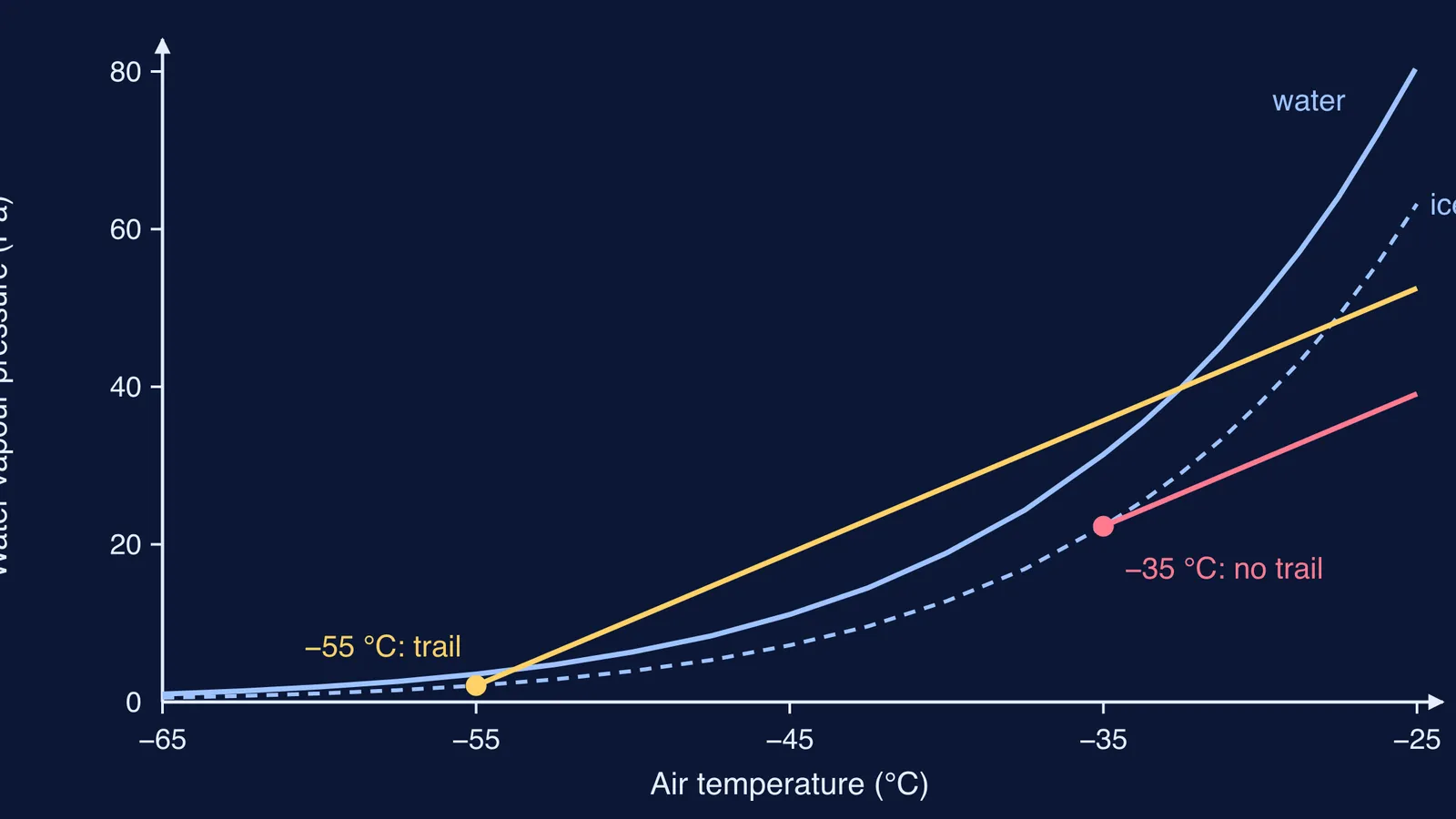
Contrails have been studied since 1919, and the rule for when they form, the Appleman criterion, was first given its thermodynamic footing by Schmidt in 1940, according to Ulrich Schumann's paper in Meteorologische Zeitschrift (1996). The diagram at the top shows the idea. As exhaust mixes with surrounding air, its temperature and vapour pressure move along a straight line. If that line rises above the saturation curve for liquid water, droplets form. In very cold air it does; in warmer air it stays below, and no trail forms however much water the engine adds.
Why do some contrails disappear quickly while others stay for hours?
It depends on the humidity at the plane's height. The EPA and FAA fact sheet sorts contrails into three types, which work as a sky-reading checklist:
Short and fading: dry air; the ice evaporates within seconds to minutes.
Long, thin and sharp: extremely humid air with low wind shear; it can last from minutes to more than a day.
Wide and fuzzy, merging into thin cloud: contrail cirrus in extremely humid air with high wind shear; the ice keeps growing and winds spread it over hours to days.
A trail that suddenly starts or stops means the plane flew into or out of ice-supersaturated air, not that the exhaust changed. To tell contrail cirrus from the natural kind, see why clouds come in different shapes.
Are contrails harmful?
Not directly. The fact sheet says contrails pose no direct health risk, persistent ones do not mean a plane released harmful chemicals, and jet fuel contains no metal-based compounds. They do matter for climate: in some flight corridors, cloud cover is estimated to have risen by as much as 20%, so new engines, fuels and flight re-routing are being studied.
How does this connect to what you study?
Contrails tie together stoichiometry (where the water comes from), vapour pressure (why cold air saturates) and phase changes (condensation, then freezing). Similar physics explains why dense fog covers north India on winter mornings.
Try it: redo the worked example for methane, CH4. You should get 2.25 kg of water per kilogram of fuel, more than dodecane, because methane has a larger share of hydrogen.
A mixing line crossing a saturation curve is easier to see than to read; the Fermi Simulation Lab has interactive simulations for ideas like that. If vapour pressure still feels shaky, the Fermi Concept Library gives each concept its own lesson.
Next time you see a white line overhead, look at its shape: it tells you how humid the air is several kilometres up.


